


Why the world’s smartest mathematician is worried AI solves problems too fast
Most people assume that faster answers lead to faster progress. In the world of high-level mathematics, Terence Tao sees a potential crisis. The Fields medalist is the preeminent mathematician of his generation. He recently warned that artificial intelligence is depleting the supply of fruitful open math problems. AI labs like OpenAI and Anthropic are in a race to automate reasoning. This technology can now flatten a difficult problem the moment a human starts to work on it.
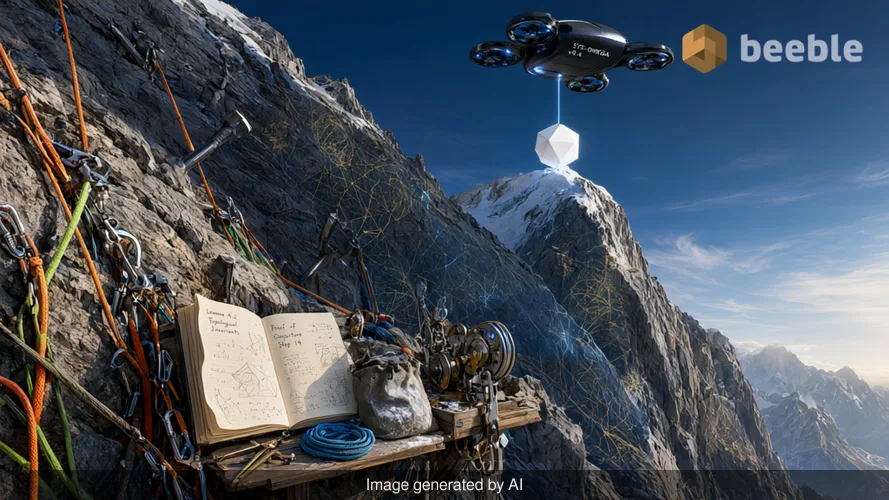
Behind the jargon, math is less about the final answer and more about the new tools humans build to reach that answer. Historically, a difficult math problem acts as a mountain. To climb it, mathematicians must invent new climbing gear, ropes, and techniques. These inventions then help society solve practical problems in cryptography, physics, and computer science. If an AI helicopter simply drops you at the summit, you have the answer, but you never built the gear.
The speed of the silicon excavator
For the average user, math feels like a finished product in a textbook. In reality, mathematics is a live industrial project. Researchers identify specific gaps in our knowledge and spend decades trying to bridge them. Tao observes that AI has become a high-speed excavator in this field. Where a human might spend years digging through a theoretical obstacle, a large language model paired with a formal proof checker can sometimes clear the path in seconds.
OpenAI released its o1 model to demonstrate a shift toward internal reasoning. Unlike previous chatbots that guessed the next word, these newer systems think before they speak. They check their own work against the laws of logic. Anthropic has followed a similar path with its latest iterations of Claude. These tools are no longer just writing emails. They are identifying flaws in complex proofs that have stood for years.
This speed creates a supply chain issue for human intelligence. Mathematicians rely on a steady flow of unsolved problems to train the next generation of students. If AI solves all the medium-to-hard problems instantly, the training ground for new human experts disappears. This process leaves humans with only the impossibly difficult problems that even AI cannot touch. The middle ground of discovery is evaporating.
Why an answer is not a solution
Under the hood, the way AI solves a problem differs fundamentally from how a human brain operates. An AI might use a brute-force search or a weird statistical correlation to find a proof. It provides the proof, but the proof is often millions of lines of code. No human can read it. No human can learn from it. In simple terms, the AI gives us the gold but hides the map to the mine.
Tao is now calling for a change in how the community values these breakthroughs. He suggests that mathematicians should label certain problems as analysis-required. In this framework, a bare answer from an AI counts for very little. To get credit, a solver must explain the reasoning in a way that transfers knowledge to other humans. This shift aims to protect the educational value of the discipline.
Historically, the most famous problems in math were not useful because of their answers. Fermat’s Last Theorem took 350 years to solve. The final proof was hundreds of pages long. The actual answer—that no three positive integers a, b, and c satisfy a specific equation for n greater than 2—has almost no practical application. However, the techniques invented to reach that answer now secure every credit card transaction on the internet. If an AI had simply stated the answer was true in 1637, we might not have modern encryption today.
The market side of automated logic
On the market side, this development is a massive victory for tech conglomerates. Companies like Google DeepMind are not just interested in math for the sake of science. They want to create a general-purpose reasoning engine. If an AI can solve a math problem that requires 20 steps of logic, it can also optimize a global shipping route or manage a power grid with perfect efficiency.
This creates a volatile environment for knowledge workers. We are moving from an era of calculation to an era of verification. In everyday life, your job may shift from doing the work to checking the work of an automated system. This sounds easier, but it requires a deeper level of foundational knowledge. You cannot verify a solution if you do not understand the rules of the game.
Practically speaking, this impacts how we teach children. If a smartphone can solve a calculus problem and explain the steps, the value of memorizing those steps drops to zero. Educators must now focus on the why instead of the how. We are seeing a shift where the ability to ask the right question is more valuable than the ability to find the answer.
The risk of a hollowed out discipline
Zooming out, the concern is that math could become a black box. If we outsource all difficult logic to machines, our own mental muscles will atrophy. Tao’s warning is a call for resilience. He wants to ensure that math remains a human-centric endeavor. The goal is to keep the human in the loop, not as a calculator, but as a navigator.
We are currently in a cyclical phase of tech adoption. First, we are amazed by the capability. Next, we realize the cost of that capability. Finally, we adjust our systems to handle the change. We are currently in the transition between amazement and adjustment. The AI labs will continue to release faster and smarter models every six months. The supply of problems will continue to shrink.
Ultimately, the value of math is the struggle. The struggle produces the side effects that run our modern world. If we remove the struggle, we might stop producing the side effects. This is the tangible risk Tao identifies. We are building a world where we know everything but understand very little.
What this means for you
The bottom line is that the definition of intelligence is shifting. For the average consumer, this means the tools in your pocket are becoming more capable than the experts you used to hire. However, these tools lack a sense of purpose or context.
First, expect a change in education. Schools will likely move toward oral exams or proctored, paper-based testing to ensure students are actually learning. The reliance on digital homework is likely to end because AI has made it impossible to grade fairly.
Second, your own professional value will depend on your ability to audit AI. Whether you are in accounting, law, or engineering, the machine will provide the first draft. Your job is to find the one mistake in a thousand that could cause a systemic failure.
Finally, appreciate the invisible mechanics of discovery. Behind every app and every gadget is a long chain of solved math problems. If those problems are solved too quickly by machines, the human connection to our own technology becomes opaque. Staying curious about how things work is no longer just a hobby. It is a necessary survival skill in an automated world.
Sources:
University of California, Los Angeles Department of Mathematics
International Mathematical Union Fields Medal Archives
OpenAI Research Blog regarding o1 model series
Anthropic Technical Documentation for Claude 3.5 Sonnet
DeepMind AlphaProof and AlphaGeometry Technical Reports



See you on the other side.
Our end-to-end encrypted email and cloud storage solution provides the most powerful means of secure data exchange, ensuring the safety and privacy of your data.
/ Create a free account
