


Why Your AI Can Write a Novel but Still Struggles to Count to Fifty

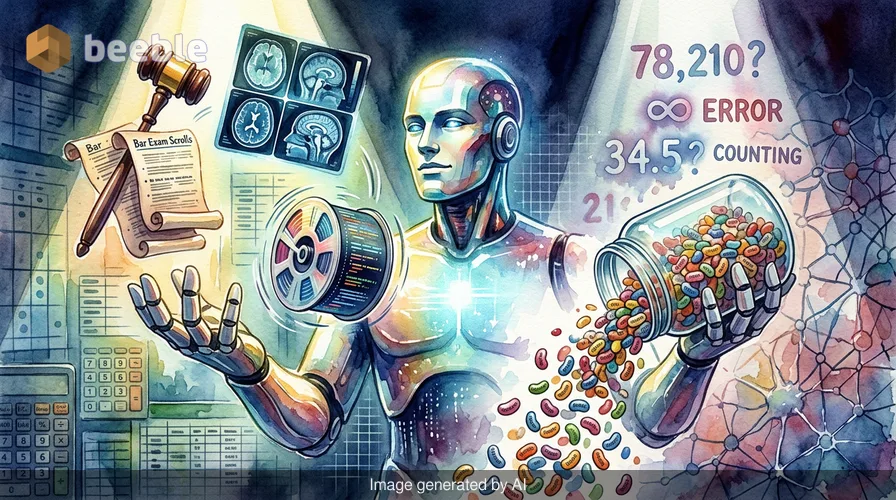
We are currently living through a bizarre technological paradox. We have built machines capable of passing the bar exam, diagnosing rare medical conditions, and refactoring thousands of lines of legacy code in seconds—yet these same digital titans often trip over the simple task of counting a list of words. If you ask a cutting-edge Large Language Model (LLM) to summarize a thousand-row spreadsheet of survey responses, it might provide a brilliantly insightful thematic analysis while simultaneously hallucinating the actual number of respondents.
This isn't just a minor glitch in the matrix; it is a fundamental window into how modern software architecture has shifted away from the rigid certainty of the past toward a fluid, probabilistic future. Under the hood, the way an AI "counts" is radically different from the way a traditional database or a human brain performs the same task. This gap between our expectations and the model's performance has given rise to a new field of study: the quantitative analysis of hallucination in data-processing tasks.
The Deceptive Simplicity of the Count
In everyday terms, counting feels like the most basic unit of digital labor. We assume that because a computer is, at its core, a glorified calculator, numerical accuracy is a given. However, LLMs are not calculators; they are sophisticated prediction engines. When you provide a model like Gemini 3 Flash or GPT-5.3 Instant with a long list of "Yes/No/Pending" responses and ask for a total, the model doesn't just increment a variable in a loop. It processes the entire text through an attention mechanism, attempting to maintain the "state" of the count across its internal neural pathways.
Through this user lens, the experience is often frustrating. You might notice your AI assistant getting the first few rows right, only to lose its place by row 400. This is what researchers call an internal attention limitation. Paradoxically, the more conversational and "human" a model becomes, the more it seems prone to the same cognitive lapses we experience when trying to count a jar of pennies while someone is shouting random numbers at us.
A New Taxonomy: The Three Faces of Hallucination
Recent exploratory research conducted by the Mirairzu Lab Kobo has identified a fascinating shift in how different models fail at these tasks. It turns out that LLMs don't just "make mistakes"; they exhibit distinct behavioral patterns that mirror different types of software friction.
First, there is the Confabulation Type, exemplified by Gemini 3 Flash. In Baseline tests, Gemini exhibited what researchers term "harmonic hallucination." It might overcount one category while undercounting another, ensuring the final total remains mathematically perfect even if the distribution is a total fabrication. Simultaneously, we see the Avoidance Type in models like GPT-5.3 Instant—where the software simply gives up once the processing load exceeds a certain threshold, returning a polite "I cannot count this many items" message.
Finally, there is the Process-Opaque Type, often seen in Claude Sonnet 4.6. Claude is remarkably accurate, even up to 2,000 items, but its methodology remains a black box. From a developer's standpoint, this is a double-edged sword: you get the right answer, but you have no way of knowing when or why the model will eventually hit its "collapse point."
| Hallucination Type | Model Example | Primary Symptom |
|---|---|---|
| Confabulation | Gemini 3 Flash | Fabricates data to fit a statistically plausible total. |
| Avoidance | GPT-5.3 Instant | Refuses or abandons the task when complexity rises. |
| Process-Opaque | Claude 4.6 | Highly accurate but provides no audit trail of its logic. |
The Failure of Traditional Prompting
Historically, the tech industry's answer to AI inaccuracy has been "Chain-of-Thought" (CoT) prompting—the simple instruction to "think step-by-step." But as software grows more complex, this once-ubiquitous solution is showing signs of technical debt.
In the Mirairzu Lab experiments, applying CoT alone to ChatGPT actually proved counter-productive. When asked to write out its reasoning for a 200-item dataset, the model's accuracy actually dropped. The extra words it had to generate acted as processing noise, distracting the model from the primary task. This aligns with recent industry findings suggesting that for the latest generation of reasoning models, being told how to think can sometimes be as disruptive as a back-seat driver shouting directions to a professional racer.
The External Scaffold: Engineering the KIS Protocol
If simple prompting fails, the industry is shifting toward more robust, proprietary protocols. One such framework is the Knowledge Innovation System (KIS), which acts as an "external scaffold" for the AI. Instead of relying on the model's internal memory, KIS forces the AI to externalize its intermediate steps into a structured log.
Essentially, KIS treats the LLM as a component in a larger machine rather than an all-knowing oracle. By enforcing a protocol like "Level 4 / Logic: Strict," the system separates the counting phase, the verification phase, and the reporting phase. This structural constraint functions like a digital blueprint, ensuring that the model cannot move to the next step until it has verified the previous one.
Behind the screen, this approach solves the "harmonic hallucination" problem. When Gemini was run through the KIS protocol, its accuracy jumped to 100% across the board. The model wasn't allowed to just guess a plausible distribution; it was forced to provide a "log: full" output that served as a verifiable audit trail.
From Accuracy to Auditability: A Paradigm Shift
Zooming out to the industry level, this research highlights a profound shift in how we judge software. For years, the gold standard has been accuracy—did the app give me the right answer? But as we integrate AI into legal, financial, and medical workflows, accuracy alone is no longer enough. We are entering the era of auditability.
As Claude’s performance illustrates, having a model that is "usually right" is a liability if you don't know why it's right. If a human auditor cannot trace the path from the raw data to the final total, the software remains a risk. Protocols like KIS represent the next stage of the web: a move away from the fragmented, "vibes-based" outputs of early chatbots toward a more resilient, transparent architecture where the process is as important as the result.
Reclaiming the Digital Blueprint
Ultimately, our relationship with technology is defined by how much of the "how it works" we are willing to outsource. When we use an LLM to count, summarize, or analyze, we are trading the mechanical certainty of traditional code for the agile intuition of neural networks.
For the ordinary user, the takeaway is pragmatic: don't assume a model's fluency is a proxy for its numeracy. The next time you ask an AI to help you with a data-heavy task, look for the "scaffolding." Does the model show its work? Does it provide a log of its steps? If it doesn't, you are looking at a black box that might be dreaming up the numbers just to keep the conversation flowing.
As we navigate this silent shift in software design, the most important skill we can develop is a "UX eye" for transparency. We should demand tools that don't just give us the answer, but provide the audit trail necessary to prove it. In a world of harmonic hallucinations, the most disruptive feature a piece of software can offer is the simple, humble truth of a verifiable log.
Sources:
- Hasegawa, H., & Kamogawa (2026). KIS: A Question-Centric Protocol Architecture for Hierarchical AI Thought Control. Zenodo.
- Huang et al. (2024). A Survey on Hallucination in Large Language Models. ACM TOIS.
- Meincke & Mollick (2025). The Decreasing Value of Chain of Thought in Prompting. Wharton School Research Paper.
- Zhao et al. (2025). NumericBench: Exposing Numeracy Gaps in Large Language Models. arXiv pre-print.
- Mirairzu Lab Kobo (2026). Quantitative Analysis of Hallucination Bias in LLM Counting Tasks.



See you on the other side.
Our end-to-end encrypted email and cloud storage solution provides the most powerful means of secure data exchange, ensuring the safety and privacy of your data.
/ Create a free account
