


Why your next browser verification check might be a backdoor to the windows kernel

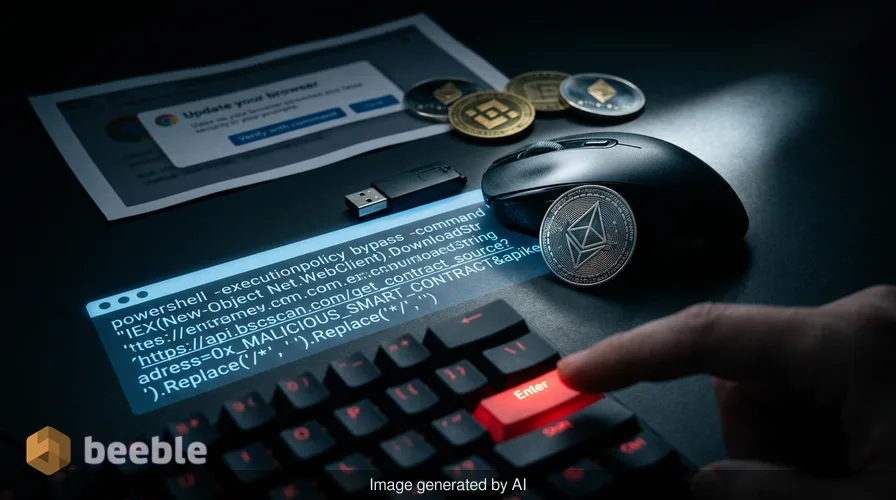
I received an encrypted message through Signal last Tuesday from a contact who spends their nights monitoring anomalous traffic on decentralized gateways. They noticed a surge in requests hitting a specific BNB Smart Chain contract address. This was not a spike in retail trading or a new meme coin launch. It was a silent heartbeat of infected machines checking in for orders. Within forty-eight hours, Microsoft Threat Intelligence confirmed the specifics of this operation. It is a campaign that weaponizes the trust we place in basic security prompts to deliver malware through an architectural trick called EtherHiding.
At its core, this attack relies on a psychological exploit. Most users are now conditioned to expect a verification step when they land on a website. We see a CAPTCHA or a browser error and our muscle memory takes over. We want to reach the content, so we follow the instructions to prove we are human. The hackers behind the ClearFake and ClickFix campaigns understand this behavior perfectly. They do not look for a zero-day vulnerability in your browser. They look for the moment you are willing to copy and paste a string of text to make a popup go away.
The psychological trap of the fake captcha
The attack begins on a legitimate but compromised website. Hackers inject malicious JavaScript into the site's code. When you visit the page, the script detects your environment and triggers an overlay. This overlay mimics a standard security check or a browser update error. It is designed to look official, often using the branding of well-known technology companies to establish immediate credibility.
One variation of this trap presents a fake CAPTCHA. It tells you that your browser failed a verification check and provides a button to fix the issue. When you click the button, the site copies a complex command to your clipboard. A set of instructions then appears on your screen. It asks you to open the Windows Run dialog by pressing the Windows key and R, paste the content of your clipboard, and press Enter.
From an end-user perspective, this looks like a manual troubleshooting step. In reality, you are executing an obfuscated PowerShell command. This command is the first stage of a malware infection. By the time you realize that no actual verification occurred, the attacker has already initiated a connection to their infrastructure. The human firewall is the first line of defense, but in this scenario, it is the primary target of the exploit.
How etherhiding turns a blockchain into a persistent command center
What makes this campaign technically interesting is where the instructions come from. Traditionally, malware retrieves its commands from a command-and-control server. These servers are easy for security teams to identify and shut down. If an incident responder finds a malicious domain, they can work with registrars or hosting providers to take the server offline. This breaks the link between the infected machine and the attacker.
To solve this problem, the ClearFake operators use EtherHiding. They host their malicious logic inside a smart contract on the BNB Smart Chain. When the JavaScript on the compromised website runs, it does not call a traditional web server. It contacts a legitimate blockchain gateway. It queries the smart contract to retrieve the latest version of the malicious command.
This method is resilient because a blockchain is decentralized by design. No central authority can simply delete a smart contract once it is deployed to the network. Only the individual who holds the private key for the contract's owner address can modify its contents. For a defender, this is a nightmare scenario. You can block specific gateways, but the attacker can quickly switch to dozens of other public entry points to reach the same blockchain data. The malicious instructions remain accessible as long as the BNB Chain exists.
Tracing the path from a browser prompt to a terminal hijack
The technical execution of the ClickFix and TerminalFix methods shows a deep understanding of Windows administration tools. Once the victim pastes the malicious string into the Run dialog or a PowerShell terminal, the payload uses living-off-the-land binaries. These are legitimate Windows components that perform administrative tasks. Because these tools are signed by Microsoft and are necessary for system operations, many security products treat their activity as benign.
I analyzed a sample of this payload in my lab last month. The initial command uses PowerShell to download a secondary script. This script then uses tools like mshta, rundll32, or msiexec to execute code in memory. It avoids writing a traditional executable file to the hard drive for as long as possible. This is a stealthy approach that bypasses basic antivirus scanners that only look for suspicious files.
Behind the scenes, the malware establishes persistence by creating scheduled tasks. These tasks ensure that the malware runs every time the computer starts. At this stage, the attacker has a foothold. They can now deploy additional payloads, such as Omnistealer, which was seen using similar blockchain-based delivery methods earlier in 2026. The goal is the theft of credentials, browser cookies, and cryptocurrency wallet data. If the infected machine is part of a corporate network, the attacker begins to move through the environment to find more valuable targets.
The evolution of decentralized command and control
Using the blockchain for malicious purposes is a trend that has matured over a decade. In 2016, the Cerber ransomware used Bitcoin transactions to communicate with its servers. Later, the Glupteba botnet used the Bitcoin blockchain as a backup system to find new control servers when its primary ones were seized. We are now seeing a shift toward smart contract platforms like BNB Chain, TRON, and Aptos.
These platforms are attractive to hackers because they support high-frequency transactions and complex data storage. The news of BNB Chain's expansion into high-frequency trading and AI-driven transactions for 2027 suggests that the network will only become more integrated into the global financial system. As the volume of legitimate traffic grows, it becomes easier for malicious queries to hide in the noise. This is not a flaw in the BNB Chain itself. It is a byproduct of any open and decentralized infrastructure. Any tool that provides censorship resistance for legitimate users will also provide it for threat actors.
Lessons from the forensic analysis of clearfake campaigns
When we look at the attack chain, we see a shift away from complex software exploits toward the exploitation of human trust. In my experience as an analyst, the most successful attacks are often the simplest ones. This campaign does not need to bypass browser sandboxes or find a memory corruption bug. It simply asks the user for permission to run.
Forensic evidence from recent incidents shows that these attackers are highly reactive. When a security company publishes a report on a specific smart contract, the hackers often update their JavaScript to point to a new contract within hours. They are running a professional operation with continuous integration and deployment. Proactively speaking, a defense strategy that relies on blacklisting specific contract addresses is doomed to fail. We must focus on the behavior of the system and the permissions of the user.
Defensive configurations for the modern enterprise
Securing a network against ClickFix requires a layered approach that addresses both the technical and the human elements. We must move toward a zero trust model where we never trust a command just because it comes from a user interface. Zero trust is like a VIP club bouncer at every internal door. Even if you have the key to the front door, you must prove your identity and your permission to enter every single room.
From a risk perspective, organizations should start by restricting access to command-line tools for non-technical staff. Most employees in accounting or marketing have no legitimate reason to use PowerShell or the Windows Run dialog. Group Policy Objects can disable these tools for specific user groups. Consequently, even if a user is tricked into pasting a command, the system will refuse to execute it.
IT teams should also enable detailed PowerShell logging. This includes Script Block Logging and Transcription. If an infection occurs, these logs provide a granular view of exactly what the attacker tried to do. They are the black box flight recorders of your operating system. Without them, forensic investigations are often a matter of guesswork. Finally, using application control software like AppLocker or Windows Defender Application Control can prevent unauthorized scripts from running, regardless of where they originated.
Practical takeaways for individual users
If you are an individual user, the defense is even simpler but requires constant vigilance. Treat your clipboard and your terminal with the same level of care you give to your passwords.
- Never paste commands into your computer that come from a website or an email, regardless of how official the prompt looks.
- If a website claims you have a browser error and provides a "fix" to download or run, close the tab immediately.
- Use a reputable password manager and enable hardware-based multi-factor authentication (MFA). This protects your accounts even if a stealer malware manages to grab your credentials.
- Keep your operating system and browser updated. While these attacks target the user, updates often include new protections against the execution of malicious scripts.
Data is a toxic asset if it is not protected. The goal of these hackers is to turn your local machine into a gateway for larger thefts. By understanding the mechanics of how they use the blockchain to hide their tracks, we can build more resilient systems that prioritize integrity over convenience. Audit your PowerShell execution policies today and ensure your team understands that no legitimate security check will ever ask them to run a manual command.
Sources:
- Microsoft Threat Intelligence Research Reports
- MITRE ATT&CK Framework (Techniques T1059, T1584)
- NIST Cybersecurity Framework (ID.AM, PR.AC)
- BNB Chain Official Documentation and Roadmap 2026-2027
Disclaimer: This article is for informational and educational purposes only. It does not replace a professional cybersecurity audit or an incident response service tailored to your specific infrastructure.



See you on the other side.
Our end-to-end encrypted email and cloud storage solution provides the most powerful means of secure data exchange, ensuring the safety and privacy of your data.
/ Create a free account
