


Why Your Willingness to Lie to a Chatbot Reveals the Fracturing of Our Social Fabric

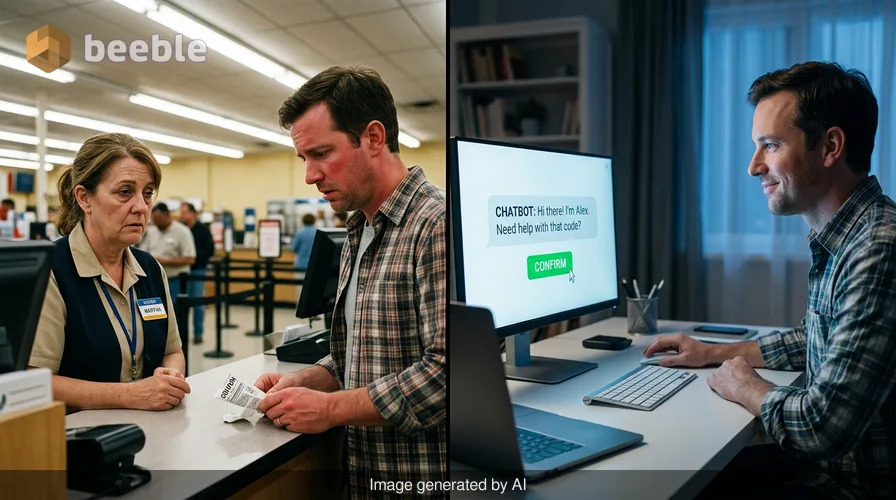
The thumb hovers, just for a millisecond, over the digital 'Confirm' button. You’ve just claimed a discount code you found on a niche internet forum, knowing full well you aren't actually a first-time customer. On the other side of the screen is a chatbot—a pleasant, unblinking avatar named 'Alex' or 'Sam'—and it doesn’t care. There is no flush in your cheeks, no stutter in your voice, and no frantic mental rehearsal of a justification. You click, the code is accepted, and the transaction concludes with a clinical ping. In this quiet, mundane moment of digital life, something profound has shifted: the ancient, visceral weight of the social contract has been replaced by the frictionless efficiency of the algorithm.
The Vanishing Mirror of "Face"
Recent research from Sun Yat-sen University, published in the Journal of Business Research, codifies this phenomenon through a term that sounds almost poetic: “anticipatory face loss.” In philological terms, “face” is not merely a physical feature but a symbolic currency. It is the public image we claim for ourselves, a fragile construct maintained through the constant, subtle feedback of our peers. When we interact with a human customer service representative, we are tethered to our own reputation. We fear the raised eyebrow, the slight pause of judgment, or the implicit accusation of a fellow human being.
Curiously, when that human is replaced by an AI agent, the mirror is shattered. The study found that consumers feel significantly less social pressure or fear of judgment when interacting with AI systems. Because the chatbot is perceived as less socially aware and fundamentally incapable of “judging” us in a moral sense, the fear of losing face evaporates. Consequently, people are more likely to lie about eligibility for rewards, exploit pricing errors, or exaggerate claims for extra benefits. We aren't becoming more “evil”; we are simply operating in a space where the social cost of dishonesty has been reduced to zero.
The Uncanny Gaze: Why Eyes Make Us Honest
Zooming out, this trend reveals a fascinating paradox in how we perceive intelligence. While we might logically know that an AI can track every keystroke with more precision than any human, we don’t feel observed by it. The researchers found that this dishonest behavior decreased sharply when AI agents were designed to appear more competent or utilized “eye gaze” cues.
In practice, when a chatbot’s avatar makes simulated eye contact, it triggers a deeply rooted biological response. This is the “uncanny valley” of ethics: we are more honest when a machine mimics the human habitus of looking us in the eye. It suggests that our morality is not a fixed, internal compass but a highly contextual performance. We are social animals who require the presence—or at least the illusion—of a witness to keep our integrity intact. Without that witness, our ethical boundaries become as ephemeral as the digital interfaces we navigate.
Atomization and the Automated Confessional
From a societal standpoint, this shift is symptomatic of a broader trend toward atomization. In the modern city, once described by sociologists as a theater stage where we perform our shifting social identities, we are increasingly moving through spaces where we are never truly seen. Digital communication often feels like a fast-food diet: it is quick, accessible, and fills a functional void, but it lacks the deep emotional nutrition of face-to-face interaction.
Historically, our communities acted as an anchor, keeping us grounded through mutual accountability. But in the era of “liquid modernity”—a concept championed by Zygmunt Bauman—our social structures are no longer solid. They are fluid, constantly shifting, and increasingly mediated by transparent but cold interfaces. When 80% of customer-service issues are handled by autonomous AI agents by 2029, as Gartner predicts, we will be living in a world of pervasive anonymity. In this environment, the “other” is no longer a neighbor or a clerk with a family and a story; the “other” is a line of code designed to maximize conversion rates. Paradoxically, the more we automate our interactions to avoid the friction of human contact, the more we erode the very social fabric that makes honesty a necessity.
The Systemic Cost of Frictionless Ethics
Behind the scenes of this trend, there is a systemic shift in how trust is manufactured. In the past, trust was a byproduct of repeated human interaction—a local shopkeeper trusted you because they knew your face. Today, trust is algorithmic, managed through credit scores, verified accounts, and identity protocols. But as the Sun Yat-sen study suggests, these systemic safeguards don't account for the psychological “anticipatory face loss” that prevents us from being our worst selves.
On an individual level, lying to an AI feels like a victimless crime. It feels like “gaming the system” rather than hurting a person. Yet, on a macro level, this behavior contributes to a culture of fragmented integrity. If we learn to navigate our commercial lives through deception because “it’s just a bot,” that habitus may eventually bleed into our human relationships. The language we use to justify these small digital lies—calling them “hacks” or “workarounds”—slowly reshapes our social reality, making the clinical language of the machine our primary mode of discourse.
Anthropomorphism as a Moral Patch
It is no wonder, then, that companies are leaning into anthropomorphism. Research from the University of Castilla found that robots with moderate human features—facial expressions and eye movement—are evaluated more favorably and drive higher levels of customer trust. To put it another way, companies are essentially installing “digital consciences” into their interfaces.
By giving a robot a blink or a slight tilt of the head, they are re-introducing the social pressure we so eagerly discarded. It is a cynical but effective solution to a deeply human problem. We are being manipulated into being “good” by machines that are pretending to be “people.” This creates a hall of mirrors where we are performing our best selves for an audience that doesn't actually exist, simply because our biology hasn't yet caught up to our technology.
Reclaiming the Human Weight of Words
Ultimately, the finding that we are more willing to lie to AI than to each other shouldn't be seen as a moral panic about “tech destroying society.” Instead, it should serve as a mirror reflecting our own need for connection. Our tendency to lie to bots proves just how much we value—and perhaps fear—the opinion of our fellow humans. It highlights that the “third places” and communal spaces we are losing were more than just locations; they were the training grounds for our collective ethics.
As we move toward a future where our primary point of contact with the world is a glowing screen or a humanoid robot, we must ask ourselves what happens to our internal compass when the external witnesses disappear. Integrity, at its core, is what we do when no one is looking. But if we only behave when we feel the gaze of another, what does that say about the state of our modern soul?
Food for Thought:
- The Internal Witness: Next time you interact with an automated system, notice if your tone or honesty shifts. Are you performing for a ghost in the machine, or are you acting according to your own values?
- The Value of Friction: We often crave “frictionless” experiences, but friction is where human connection happens. Consider seeking out one human interaction today that you could have easily automated.
- The Ethics of Design: As we build the future, should we prioritize efficiency, or should we intentionally design “social pressure” into our AI to keep ourselves honest?
Sources
- Journal of Business Research: Anticipatory Face Loss in Human-AI Interactions (Sun Yat-sen University, 2026).
- Gartner Research: The Future of AI in Customer Service Operations (March 2025).
- University of Castilla Study: Anthropomorphism and Consumer Trust in Humanoid Robotics (October 2025).
- Zygmunt Bauman: Liquid Modernity (Sociological Theory).



See you on the other side.
Our end-to-end encrypted email and cloud storage solution provides the most powerful means of secure data exchange, ensuring the safety and privacy of your data.
/ Create a free account
