


Will the EU finally end the era of fake AI real estate photos?

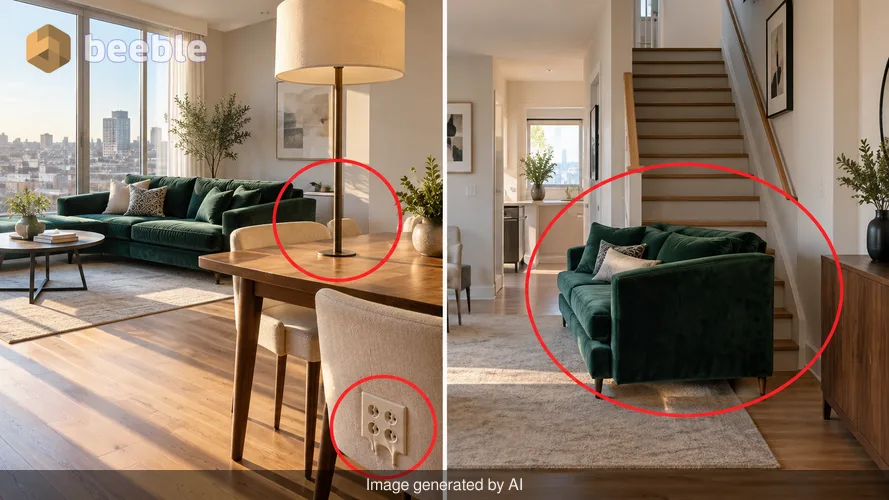
Have you ever found the perfect apartment online, only to realize the photos are a digital lie? You scroll through a listing and see a sun-drenched living room with expensive-looking oak floors and a plush velvet sofa. Everything looks ideal until you notice the details. A floor lamp grows directly out of a dining table. The electrical outlets have six holes and appear to be melting into the drywall. In the next photo, the velvet sofa has moved, but it is now blocking the only staircase in the house. This is the world of housefishing, a growing trend where AI-generated images lure renters and buyers into properties that look nothing like the real thing.
Technological tools now allow real estate agents to stage a home without lifting a single chair. While physical staging costs thousands of dollars for furniture rentals and movers, an AI tool can perform a digital renovation in seconds for a few cents. This shift saves money for the industry, but it creates a minefield for consumers who just want an honest look at where they might live. The European Union has noticed this problem. With the full implementation of the EU AI Act, the era of secret digital makeovers is supposed to end.
The rise of the digital housefishing trap
Housefishing is the real estate equivalent of catfishing on a dating app. The goal is to make a product look more attractive than it is in reality. In the past, this involved wide-angle lenses or high-contrast editing to make rooms seem brighter. Today, the technology is much more intrusive. AI models can now add entire kitchen islands, remove cracked walls, or replace a view of a brick alleyway with a lush green park.
For the average user, these images are often a digital illusion. A recent example on a housing forum in Ireland showed a house listed with beautiful furniture and artwork. When a user visited the property, they found an empty shell of a building. The AI version did more than just add furniture; it changed the dimensions of the room. A wall that was five meters long in the photo was barely three meters in person. This is not just a stylistic choice. It is a fundamental misrepresentation of a physical asset.
Steven Lee from the Professional Institute of Real Estate Agents views this as an evolution of traditional staging. He notes that agents have always used furniture to help buyers visualize potential. From his perspective, the computer is simply a more efficient tool for a long-standing practice. However, when the digital intern in charge of the photos starts ignoring the laws of physics, the line between marketing and deception vanishes.
The messy reality of the Irish couch incident
Concrete examples of AI failure are becoming easier to find as the technology proliferates. In the Irish case, the AI-generated couch was placed directly in front of the stairs, making it impossible for a resident to reach the second floor. This lack of spatial awareness is a hallmark of current generative tools. They understand what a sofa looks like, but they do not always understand how a human uses a room.
Beyond simple furniture placement, these tools often fix structural flaws that a buyer needs to know about. An agent might use AI to hide water damage on a ceiling or to make a cramped kitchen look like a chef's paradise. For someone moving to a new city who cannot visit the site in person, this creates a significant financial risk. They might sign a lease or put down a deposit based on a fake image. Claudio Teixeira of the European Consumer Organization points out that not everyone has the digital literacy to spot these errors. The elderly are particularly at risk, as they may not be familiar with how easily a digital image can be manipulated.
Article 50 and the quest for digital honesty
To combat this, the EU AI Act introduces strict transparency requirements under Article 50. This regulation treats AI-modified content as something that requires a warning label. If a real estate agent uses a platform to furnish an apartment digitally, the law classifies the result as partially AI-modified. This means the photo must include a clear, visible icon or text stating that the image is not real.
David Rappenglück, a senior law associate at CMS, describes Article 50 as a protection of fundamental consumer rights. The logic is simple: if you look at a picture that is not a true reflection of reality, you have a right to know. The law places responsibility on two different groups. First, the providers—the tech companies like OpenAI or Midjourney—must ensure their systems create images with machine-readable metadata. This is like a digital fingerprint that stays with the file. Second, the deployers—the real estate agents or listing platforms—must ensure a human-readable label is present on the website.
| Requirement Type | Responsibility | Action Required |
|---|---|---|
| Technical | AI Provider (OpenAI, etc.) | Embed machine-readable metadata in the file. |
| Visual | AI Deployer (Estate Agent) | Add a visible "AI Generated" label or icon to the listing. |
| Legal | Platform (Zillow, Daft, etc.) | Ensure users can easily identify modified content. |
The invisible watermark problem for homebuyers
While the law is clear, enforcement is a different story. If an agent uses a local, private AI model to edit a photo and then uploads it without a label, it is difficult for a consumer to prove the deception. The machine-readable format required from providers is a technical solution, but most homebuyers do not have the software to check the metadata of a JPEG file.
This creates a gap where dishonest actors might still try to bypass the rules. Currently, identifying housefishing relies on the "uncanny valley" effect—that feeling that something is just slightly wrong. You might notice a chair with five legs or a window that has no frame. However, as AI becomes more sophisticated, these errors will disappear. Without the mandatory labels required by the EU, the distinction between a photo and a rendering will become invisible to the human eye.
Why transparency matters for the remote mover
The real estate market is increasingly global. People move across borders for work and often secure housing before they arrive. In this systemic shift toward remote transactions, trust is the primary currency. If the digital representation of a home is a lie, the entire market becomes volatile and opaque. Transparency is not just about being honest; it is about keeping the market functional.
When you see a label that says "Virtually Staged," you can adjust your expectations. You know the furniture is a suggestion, not a reality. You know the walls might be a different color. This label gives you the prompt to ask the agent for a video walkthrough or a raw, unedited photo. It empowers the consumer to make a decision based on facts rather than a generated fantasy.
How to spot a fake listing before you book a viewing
Until every listing platform follows the EU AI Act perfectly, you must be your own detective. Look at the corners of the room. AI often struggles with where two walls meet the ceiling, creating blurry or distorted lines. Check the reflections in mirrors or windows. An AI-generated room often shows a reflection of a different room or a window that does not exist in the floor plan.
Pay attention to the lighting. If every corner of a room is perfectly bright without a visible light source, it is likely a digital enhancement. Finally, look for repeating patterns. Generative models often use the same piece of art or the same plant in every room to save on processing power. If the same cactus is in the bathroom, the kitchen, and the bedroom, you are looking at a digital mirage.
Ultimately, the EU AI Act is a foundational step toward a more honest digital economy. It shifts the burden of proof from the buyer to the seller. As a consumer, your best defense is a healthy dose of skepticism. The next time you see a listing that looks like it belongs in a luxury magazine for a suspiciously low price, look for the AI icon. If it is not there, start looking for that fifth chair leg.
Sources:
Official Journal of the European Union, Regulation (EU) 2024/1689 (AI Act)
CMS Law-Now Industry Reports
European Consumer Organization (BEUC) Digital Policy Position Paper
Professional Institute of Real Estate Agents Annual Tech Survey



See you on the other side.
Our end-to-end encrypted email and cloud storage solution provides the most powerful means of secure data exchange, ensuring the safety and privacy of your data.
/ Create a free account
