


Would you trust a digital intern to handle your customer service complaints?

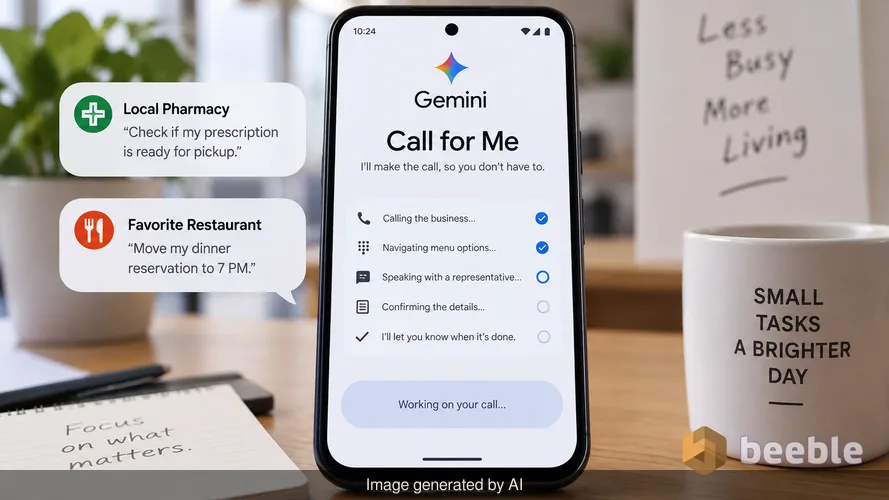
How much is twenty minutes of your life worth? For most people, that is the standard tax paid for the simple act of calling a local pharmacy to check a prescription or a restaurant to move a dinner reservation. You dial the number, navigate a maze of numeric prompts, and wait through a loop of low-quality hold music. Google now wants to automate this friction away with a new Gemini feature called Call for Me.
This experiment represents a significant shift in how personal AI interacts with the physical world. Instead of just summarizing emails or generating images, Gemini acts as a tireless intern for your personal logistics. The software handles the tedious steps of a phone call, from the initial ring to the final confirmation, while you focus on other tasks.
The evolution of the automated assistant
Google is not new to the world of automated calling. In 2018, the company introduced Duplex, a system that could call hair salons and restaurants with a voice that sounded remarkably human. It even included vocal fillers like "um" and "uh" to put the person on the other end of the line at ease. While Duplex was impressive, it was a specialized tool with a narrow focus.
Since then, Google has added several layers to its phone assistant suite. Features like Hold for Me allow your phone to wait on the line until a real person answers, while Direct My Call transcribes phone menus so you do not have to memorize which number leads to the billing department. Call for Me is the next logical step in this progression. It moves from merely assisting during a call to initiating and managing the entire interaction.
Unlike previous versions, this new tool is part of the Gemini ecosystem. This means it has access to a broader context of your digital life, provided you give it permission. It is a more flexible system that handles nuances that older, rigid programs often missed.
How Call for Me works under the hood
To use this feature, you must have a Pixel 11, a Gemini subscription, and the beta version of the Google Phone app. The system uses your actual phone number to place the call, which makes the interaction look legitimate to the business receiving it. Once the call starts, Gemini introduces itself to the person or the automated system on the other end.
One of the most practical aspects of this technology is its ability to navigate Interactive Voice Response (IVR) systems. These are the "press one for sales" menus that define modern customer service. Gemini listens to these prompts, selects the correct options, and waits through the hold time. While this happens, your phone displays a live transcript of the conversation.
If the AI hits a snag or the conversation becomes too complex, you have the option to take over. You can jump into the call at any moment, much like an executive stepping into a meeting that an assistant started. This transparency is intended to build trust, as you are never in the dark about what the AI says on your behalf.
Privacy and the data exchange
For Gemini to be effective in these calls, it needs access to your personal information. If you ask the AI to move a doctor's appointment, it needs to know your schedule and potentially your patient ID or date of birth. Google states that the AI will only share information that you specifically approve for the call.
Practically speaking, this creates a new layer of data management for the user. You are no longer just sharing data with a website; you are authorizing an agent to speak that data into a recorded phone line. This systemic change requires a shift in how we think about privacy settings. The information is not just sitting in a database—it is active and conversational.
Google is starting this experiment at a small scale because real-world conversations are volatile. A human on the other end might have a thick accent, a bad connection, or a grumpy attitude. The AI must be resilient enough to handle these variables without failing or, worse, agreeing to terms that the user did not intend.
The competitive market for AI agents
Google is not the only player in this space. The launch of Call for Me follows the release of Meta’s Muse and Instinct, which also offer automated calling capabilities. The tech industry is moving away from chatbots that just talk and toward agents that act.
| Feature | Google Call for Me | Previous Google Tools (Duplex/Hold for Me) |
|---|---|---|
| Initiates Calls | Yes | Limited (mostly reservations) |
| Navigates IVR | Yes | Partial (Direct My Call) |
| Shares Personal Info | Yes (with approval) | No |
| Live Transcript | Yes | Yes |
| Hardware Requirement | Pixel 11 | Various Pixel models |
On the market side, this is a race to become the primary interface for the user's life. If Gemini handles your calls, your emails, and your calendar, the switching cost to a different ecosystem becomes incredibly high. This is a strategy for long-term user retention in a volatile tech economy.
The industrial backbone of the phone tree
Behind these consumer features lies a massive infrastructure of telecommunications and natural language processing. Heavy industry and large-scale retail depend on automated phone systems to manage thousands of inquiries every hour. These systems are the invisible backbone of customer service.
When Gemini calls a business, it interacts with these industrial-grade systems. If millions of AI agents start calling these phone trees, businesses may need to upgrade their own infrastructure to handle the volume and speed of AI-to-AI communication. We are approaching a point where the majority of voice traffic on business lines might not involve a human voice on either end.
This shift could eventually lead to the death of the traditional phone menu. If every phone has an AI that can "talk" to a business's server directly, the need for a voice-based menu vanishes. For now, however, Gemini acts as a bridge between our high-tech smartphones and the aging legacy systems that many businesses still use.
What this means for your daily routine
The bottom line for the average user is a tangible reduction in mental clutter. We often procrastinate on small tasks, like calling to see if a specific pair of boots is in stock, because the process is annoying. By delegating these chores to a digital intern, you regain fragments of time throughout your day.
However, there is a learning curve. You must become comfortable with the idea of a software program representing you. There is also the financial cost to consider. Between the price of a flagship Pixel 11 and the monthly Gemini subscription, this convenience is a premium product.
Ultimately, Call for Me is a glimpse into a future where our devices are less like tools and more like staff. It is an emerging reality where the phone in your pocket does more than just transmit your voice—it speaks for you when you are too busy to bother.
From a consumer standpoint, the best approach is to observe how these experiments handle the messiness of real-world interactions. Pay attention to the transcripts and see where the AI succeeds or stumbles. As these agents become more robust, our relationship with the "send" button will change forever. Instead of sending a message, we will be sending an envoy.
Sources:
- Google Official Keyword Blog: Introducing Gemini Call for Me on Pixel 11
- Google Assistant Support: Understanding Automated Calling Features
- Meta Newsroom: Muse and Instinct AI Agent Release Notes
- Federal Communications Commission: Guidelines on AI-Generated Voice and Telemarketing



See you on the other side.
Our end-to-end encrypted email and cloud storage solution provides the most powerful means of secure data exchange, ensuring the safety and privacy of your data.
/ Create a free account
