


Zagreb’s Driverless Dawn: How Uber, Pony.ai, and Verne are Rewriting the European Commute

The End of the Steering Wheel?
Have you ever considered how much of your life is spent navigating the friction-heavy reality of urban traffic? For most of us, the act of getting from point A to point B is a necessary evil—a sequence of red lights, parking hunts, and the occasional stressful interaction with a disgruntled driver. But what if the person behind the wheel wasn’t a person at all, but a sophisticated, deterministic system designed to navigate the chaos of a city with more precision than any human could muster?
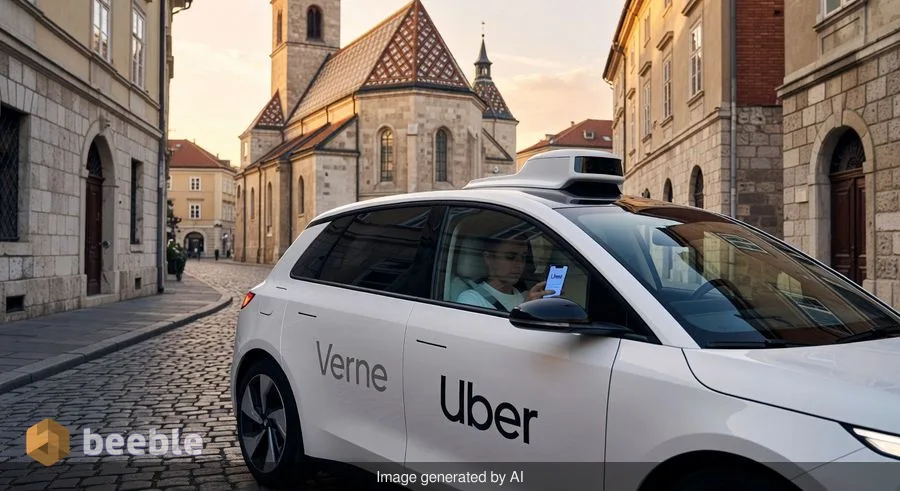
This isn't a scene from a science fiction novel, though the name of the company at the center of it suggests otherwise. Uber, Pony.ai, and the Croatian startup Verne have officially joined forces to launch Europe’s first commercial robotaxi service. The rollout begins in Zagreb, the capital of Croatia, marking a paradigm-shifting moment for European transportation. As someone who grew up in a small town where the arrival of a new bus route was a major event, I’ve always been fascinated by how technology erodes borders and collapses distances. Seeing a global giant like Uber partner with a local innovator in the Balkans feels like a full-circle moment for the digital age.
A Trio of Innovation: Who’s Doing What?
To understand how this service works, it helps to view the partnership as a living organism where each part serves a vital function. Under the hood, the roles are clearly defined to ensure a seamless launch.
- Pony.ai: The Chinese autonomous driving powerhouse provides the "brain." Their cutting-edge AI stack has been refined through millions of miles of testing in some of the world’s most complex driving environments. Think of training AI as raising an apprentice; it requires constant feedback and a robust data set to reach mastery.
- Verne: Named after the legendary French writer Jules Verne, this Croatian startup (born from the mind of Mate Rimac and his team) acts as the fleet owner. They manage the physical vehicles and the day-to-day operations. They are the boots—or rather, the tires—on the ground.
- Uber: The platform giant acts as the bridge. By integrating Verne’s fleet into the Uber app, they provide the scale and user base necessary to make the service commercially viable from day one.
Curiously, this move signals a major shift in Uber’s long-term strategy. Rather than trying to build the entire autonomous stack themselves—a pursuit that once drained billions in capital—they are now the ultimate aggregator, a utility grid for mobility that plugs in the best tech from around the world.
Why Zagreb? The Strategic Choice of a European Hub
Choosing Zagreb as the launchpad for Europe’s robotaxi revolution might seem like an unconventional choice to some. Nevertheless, the city offers a unique blend of complex urban layout and a forward-thinking regulatory environment. Because of this, Verne has been able to spearhead efforts to obtain the necessary European regulatory approvals that will eventually serve as a blueprint for other cities.
In practice, the trio has already begun on-road testing. I recently spent some time in a coworking space in the region, and the buzz among local engineers is palpable. There is a sense that Croatia is no longer just a beautiful tourist destination, but a hub for transformative tech. While traveling to study how technology impacts different cultures, I’ve noticed that smaller, agile nations often leapfrog larger ones when it comes to adopting disruptive infrastructure. Zagreb is currently the laboratory for the future of the European street.
The User Experience: From App to Asphalt
When the service goes live for fare-paying passengers, the process will be remarkably intuitive. Users will be able to hail a Verne robotaxi directly through the Uber app or Verne’s own dedicated platform.
| Feature | Details |
|---|---|
| Fleet Size | Scaling to thousands of vehicles over the next few years |
| Technology | Pony.ai Level 4 Autonomous Driving System |
| Service Area | Initially Zagreb, with plans for European expansion |
| Integration | Dual-app availability (Uber & Verne) |
| Vehicle Type | Purpose-built autonomous vehicles designed for passenger comfort |
Essentially, the goal is to remove the "human error" variable from the equation. We often treat our cars like pets, naming them and caring for them individually, but in the world of robotaxis, servers and vehicles are treated more like cattle—highly efficient, interchangeable units of a larger, performant network. This shift from ownership to access is the core of the autonomous revolution.
Balancing the Digital and the Physical
As a tech journalist who spends a significant amount of time testing smart rings to track sleep across time zones and using meditation apps to stay grounded, I am often the first to advocate for new gadgets. However, I also believe in a healthy balance. The rise of robotaxis is an incredible leap forward for accessibility and safety. It allows the elderly or the visually impaired to regain a level of independence that was previously obsolete.
At the same time, we must be mindful of the social fabric. During my travels, I’ve seen how the "gig economy" has provided a safety net for many, and the transition to autonomous fleets will undoubtedly be a nuanced journey for the labor market. The companies involved have stated their aim to build a scalable path that benefits the urban ecosystem as a whole, but the transition remains a delicate dance between innovation and social responsibility.
What’s Next for Verne and Uber?
The roadmap is ambitious. Following the Zagreb launch, the partners intend to scale to a fleet of thousands of robotaxis, potentially moving into other European markets. Uber’s investment in Verne ensures they have skin in the game, moving beyond a simple partnership into a strategic alliance.
Oddly enough, the biggest challenge might not be the code, but the culture. Convincing a population to step into a car with no driver requires a high level of trust in the "black box" of AI. But as we’ve seen with the transition from paper maps to GPS, once a technology becomes frictionless, it quickly becomes the default.
Practical Takeaways for the Future Traveler
If you find yourself in Zagreb or are watching this space closely, here is what you should keep in mind:
- Download both apps: While Uber is the familiar choice, Verne’s native app may offer exclusive features or loyalty rewards as they look to build their brand.
- Watch the regulations: The success of this pilot will dictate how quickly robotaxis arrive in London, Paris, or Berlin. Regulatory hurdles are the primary bottleneck, not the technology itself.
- Embrace the shift: Start thinking about mobility as a service rather than an asset. The financial debt of car ownership (insurance, maintenance, fuel) may soon be a thing of the past for city dwellers.
As the sun sets over the Sava River, the sight of a driverless car navigating the streets of Zagreb is a reminder that the future is already here—it’s just being distributed one city at a time. For now, I’ll keep my notifications on for the launch date, but I’ll also make sure to set aside time for a run through the park, away from any screens or sensors.
Sources:
- Official Press Release: Uber, Pony.ai, and Verne Partnership Announcement (March 2026).
- Verne Corporate Strategy and Fleet Management Overview.
- Pony.ai Autonomous Systems Technical Specifications.
- European Commission Mobility and Transport Regulatory Framework Updates.



See you on the other side.
Our end-to-end encrypted email and cloud storage solution provides the most powerful means of secure data exchange, ensuring the safety and privacy of your data.
/ Create a free account
