


Zuckerberg’s Personal AI: Why Meta is Automating the C-Suite to Stay Competitive

When was the last time you felt like your organization was a game of 'telephone,' where a simple request for data passed through five layers of management only to return as a diluted, unrecognizable version of the truth? For Mark Zuckerberg, the answer seems to be 'too often.'
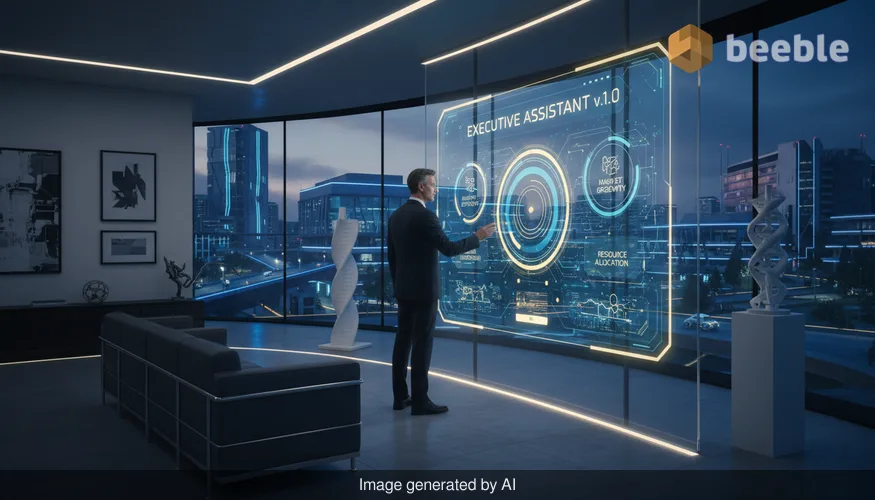
Recent reports, including detailed insights from The Wall Street Journal, reveal that the Meta CEO is building a sophisticated artificial intelligence agent designed to assist him with his executive duties. This isn't just a glorified calendar app; it is a move toward a more autonomous, friction-heavy-free management style. By developing a bot that can retrieve information directly from the company’s internal systems, Zuckerberg is effectively attempting to bypass the traditional organizational structure. This shift marks a transformative moment in corporate governance, where the "Year of Efficiency" has evolved into the "Era of the Agent."
The AI as an Apprentice
To understand what Zuckerberg is building, we have to look past the standard chatbot. While a typical LLM might summarize a meeting, an AI agent is more like raising an apprentice. It doesn't just talk; it acts. In practice, this means the agent can autonomously plan and carry out tasks—such as searching for specific performance metrics across different departments or synthesizing complex technical hurdles—without a human intermediary.
Essentially, Zuckerberg is looking for a way to interact with Meta as if it were a single, living organism rather than a sprawling bureaucracy. Curiously, this isn't his first foray into personal AI. Years ago, he built "Jarvis" to run his home. But while Jarvis was a hobbyist’s project for dimming lights and playing music, this new agent is a robust tool designed for the volatile world of global tech competition.
Flattening the Living Organism
During a recent earnings call, Zuckerberg noted that Meta is "elevating individual contributors and flattening teams." This isn't just corporate-speak for layoffs; it’s a fundamental redesign of how a company functions. By using AI to handle the information-gathering roles traditionally held by middle management, Meta can shave layers from its structure.
As a result, the distance between the CEO’s vision and the engineer’s execution shrinks. To put it another way, if code is city planning, Zuckerberg is trying to remove the bureaucratic red tape that prevents the mayor from seeing the blueprints of a new bridge. This approach is intended to make the company more resilient and performant in an AI race that moves at an unprecedented pace.
A View from the Digital Frontier
Having grown up in a small town, I realized early on that the internet erodes borders. Later, after earning my degree in sociology and traveling to study how technology impacts different cultures, I saw this play out in real-time. Whether I’m writing from a tech expo in Lisbon or a coworking space in Bali, the friction of distance is disappearing.
However, this erasure of boundaries comes with a cost. While testing the latest smart rings to track my sleep across time zones or using meditation apps to stay grounded, I’ve noticed that the more we automate, the more we risk losing the nuanced human touch. Zuckerberg’s push for a flattened, AI-driven Meta is innovative, but it also makes the role of the middle manager precarious. We are moving toward a world where you are either the one building the AI or the one being managed by it.
Under the Hood: The Tech Behind the Bot
While the specific architecture remains a closely guarded secret, the bot likely leverages Meta’s own Llama series of models. Unlike a standard out-of-the-box solution, this agent must be deeply integrated into Meta’s internal data lakes.
- Asynchronous Processing: The agent likely works in the background, pulling reports and identifying trends while the CEO focuses on high-level strategy.
- Deterministic Guardrails: To be useful for an executive, the AI cannot hallucinate. It must provide factual, data-driven answers based on internal reality.
- Seamless Integration: The goal is a sleek interface that allows for natural language queries to replace hours of manual data digging.
The Precarious Balance of Automation
Despite the clear benefits of speed and clarity, there is an inherent risk in relying on a "black box" to run a multi-billion dollar company. If the data fed into the AI is flawed, the CEO’s decisions will be equally compromised. Nevertheless, Zuckerberg seems convinced that the trade-off is worth it. He believes that a leaner, AI-augmented team will be "a lot more fun" and significantly more productive.
Oddly enough, this mirrors a trend I’ve seen in food-tech during my travels. Just as automated kitchens aim to provide consistent, healthy meals by removing human error, Zuckerberg is trying to provide consistent, data-driven leadership. But just as I occasionally need to turn off my notifications and go for a run or practice yoga to reconnect with reality, a corporation needs to ensure it doesn't lose its soul to the algorithm.
Practical Takeaways for the AI Transition
If you’re looking to stay competitive in an environment where even the CEO is being augmented by AI, consider these steps:
- Become AI-Fluent: Don’t just use AI; understand how agents work. Learn the difference between a simple prompt and an agentic workflow.
- Focus on High-Value Intuition: AI is excellent at data retrieval but still struggles with nuanced cultural and emotional intelligence. Double down on these human-centric skills.
- Audit Your Workflow: Identify friction-heavy tasks in your daily routine. Could an asynchronous tool or a simple automation script handle them?
- Maintain a Healthy Balance: Automation can lead to burnout if you never "unplug." Use the time saved by AI to focus on deep work or physical well-being.
As we watch Meta’s experiment unfold, it’s clear that the traditional corporate blueprint is being rewritten. The question is no longer whether AI will help run our companies, but how quickly we can adapt to being part of an AI-driven ecosystem.
Sources:
- The Wall Street Journal: Reports on Meta's internal AI agent development.
- Meta Investor Relations: Transcripts from recent earnings calls regarding organizational flattening.
- TechCrunch: Analysis of Meta’s Llama model evolution and agentic capabilities.



See you on the other side.
Our end-to-end encrypted email and cloud storage solution provides the most powerful means of secure data exchange, ensuring the safety and privacy of your data.
/ Create a free account
