


Beyond the Frame: Why Gamers are Rejecting the Generative Vision of DLSS 5

When Does Enhancement Become Revisionism?
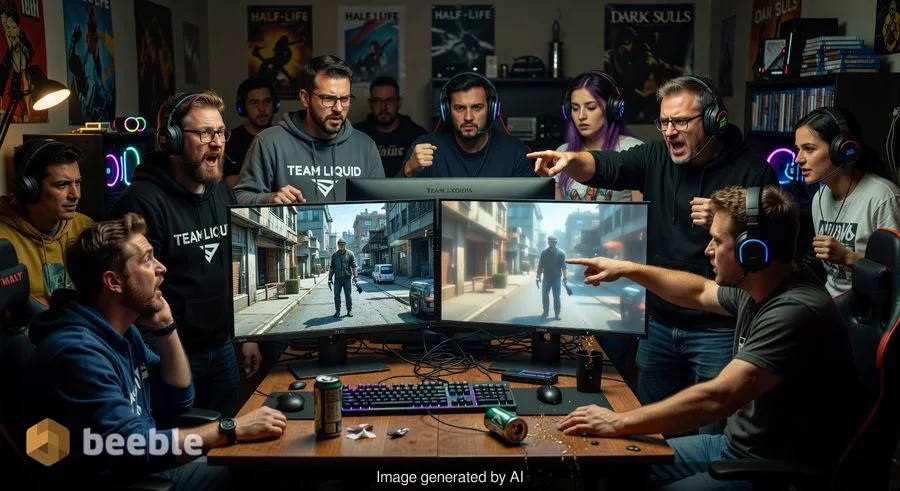
When does a tool designed to improve performance start to erode the very art it’s meant to display? This is the question echoing through forums, Discord servers, and social media feeds following Nvidia’s reveal of DLSS 5 yesterday. Since the original Deep Learning Super Sampling (DLSS) debuted alongside the RTX 2080 in 2018, the gaming community has largely embraced the technology. We viewed it as a clever, transformative way to squeeze more life out of our hardware, using machine learning to upscale resolutions and smooth out frame rates.
However, with the announcement of DLSS 5, Nvidia appears to have stepped off the path of optimization and onto the precarious ground of generative replacement. This isn't just about making a 1080p image look like 4K anymore. DLSS 5 introduces what Nvidia calls "Generative AI Glow-ups," a feature that uses neural networks to overhaul lighting, shadows, and even surface textures in real-time. To put it another way, the GPU is no longer just reporting what the game engine says; it’s starting to hallucinate its own version of the world.
The Rise of the Generative Gloss
Curiously, the reaction from the core gaming audience has been swift and overwhelmingly negative. While the tech is undeniably innovative, the visual results have been described by many as a bland, uncanny gloss. In the pursuit of "perfect" lighting, the AI often strips away the specific artistic choices made by environment artists.
I remember my early days working in a tech startup where we tried to implement an automated "beautification" filter for user-generated content. We thought we were providing a service, but we quickly realized that by smoothing out every wrinkle and normalizing every color palette, we were deleting the character that made the original images interesting. Nvidia’s DLSS 5 feels like that startup mistake scaled up to a multi-billion dollar industry level.
Consequently, the very thing that makes a game like Cyberpunk 2077 or Elden Ring visually distinct—the intentional grit, the specific play of shadow, the hand-painted feel of a texture—is being replaced by a generic, AI-interpreted sheen. It’s the digital equivalent of putting a "vivid" filter on a classic film; it might look brighter, but it loses its soul.
The Technical Trade-off: Accuracy vs. Aesthetics
To understand why this is happening, we have to look at the intricate way DLSS has evolved.
- DLSS 1 & 2: Focused on spatial upscaling (making small images big).
- DLSS 3: Introduced Frame Generation (creating entirely new frames between existing ones).
- DLSS 3.5: Added Ray Reconstruction (cleaning up noisy lighting).
- DLSS 5: Moves into Asset and Lighting Generation.
In contrast to previous iterations, DLSS 5 doesn't just clean up the signal; it changes the message. By using generative models to "improve" textures, the GPU might decide a brick wall should look cleaner or a puddle should be more reflective than the developer intended. As a result, the game world begins to feel like a living organism that is constantly shifting, leading to a shimmering, unstable quality that many gamers find nauseating rather than immersive.
Why the Industry is Pushing Back
It isn't just the players who are frustrated; industry veterans are also raising eyebrows. Game development is a journey of thousands of micro-decisions. Every light source is placed with intent. When an AI comes over the top and decides to "fix" the lighting to meet a mathematical ideal of realism, it invalidates the work of the lighting artists.
Nevertheless, Nvidia argues that this is the only way to achieve true photorealism in an era where hardware gains are slowing down. They view the gaming ecosystem as one that must eventually transition to a fully AI-rendered pipeline. But for those of us who value the human element in digital art, this feels like a step toward a homogenized future where every game looks like it was generated by the same prompt.
The "Uncanny Valley" of Environments
We often talk about the uncanny valley in the context of human faces, but DLSS 5 has proven that environments can fall into it too. There is something fundamentally unsettling about a world that looks "too perfect." When every surface has a mathematically perfect sheen and every shadow is flawlessly soft, the world stops feeling like a place and starts feeling like a tech demo.
During my years managing remote teams in the tech space, I’ve noticed that the most successful projects are those that embrace nuance and imperfection. The same applies to gaming. The grit on a dungeon floor or the flickering of a poorly shielded light bulb adds to the narrative. If DLSS 5 wipes that away in favor of a "glow-up," we lose the story the environment was trying to tell.
What Happens Next?
As we look toward the official launch of the next generation of cards, Nvidia faces a remarkable challenge. They have built a powerful engine, but the drivers (the gamers) are threatening to jump out of the car.
If you are concerned about the direction of generative AI in your games, here are a few things to keep an eye on:
- Developer Toggles: Look for games that allow you to disable "Generative Overhauls" while keeping standard upscaling active.
- Artistic Integrity Mods: Expect a surge in the modding community for "Vanilla Visuals" patches that bypass AI re-texturing.
- The Competition: Watch how AMD and Intel respond. If they stick to "faithful upscaling" while Nvidia pushes "generative replacement," we might see a significant shift in market share.
Nvidia’s DLSS 5 is a technical marvel, but it serves as a reminder that just because we can automate the aesthetic of a world doesn't mean we should. Technology should be a building block for human creativity, not a replacement for it.
What do you think about the move toward generative AI in gaming? Is it an inevitable evolution or a threat to artistic intent? Let us know in the comments below.
Sources
- Nvidia Official Newsroom: RTX 50-Series and DLSS 5 Technical Preview.
- Digital Foundry: The Visual Cost of Generative Reconstruction.
- GDC 2026: Panel on AI Ethics in Environment Design.
- PC Gamer: Community Backlash to DLSS 5 "Glow-up" Features.



See you on the other side.
Our end-to-end encrypted email and cloud storage solution provides the most powerful means of secure data exchange, ensuring the safety and privacy of your data.
/ Create a free account
