


Breakdown: How 70 Operatives Orchestrated a €140M Fraud Engine via Industrialized CEO Impersonation

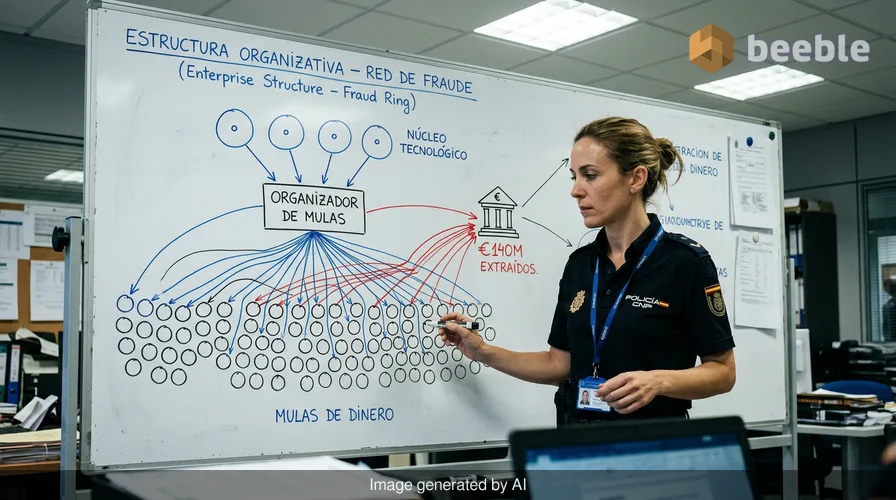
70 identified individuals. 19 registered shell companies. Nearly 1,000 distinct financial accounts. €140 million in documented theft. These figures from the July 2026 Spanish National Police report describe a criminal enterprise that operated with the efficiency of a mid-sized fintech corporation. This was not a loose collective of amateur hackers; it was a structured organization that treated cybercrime as a scalable logistics problem. To gauge the scale, consider that €61 million of the total haul originated solely from Business Email Compromise (BEC) and CEO impersonation attacks within the last calendar year. This specific incident signals a maturation of the threat model where technical exploitation is merely a precursor to massive, automated financial laundering.
The architecture of an industrialized fraud ring
The operation relied on a bottom-heavy labor structure that reflects a sophisticated understanding of modern risk management. Only four core members handled the technical offensive operations, while over 67 individuals served as money mules. This division of labor creates an expertise deficit as an unspoken ally for the attackers. The core technicians do not need to risk exposure by interacting with the traditional banking system. Instead, they outsource the highest-risk activity—moving stolen funds—to a disposable layer of underlings. These mules are managed by a mule herder, a specific role dedicated to the maintenance of the group's financial infrastructure. This structural decoupling ensures that even if police arrest dozens of street-level associates, the technical brain of the operation remains intact and operational.
What this means in practice is that the attackers built a redundant, distributed network for capital flight. The seizure of 170 smartphones and 15 computers during the raid suggests a high degree of operational mobility. Each smartphone likely managed a handful of the 1,000 accounts, spreading the risk of detection across a vast surface area. When a single account is flagged for suspicious activity, the loss to the criminal organization is negligible. The remaining 999 accounts continue to function, ensuring that the velocity of capital movement exceeds the response time of institutional fraud departments.
Mechanics of the compromise chain
The attackers utilized four primary vectors: Man-in-the-Middle (MitM) attacks, CEO impersonation, social engineering via fake invoices, and fraudulent investment platforms. In the MitM scenarios, the gang inserted themselves into active business conversations by compromising email servers or using look-alike domains. They did not immediately exfiltrate data; they waited for the moment of a financial transaction. For clarity, they monitored the communication flow until an invoice was expected, then substituted the legitimate banking details with those of their shell companies. The victim organization followed its internal processes perfectly, yet the funds ended up in a criminal account. This demonstrates that process-oriented security is useless if the underlying data stream is compromised.
CEO impersonation represents the most lucrative segment of their portfolio, accounting for nearly 44% of their total revenue. These attacks exploit the hierarchy of corporate culture. An urgent request from a high-level executive bypasses standard verification steps in most organizations. The attackers researched their targets extensively, likely using scraped LinkedIn data and leaked corporate directories to map the reporting structure. They then timed their requests during periods of high stress or transition, such as quarterly closes or public holidays. The technical component was minimal—often just a spoofed email header—but the psychological engineering was surgical.
Why traditional perimeters fail against financial hijacking
The success of this €140 million operation proves that the traditional perimeter is a legacy concept that offers no protection against modern fraud. Most affected organizations likely had firewalls, antivirus software, and encrypted databases. However, none of these tools prevent a legitimate employee from voluntarily initiating a wire transfer to a fraudulent account. An unsegmented legacy is an open door. If the finance department's email environment is not isolated and monitored with the same rigor as the production server room, the organization remains vulnerable to these specific tactics.
Internal segmentation is the only viable survival strategy in this environment. The logic shifts to assuming that identity is always at risk of compromise. When the gang successfully impersonated a CEO, they were not hacking a computer; they were hacking the organization's trust model. Most enterprises treat an authenticated internal email as a trusted command. In a Zero Trust architecture, no communication is trusted by default, regardless of its origin. Every request for a high-value financial transaction must undergo independent, out-of-band verification that does not rely on the same communication channel that delivered the request.
Hardening the transaction lifecycle
To prevent becoming a statistic in a police report, enterprises must treat financial transactions as critical infrastructure. The Spanish case highlights the failure of basic hygiene in identity management. The use of 19 shell companies indicates that the attackers were able to navigate the Know Your Customer (KYC) requirements of multiple financial institutions, often across international borders. This suggests that the attackers targeted banks with weaker compliance frameworks, moving the money from Spain to Portugal and eventually Panama.
From an architectural standpoint, the fix is not more training, but better controls. Security awareness training is a weak defense against a determined professional. Instead, organizations should implement cryptographic signing for all internal invoices and wire transfer requests. If the digital signature does not match the executive's hardware-backed private key, the transaction is automatically flagged. This removes human discretion from the equation. A compromise of the email account becomes an annoyance rather than a catastrophe because the attacker lacks the physical token required to authorize a payment.
Action plan for the next 6-12 months
Survival in an era of industrialized fraud requires a shift from reactive detection to architectural resilience. CISOs must prioritize the following steps to mitigate the risks demonstrated by the Iberian syndicate:
- Audit Financial Communication Workflows (Month 1-3): Identify every path an invoice takes from receipt to payment. Document every individual who has the authority to approve wire transfers.
- Implement Hardware-Based MFA (Month 3-6): Move beyond SMS or app-based multi-factor authentication for all finance and executive accounts. Deploy FIDO2-compliant security keys to eliminate the possibility of session hijacking through MitM attacks.
- Deploy Cryptographic Invoice Verification (Month 6-9): Establish a system where vendors must sign invoices with a verified private key. Any change in banking details must be confirmed through a secondary, non-digital channel such as a known-good phone number or a physical meeting.
- Microsegment the Email Environment (Month 9-12): Separate executive and finance communications from the rest of the corporate network. Implement strict conditional access policies that prevent access to these accounts from unauthorized locations or devices.
- Conduct Social Engineering Penetration Tests: Specifically target the finance department with simulated CEO impersonation attacks. Use the results to identify gaps in the approval process rather than blaming individual employees.
The new reality of enterprise security
The Spanish takedown is a success for law enforcement, but it is a warning for the private sector. Recovering €3 million out of €140 million is a 2% recovery rate. For the victims, the intervention came too late. This asymmetry between the speed of the crime and the speed of the law means that prevention is the only metric that matters. The attackers used 170 smartphones to manage their empire; most companies only use one or two layers of defense for their entire treasury.
The goal is not to build a perfect wall that no attacker can climb. The goal is to ensure that a compromise of a single email account or a single employee does not lead to the total drainage of corporate accounts. By shrinking the blast radius of a single compromise through segmentation and hardware-backed identity, a CISO transforms a potentially bankrupting event into a manageable security incident. Architecture is the final word in defense.
Sources: Spain National Police (Policía Nacional), Europol Cybercrime Centre (EC3), Portuguese Judicial Police (Polícia Judiciária), Panama National Police.
Disclaimer: This article is for informational and educational purposes only and does not replace a professional cybersecurity audit or incident response service.



See you on the other side.
Our end-to-end encrypted email and cloud storage solution provides the most powerful means of secure data exchange, ensuring the safety and privacy of your data.
/ Create a free account
