


Can a nonprofit build an AI that actually speaks your language?

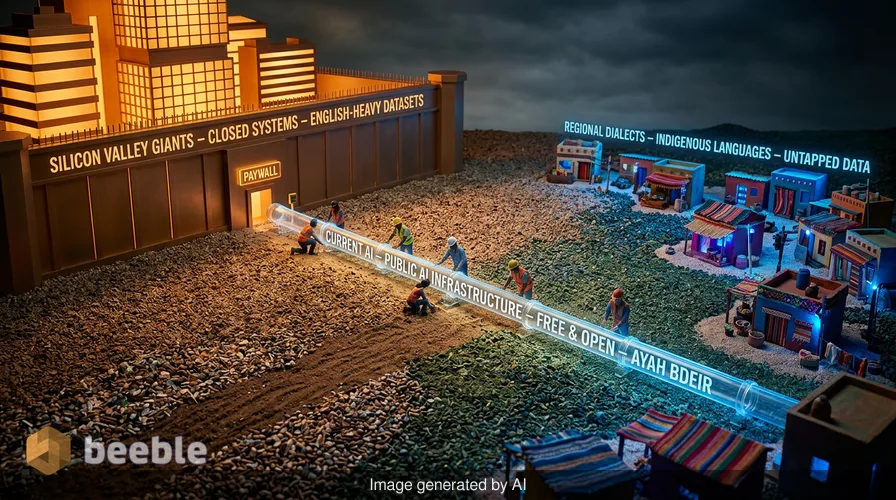
Would you trust a tool to manage your health or your crops if it struggled to understand your native dialect? This is the reality for billions of people. While the tech world celebrates the latest chatbots, a massive language gap remains. Most major artificial intelligence systems rely on English-heavy datasets. This leaves speakers of regional languages and Indigenous dialects out of the conversation. A nonprofit organization called Current AI is now attempting to fix this imbalance by building what it calls the World Wide Web of AI.
Historically, the internet grew because of open standards that anyone could use for free. Current AI aims to replicate this model for the age of machine learning. The organization launched in early 2025 with a clear mission. It wants to create public AI infrastructure that does not belong to a single corporation. This effort is led by Ayah Bdeir, the founder of the education tech company littleBits and a former lead for AI strategy at Mozilla. Her team is racing to provide a free, open alternative to the closed systems owned by Silicon Valley giants.
A pocket-sized solution for the global south
Practically speaking, the digital divide is often a language divide. In rural India, a farmer who notices a disease on her crops might search for a solution online. If she speaks a dialect that the internet ignores, she is effectively locked out of the most advanced knowledge available. To solve this, Current AI collaborated with Bhashini, a division of the Indian government. Together, they developed Suno Sutra. The name translates to listening chronicles in Hindi.
Suno Sutra is a small, handheld device that does not require an internet connection to function. It runs AI models locally in 22 different Indian languages. This is a departure from the way most people use AI today. Usually, your data travels to a massive server farm and back. By keeping the processing on the device, the system becomes a reliable tool for people in areas with poor connectivity. The project is open source. This means developers in any village or city can modify the software to fit their specific community needs.
Building the digital library of human culture
Language is the invisible backbone of any society. It is how traditions and identities survive over time. When a technology cannot speak a language, it risks erasing the culture that uses it. Ayah Bdeir notes that half of the world’s spoken languages face extinction. When English drives the development of every major AI, the nuances of smaller communities are lost. Current AI treats these languages as a public good rather than a product.
Looking at the big picture, the nonprofit is funding projects that preserve this cultural data. Last month, it distributed $3.2 million in grants to organizations in Kenya, Lebanon, and Brazil. In the Amazon, a group called Portal sem Porteiras is building offline tools for Indigenous communities. These tools allow elders to pass down ecological knowledge in their own tongues. The data stays within the territory. This prevents outside corporations from scraping the information to train commercial models without permission.
Moving beyond the Silicon Valley business model
Under the hood, the current AI industry relies on a specific financial structure. Companies like OpenAI, Google, and Anthropic are private entities. They must answer to investors and prioritize profit. This often leads to a focus on languages and regions with the most spending power. Current AI operates as a public-private partnership. It has secured $400 million in committed funding from sources like the French government, the Ford Foundation, and Salesforce.
These organizations act as funders rather than investors. They do not expect a financial return on their capital. This allows the nonprofit to prioritize public interest over stock prices. The goal is to create a system where improvements benefit the global population. This mirrors the early days of the web. No one owns the protocol for email or the basic structure of a website. Current AI believes the underlying logic of artificial intelligence should be just as accessible.
How the hardware works without the cloud
Most modern AI feels like magic because it uses immense computing power in the cloud. However, this dependency creates a bottleneck for the average user in a developing economy. It also raises concerns about who sees the data. Current AI is focusing on small language models that can run on modest hardware. These models are less power-hungry and more specialized.
| Feature | Commercial AI (Big Tech) | Public AI (Current AI) |
|---|---|---|
| Ownership | Private shareholders | Public interest/Open source |
| Data Storage | Centralized cloud servers | Local devices or community hubs |
| Language Focus | High-market value languages | Global South and Indigenous dialects |
| Access Cost | Subscription or data harvesting | Free for the end user |
| Connectivity | Requires stable internet | Functional offline |
By shrinking the size of these models, the technology becomes decentralized. A community in Kenya can run its own AI stack to manage local health records or farming schedules. This removes the need to pay a subscription to a company thousands of miles away. It also ensures that the AI understands local context, such as regional weather patterns or specific pests that a generic model might ignore.
The new coalition for open source software
Earlier this month at a summit in Geneva, the organization launched AlphaChat. This open-source chatbot was built in just seven weeks. It was not the work of a single lab. Instead, ten different organizations contributed to the project. Hugging Face provided the model framework, while Mozilla and the MIT Media Lab provided safety tools and computing resources. This collaborative approach shows that high-quality AI does not require a monolithic corporate structure.
Curiously, the nonprofit also teamed up with a Tokyo-based startup called Sakana AI. They are working on Sovereign AI. This refers to technology that is designed to support the specific language and culture of a nation. While the initial focus is on Japan, the partnership plans to expand this stack to the Global South. This gives nations a way to build their own digital intelligence without relying on foreign technology providers.
Why public infrastructure matters for your privacy
On the market side, the biggest concern for many users is data ownership. When you use a free chatbot today, you are often the product. Your conversations train the next version of the software. Current AI is testing different models where the user keeps control. One approach involves writing consent protocols directly into the software. This allows a community to halt data collection at any point.
None of the current projects have a perfect solution for data privacy yet. However, the organization is making the question of ownership a core part of the development process. In Lebanon, the Institute for Worldmaking is digitizing Arab cultural history. They are creating machine-readable databases that the community controls. This prevents a scenario where a private company owns the digital record of a nation's history.
Practical foresight for the everyday user
Essentially, the work being done by Current AI is a reminder that technology is not a force of nature. It is a set of choices made by people. For the average user, the rise of public AI infrastructure means more choices in the future. You may soon have the option to use a tool that is fast, local, and private, rather than one that requires a constant internet connection and a data-sharing agreement.
As AI becomes more integrated into daily life, you should observe which tools respect your context and which ones treat your culture as an afterthought. The bottom line is that a digital tool is only as useful as its ability to understand the person using it. By building a public alternative to corporate AI, organizations like Current AI are ensuring that the digital future has room for everyone, regardless of the language they speak or the country they call home.
Sources: TechCrunch, Current AI Project Documentation, Bhashini Government Initiative Records, AI for Good Global Summit Reports.



See you on the other side.
Our end-to-end encrypted email and cloud storage solution provides the most powerful means of secure data exchange, ensuring the safety and privacy of your data.
/ Create a free account
