


General motors might skip the cheap battery tech everyone else is buying

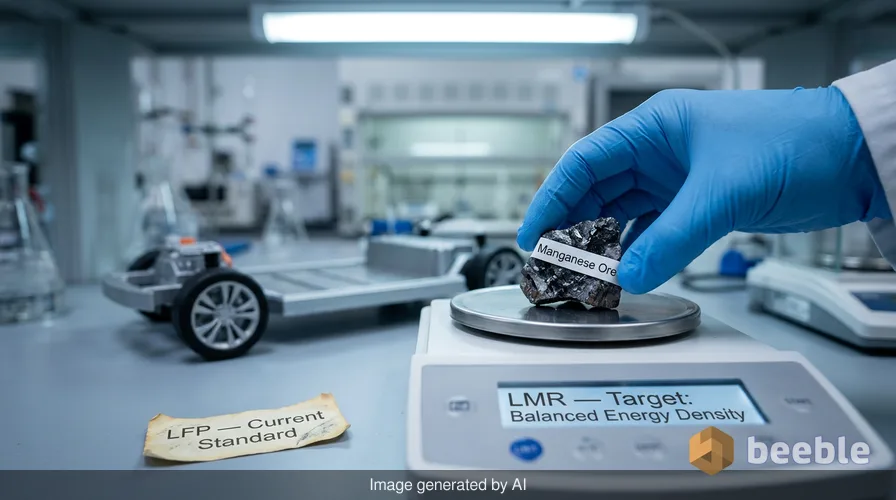
When you sit in the driver's seat of an electric car, you are essentially sitting on top of several hundred pounds of carefully balanced minerals. These metals determine how far you can drive, how fast you can charge, and how much the car costs to buy. For years, the auto industry has viewed the battery as the most expensive part of the vehicle. To fix this, many companies turned to iron. Lithium iron phosphate, or LFP, is the current favorite for entry-level electric cars because it is cheap and lasts for thousands of charges. However, General Motors is now signaling a change in direction that moves away from that iron-heavy path. The company is looking at a different mix of materials that could change the math of electric vehicle ownership.
At the center of this shift is a battery chemistry called lithium manganese-rich, or LMR. While rivals like Tesla and Ford are doubling down on iron-based batteries to lower prices, General Motors is betting that manganese is the better ingredient for the American market. This decision is not just about the cost of the raw materials. It is a calculated move to balance the weight of the car with the distance it can travel on a single charge. Heavy industry is the invisible backbone of modern life, and the choices made in these battery labs eventually dictate what kind of value you get for your trade-in five years from now.
Why iron became the industry standard
To understand why General Motors is considering a different path, we have to look at why everyone else is using iron. Most early electric cars used batteries rich in nickel and cobalt. These materials are excellent at storing energy in small spaces, but they are expensive and the supply chains are volatile. Nickel prices often swing wildly based on global politics. Cobalt mining also faces significant ethical and environmental scrutiny.
Chinese battery manufacturers found a solution in LFP. By using iron and phosphate, they created a battery that is significantly cheaper to produce. These batteries are also incredibly resilient. They do not catch fire as easily as nickel-based batteries and can be charged to 100% every day without wearing out quickly. This is why the base models of the Tesla Model 3 and various Ford Mustang Mach-E versions now use LFP. The trade-off is weight. Iron is heavy and does not store as much energy as nickel. To get a long driving range with an LFP battery, you need a much larger and heavier battery pack. For a heavy SUV or a pickup truck, this weight becomes a systemic problem for the vehicle's efficiency.
The manganese contender enters the ring
General Motors has spent more than a decade working on LMR as an alternative. Manganese is an abundant and inexpensive mineral. In terms of cost, making an LMR battery in the United States is roughly the same as making an LFP battery. The advantage lies in the energy density. An LMR battery can store more electricity in the same amount of space and weight compared to an iron-based battery.
Essentially, LMR offers the range of a premium nickel battery at the price of a budget iron battery. This is a disruptive prospect for the mass market. If General Motors can successfully move this chemistry from the lab to the factory, it could produce electric SUVs that are lighter and travel further than those of its competitors without a price increase. Kurt Kelty, the head of battery technology at General Motors, recently suggested that LFP may not even earn its way into the company's vehicle lineup. This is a bold stance when the rest of the world is rushing toward iron.
Solving the density problem without the cost
Under the hood, the choice of LMR is a play for efficiency. A lighter battery means the car needs less energy to move. It also means the suspension and brakes do not have to work as hard to manage the weight of the vehicle. For the average user, this translates to a car that feels more nimble and potentially uses less electricity per mile.
However, LMR has a historical weakness that has kept it out of cars until now. These batteries tend to lose their strength after repeated use. This is often called voltage fade. While an iron battery might last for 3,000 charge cycles, early versions of LMR struggled to maintain their performance over the lifespan of a vehicle. General Motors claims its development is on schedule, which suggests the company believes it has solved these durability issues. If the company is correct, LMR becomes the workhorse of its fleet, powering everything from compact crossovers to large haulers.
The manufacturing pivot in tennessee
This shift in chemistry has immediate consequences for how General Motors builds its batteries. The company has a massive joint-venture plant in Tennessee that was originally expected to produce LFP cells for cars. As of June 2026, that factory is starting production, but the destination for those iron-based cells has changed. Instead of going into the floors of new electric cars, those LFP batteries are being diverted to energy storage systems.
Energy storage systems are the large battery banks used by utility companies to store solar and wind power. In that environment, the weight of the battery does not matter because the battery is not moving. The long life and safety of iron are perfect for stationary storage. By using the Tennessee plant for this purpose, General Motors can still utilize its investment while focusing its vehicle efforts on LMR. This allows the company to keep its supply chain streamlined and domestic, which is a key factor in qualifying for federal tax credits.
What this means for the second-hand car market
From a consumer standpoint, the choice between LFP and LMR is a choice between two different types of value. An LFP-powered car is like a reliable old hammer. It might be heavy, and it might not have the longest reach, but it will work exactly the same way in ten years as it does today. This makes iron-based electric cars very attractive for people who plan to keep their vehicles for a decade or more.
LMR is more of a high-performance tool. It gives you the long driving range that many Americans demand, especially for road trips and cold weather. The risk for the consumer is the unknown long-term health of the battery. If LMR batteries degrade faster than LFP, the resale value of these cars could be more volatile. Buyers will need to pay close attention to the battery health reports when these vehicles eventually hit the used market. General Motors is banking on the idea that most drivers prioritize 300 miles of range today over a twenty-year battery lifespan.
Choosing range over durability
Looking at the big picture, General Motors is attempting to solve the biggest hurdle to electric vehicle adoption: the price-to-range ratio. Most people are hesitant to buy an electric car if it cannot travel at least 250 miles on a charge, but they also do not want to pay a premium for a massive nickel battery. By focusing on manganese, General Motors is trying to find a middle path.
This strategy is transparent in its goals. The company wants to produce high-volume, affordable cars that do not feel like a compromise in terms of range. While rivals are focusing on the durability and safety of iron, General Motors is prioritizing energy density and weight reduction. This is a classic industrial trade-off. Historically, the company that provides the most utility for the lowest price wins the mass market. If manganese is indeed the secret ingredient that makes electric cars lighter and cheaper, General Motors will have a significant advantage over its competitors.
Ultimately, you should look beyond the sticker price when shopping for an electric vehicle in the coming years. The chemistry inside the battery will tell you more about the car's future than the horsepower numbers. A move toward LMR suggests that we are entering an era where electric cars are designed for specific uses rather than being one-size-fits-all. You might choose an iron-based car for your daily commute and a manganese-based car for family trips. This diversification of technology is a sign that the industry is maturing. The focus is shifting from simply making an electric car work to making it fit the specific needs of different types of drivers.
Sources:
Reuters, S&P Global Mobility, General Motors Investor Relations, Department of Energy Battery Technologies Office.



See you on the other side.
Our end-to-end encrypted email and cloud storage solution provides the most powerful means of secure data exchange, ensuring the safety and privacy of your data.
/ Create a free account
