


Is a real person actually making your AI assistant's phone calls?

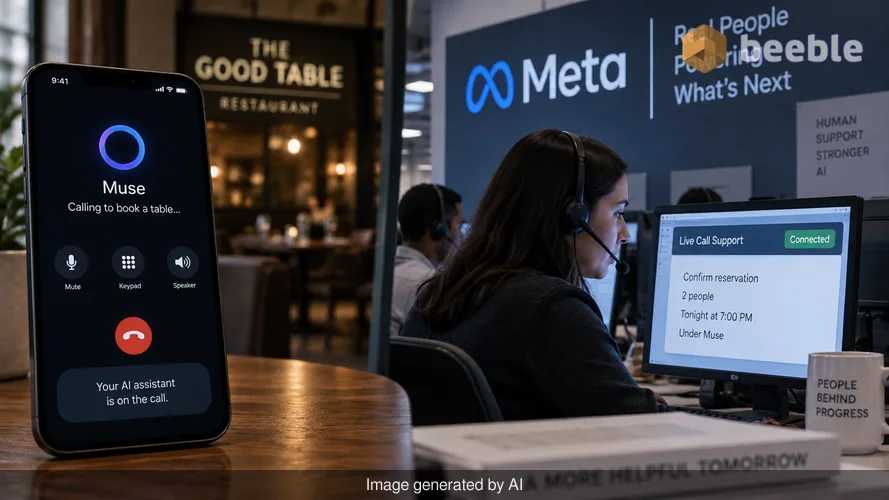
Have you ever wondered why your digital assistant sounds a little too capable when it calls a restaurant to book a table? Most users assume a complex web of code is doing the heavy lifting. However, Meta's recent internal tests for its new personal AI agent, Muse, reveal a more manual reality. The company is using human contractors to handle certain phone calls that the digital agent is supposed to manage on its own. While the tech industry often markets AI as a tireless intern capable of infinite tasks, these tests show that the human touch is still the secret sauce behind the scenes.
Internal company posts seen by Reuters indicate that Meta told its employees about this human concierge test just last week. The timing is notable because it follows the public launch of a phone calling feature for Muse. This practice involves human contractors in call centers quietly stepping in to complete tasks when the AI reaches its limits. For the average user, this raises a fundamental question about where the automation ends and human surveillance begins.
The wizard behind the digital curtain
In simple terms, Muse is designed to act as a bridge between your digital life and the physical world. If you need a hair appointment or a dinner reservation, you tell the AI, and it makes the call. Behind the jargon, this process relies on natural language processing to understand your request and voice synthesis to speak to the person on the other end. But voice AI still struggles with the messy, unpredictable nature of human conversation. A busy restaurant owner with a thick accent or a noisy background can easily confuse an algorithm.
When the software falters, Meta routes the call to a human contractor. This person hears the conversation and finishes the task on behalf of the AI. The goal is to ensure the user gets their reservation, even if the technology is not quite ready for prime time. This method is common in the tech industry, often referred to as a Wizard of Oz test. The user sees a seamless automated experience, but a human is pulling the levers behind a curtain to make it work.
Why privacy concerns are surfacing in the office
Looking at the big picture, the use of human contractors introduces significant privacy risks. Meta employees have raised alarms in internal forums about the sensitive information that might pass through these calls. When you ask an AI to call your doctor’s office or a pharmacy, you are sharing health data. If a human contractor is on the other end of that line, they may hear your full name, birth date, and medical requirements.
Meta spokesperson Daniel Roberts says the company is working with merchants to improve the feature. He notes that the feedback from employees is positive and helps the company implement safety protections. However, the risk of sensitive data leaking to call center contractors is a tangible problem. These contractors are often third-party workers who do not have the same long-term stakes in the company as full-time engineers. Historically, similar programs at other tech giants have led to contractors listening to private moments, from domestic arguments to confidential business deals.
The recurring ghost in the machine
This is not the first time a tech company has used humans to masquerade as AI. Years ago, a startup called M was Meta’s first attempt at a hybrid assistant. It relied heavily on human workers to complete tasks that the software could not handle. Eventually, Meta shut down M because the model was not scalable. Hiring thousands of people to act as an AI's brain is expensive and slow. The fact that Muse is returning to this strategy shows that the gap between AI capability and human expectation is still wide.
Practically speaking, the tech industry uses these methods to gather data. By watching how humans handle difficult calls, Meta can train its Muse models to be more resilient. Each time a contractor steps in, the system records the interaction and uses it as a lesson for the next software update. From a consumer standpoint, you are not just a customer. You are a source of training data for a product that is still in its infancy.
What this means for your data and budget
Under the hood, the cost of human labor is high. If Meta continues to use a human concierge, it may eventually charge for premium tiers of the Muse service. AI is cheap to run at scale, but call centers are not. If you use Muse for free, you should expect that your data is the payment. Every call you place through an AI agent is a data point that Meta owns.
For the everyday user, the immediate impact is a need for caution. When a service is in a testing phase, the privacy walls are often thinner. If you use Muse to handle logistics, consider the sensitivity of the information you provide. You should avoid using AI agents for calls that involve:
- Financial details or credit card numbers.
- Medical appointments and health history.
- Private residential addresses or security codes.
- Sensitive legal or professional discussions.
Ultimately, the technology is a tool, not a person. It lacks the ethical judgment to know when to stop recording or when to discard a piece of private information. The presence of a human contractor adds another layer of eyes and ears to your personal business.
Moving toward a more transparent AI
Meta says it will only roll out the feature publicly when it has the proper disclosures. This transparency is foundational for user trust. Currently, the test serves as a reminder that the digital crude oil of our era is personal data. As Muse evolves, the company must be clear about exactly who is on the line. If a human is involved, the user has a right to know before they start speaking.
Zooming out, this story is a reality check for the AI boom. We are in a volatile period where the marketing for AI often outpaces the engineering. While Muse might seem like a leap into the future, it is still tethered to traditional human labor. The invisible backbone of the modern tech world remains the thousands of contractors who fix the mistakes that algorithms make.
Practically speaking, you should watch your digital habits as these agents become more common in your apps. The next time you ask an AI to make a call, remember that there might be a person in a call center somewhere in the world taking notes. You are not just talking to a machine. You are interacting with a complex, half-human system that is still learning how to handle your private life.
Sources: Internal Meta communications reported by Reuters, official statements from Meta spokesperson Daniel Roberts.



See you on the other side.
Our end-to-end encrypted email and cloud storage solution provides the most powerful means of secure data exchange, ensuring the safety and privacy of your data.
/ Create a free account
