


Meta is Turning Its Employees Into the Digital Crash Test Dummies of the AI Era

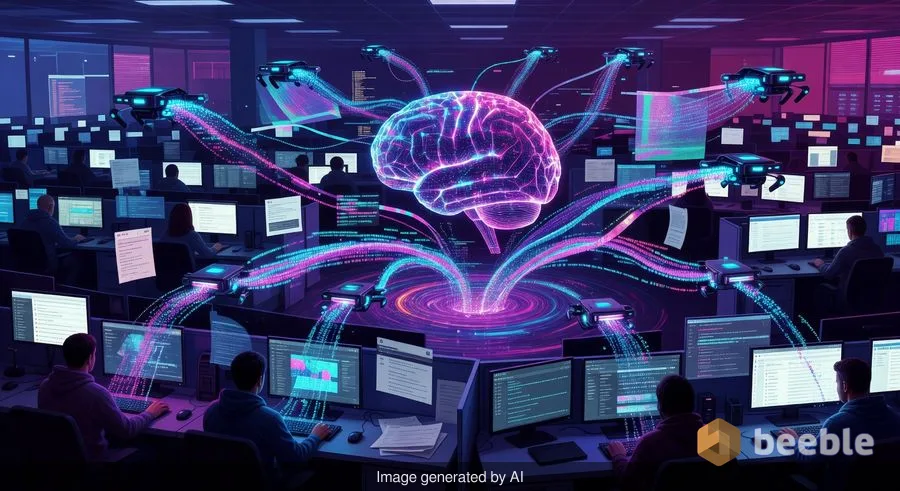
While popular narratives often suggest that the greatest hurdle for artificial intelligence is a lack of high-quality human literature or complex coding logic, the reality is far more granular and, frankly, much closer to the bone. The industry has reached a point where reading all the books in the world is no longer enough. To move to the next level, AI needs to learn how to move. It needs to know how we click, how we hesitate, and how we navigate the labyrinthine menus of modern software.
In a recent development first reported by Reuters, Meta has confirmed it is now using its own workforce as a living laboratory. By recording the keystrokes and mouse movements of its employees, the social media giant is attempting to bridge the gap between an AI that can write a poem and an AI that can actually use a computer on your behalf. Looking at the big picture, this isn't just a quirky internal experiment; it is a fundamental shift in how the digital crude oil of our era is extracted.
The Shift from What We Say to How We Do
For the last several years, the AI revolution has been fueled by text. Large Language Models (LLMs) like GPT-4 or Meta’s own Llama were trained on the collective output of the internet—blogs, Reddit threads, digitized books, and open-source code. This created a generation of AI that is incredibly articulate but essentially paralyzed. It can tell you how to book a flight, but it cannot open a browser, navigate to a travel site, select the dates, and click the 'buy' button for you.
To build what the industry calls 'agentic' AI—tools that act as a tireless intern capable of performing multi-step digital tasks—developers need a different kind of data. They need a roadmap of human intent expressed through peripheral devices. Essentially, Meta is looking for the 'connective tissue' of digital work. When an employee clicks a dropdown menu, pauses for two seconds, and then selects a specific sub-option, they are providing a lesson in logic that text alone cannot convey.
Behind the jargon, this is about teaching machines the physical rhythm of software. While a human sees a 'Submit' button, the computer sees a coordinate on a screen. By capturing millions of these interactions, Meta hopes to build models that understand the systemic relationship between a user's goal and the clicks required to achieve it.
Under the Hood: The Internal Mechanics of Data Harvesting
Meta’s approach involves a new internal tool designed to capture inputs across specific applications. According to the company, this includes everything from mouse movements and button clicks to the way employees navigate nested menus. From a tech architecture standpoint, this is a massive telemetry project. Imagine every twitch of a cursor being converted into a data point that helps a neural network understand that a certain icon represents 'edit' while another represents 'delete.'
Practically speaking, this data is incredibly high-resolution. It’s not just about the final action; it’s about the path taken to get there. For the average user, this might seem like overkill, but for a machine, the 'wrong' moves are just as educational as the 'right' ones. If an employee accidentally clicks the wrong tab and immediately corrects it, the AI learns about common human errors and how to avoid them.
Meta has been quick to point out that there are safeguards in place to protect sensitive content. They claim the data is not used for performance reviews or any purpose other than training. However, the line between 'training data' and 'surveillance' is becoming increasingly opaque. When a company records every single mechanical interaction an employee has with their workstation, the traditional boundaries of workplace privacy begin to dissolve.
Scavenging the Digital Archives
This move by Meta is part of an overarching trend: the desperate hunt for new data sources. Recently, reports emerged of 'zombie' startups and defunct companies having their corporate communications—think years of Slack archives and Jira tickets—scavenged and sold to AI developers. To put it another way, your old office banter and project management complaints are being recycled into the brains of tomorrow’s digital assistants.
| Data Type | Traditional Source | Emerging Source (The "New" Data) |
|---|---|---|
| Knowledge | Wikipedia, Books, News | Internal Slack channels, Jira tickets |
| Logic | Research papers, Code | Employee keystroke logs, clickstreams |
| Communication | Public forums, Social media | Private corporate emails, archived chats |
| Interaction | User feedback, App reviews | Real-time mouse telemetry, hover patterns |
This shift highlights a volatile tension in the industry. As the supply of public, high-quality text dries up, tech giants are turning inward or looking toward private silos. The result is a robust but potentially intrusive new methodology. If a company can’t find enough data on the open web, they will simply manufacture it by observing their own people in real-time.
What This Means for the Everyday Consumer
While this story focuses on Meta’s internal staff, the implications for the broader public are tangible. We are likely entering the final stages of the 'freemium' era of data. Currently, Meta is using its own employees because it’s legally simpler and provides a controlled environment. However, once these models are refined, the next logical step is to roll out these tracking features to a broader audience—perhaps under the guise of 'improving user experience' or 'personalized AI assistance.'
For the average user, the bottom line is that your digital behavior is now more valuable than your digital content. It’s no longer just about what you post on Instagram; it’s about how you use the app. How long do you hover over a specific ad? Which sequence of buttons do you press to report a bug? This information is becoming the foundational layer for the next generation of intuitive software.
Looking at the market side, this also signals a new era of competition. Companies with large workforces and proprietary software ecosystems—like Microsoft, Google, and Meta—have a massive advantage. They have a built-in, captive audience of 'trainers' who are being paid to generate the very data that might eventually automate parts of their own jobs. It is a cyclical process that is both impressive and slightly unsettling.
The Future of the Human-AI Interface
Curiously, this move suggests that the future of AI isn't just about being 'smart'; it's about being 'handy.' We are moving away from the AI as a search engine and toward the AI as a digital limb. To reach that goal, companies are willing to push the envelope on privacy and data collection.
Ultimately, the democratization of tech usually comes with a hidden tax. In the early 2000s, that tax was our personal information for targeted ads. In the 2020s, the tax appears to be our mechanical habits. By watching Meta employees today, these models are learning the nuances of human intent so they can anticipate our needs tomorrow.
As we look forward, it’s worth considering how this changes our relationship with our tools. If every click is a lesson for a machine, our computers are no longer just static objects; they are pupils. This realization should urge us to observe our own digital habits more closely. Are we using our devices, or are we inadvertently training our replacements?
From a consumer standpoint, the best approach is one of resilient skepticism. As these 'agentic' features begin to appear in your favorite apps, remember that the seamless, intuitive experience they provide was likely built on the back of thousands of tracked keystrokes. The transparency of these data practices will remain a key battleground in the years to come, as we decide exactly how much of our 'digital exhaust' we are willing to hand over in exchange for a slightly more efficient Tuesday.
Sources:
- Reuters: Internal Report on Meta AI Data Strategies
- TechCrunch: Meta Spokesperson Statement on AI Training Tools
- MarketWatch: Analysis of Data Scarcity in Large Language Models
- Industrial AI Quarterly: The Rise of Action-Based Neural Networks



See you on the other side.
Our end-to-end encrypted email and cloud storage solution provides the most powerful means of secure data exchange, ensuring the safety and privacy of your data.
/ Create a free account
