


Old Masters, New Methods: How AI and Green Chemistry are Rewriting the History of Art Restoration

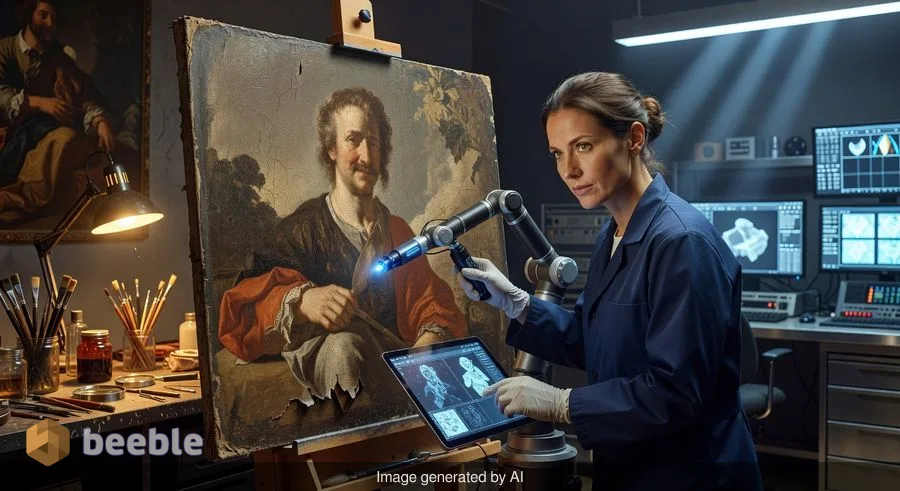
The Software Archaeology of the Renaissance
Have you ever had to inherit a codebase so old and undocumented that it felt more like an archaeological dig than a programming task? I remember a particular project early in my career—a monolithic legacy system that had been patched, hacked, and ‘optimized’ by dozens of developers over fifteen years. Every time we peeled back a layer of poorly commented logic, we found a deeper, more fragile foundation underneath. Essentially, we weren't just coding; we were performing software archaeology.
Art restorers face a remarkably similar challenge, though their ‘legacy systems’ are five-hundred-year-old canvases and their ‘technical debt’ is centuries of oxidized varnish and misguided previous repairs. For decades, this work was a slow, precarious battle of attrition involving toxic solvents and microscopic scalpels. Nevertheless, we are currently witnessing a paradigm-shifting era where technology is acting as a bridge between the brushstrokes of the past and the algorithms of the future. From AI-generated masks to eco-friendly nanogels, the tools of the trade are becoming as sophisticated as the masterpieces they protect.
Training the Digital Apprentice: AI and Neural Inpainting
One of the most disruptive developments in the field is the rise of artificial intelligence as a ‘digital apprentice.’ In the past, if a 15th-century painting had a significant loss of pigment, a restorer would have to spend weeks manually researching the artist’s style to hypothesize what the missing section looked like. Today, AI-generated masks are transforming this three-month process into a three-hour task.
By training neural networks on the complete oeuvre of an artist—essentially raising an apprentice on a diet of high-resolution scans—AI can suggest ‘inpainting’ solutions that match the specific brushwork, color palette, and chemical aging patterns of the original creator. Curiously, this isn't about the AI actually painting the canvas. Instead, it provides a non-invasive digital blueprint. Restorers use these AI masks to visualize the end result before a single drop of pigment is applied, reducing the ‘engineering vs. product tug-of-war’ that often occurs when deciding how much of a historical gap should be filled.
Green Chemistry and the Rise of Nanogels
If AI is the brain of modern restoration, then green chemistry is its immune system. For years, the standard method for removing grime involved volatile organic solvents that were as dangerous to the restorer’s lungs as they were potentially volatile to the paint layers. In practice, choosing a solvent was a high-stakes gamble; one wrong move could dissolve the original glaze.
Consequently, scientists have developed a new generation of eco-friendly cleaning gels derived from renewable materials. These hydrogels act like a sophisticated, sleek delivery system. Rather than flooding a surface with liquid, these gels release moisture in a controlled, scalable manner, lifting dirt and oxidized varnish without penetrating the vulnerable paint layers beneath. To put it another way, if traditional solvents are a fire hose, these nanogels are a precision-engineered irrigation system. They are robust enough to tackle centuries of soot but nuanced enough to leave the artist's original intent untouched.
Seeing Through Time: Hyperspectral Imaging
We often think of a painting as a static image, but it is actually a multifaceted stack of historical decisions. Much like a developer looking at the Git history of a file, art historians want to see the ‘commits’ the artist made before the final version was finished. This is where hyperspectral and infrared imaging come into play.
By capturing light outside the visible spectrum, these tools allow us to see through layers of paint to the underdrawings below. We might find that a somber portrait originally featured a hidden smile, or that a landscape once contained a figure that was later painted over. This isn't just a gimmick; it’s vital for identifying losses of paint hidden below the surface. Knowing exactly where the ‘bugs’ are in the physical structure of the painting allows restorers to apply a seamless patch rather than a broad, unnecessary overhaul. It turns the restoration process from a guessing game into a data-driven science.
The Human Element in a High-Tech Workshop
Despite these innovative leaps, the ‘3 AM production incident’ of art restoration—a chemical reaction going sideways or a structural failure—remains a constant threat. Technology, for all its power, is not a replacement for the human eye. The most successful institutions, like the Louvre and the Met, treat technology as an ecosystem rather than a silver bullet.
I’ve often found that in tech, we talk about the ‘Rubber Duck Moment’—that epiphany you get when explaining a problem to a static object. In restoration, the AI often serves as that rubber duck. It offers a perspective that the human eye, clouded by hours of staring at a single square inch of canvas, might miss. Oddly enough, the more advanced our tools become, the more we realize how remarkable the original ‘analog’ creators truly were. Our code might become obsolete in five years, but their pigments have survived half a millennium.
The Future of the Past
As we look toward the end of the decade, the integration of these technologies will only deepen. We are moving toward a future where every major artwork has a ‘digital twin’—a comprehensive, data-rich model that tracks its physical health in real-time. This isn't just about fixing what is broken; it’s about preventative maintenance. By using sensors to monitor the ‘wild west’ of gallery environments, we can intervene before a crack even forms.
Art restoration is no longer just a craft; it is a cutting-edge intersection of heritage and hardware. For those of us who spend our days building the future, there is something deeply grounding about using those same skills to save the past.
What to do next:
- Explore: Visit the digital archives of the Rijksmuseum’s ‘Operation Night Watch’ to see high-resolution imaging in action.
- Learn: Look into the ‘Nanorestore’ projects to understand how nanotechnology is replacing toxic chemicals in conservation.
- Support: Many local museums are digitizing their collections; consider volunteering your tech skills for metadata tagging or digital archiving projects.
Sources
- The Getty Conservation Institute: Research on cleaning of paintings and green chemistry.
- Rijksmuseum: Documentation on 'Operation Night Watch' and AI-driven reconstruction.
- Journal of Cultural Heritage: Studies on hyperspectral imaging and neural inpainting in art.
- MIT Technology Review: Reporting on AI’s role in historical preservation.



See you on the other side.
Our end-to-end encrypted email and cloud storage solution provides the most powerful means of secure data exchange, ensuring the safety and privacy of your data.
/ Create a free account
