


Perplexity’s massive Indian giveaway reveals the true price of digital habits

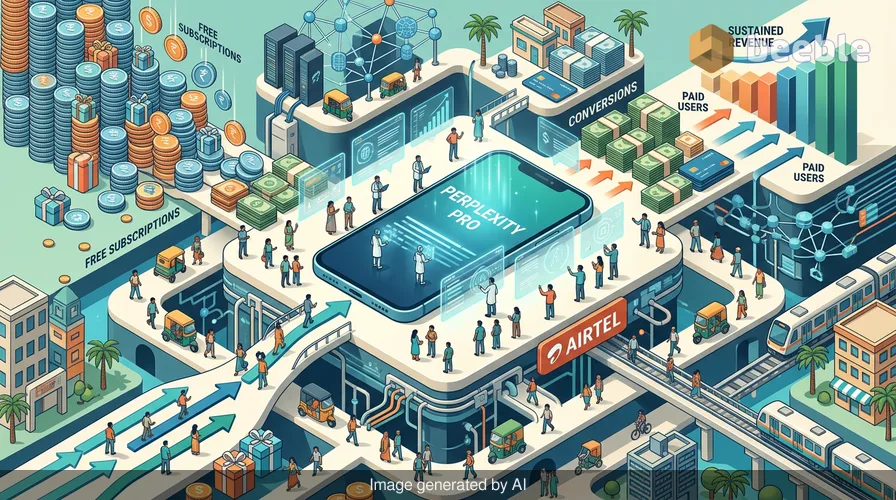
The standard belief in global technology circles is that Indian consumers will use a service only as long as it is free. For years, companies have treated the region as a high-volume, low-revenue market where users hop from one promotional offer to the next. However, the results from Perplexity’s massive experiment with telecom giant Airtel suggest this narrative is changing. By giving away a $200 premium service to hundreds of millions of people, the AI startup did more than just inflate its user count. It created a habit that a significant number of people now seem willing to pay for.
Looking at the big picture, this was one of the largest growth experiments in the history of generative artificial intelligence. In July 2025, Perplexity partnered with Airtel, India’s second-largest carrier, to offer a free 12-month Pro subscription to its 360 million customers. At a time when AI companies are burning billions on computing power, giving away their most valuable product for free seemed like a risky bet. Now that the first wave of those free subscriptions is expiring in August 2026, we have the first real evidence of how many people will actually open their wallets for a tireless intern that lives on their phone.
A year of unlimited answers for 360 million people
The scale of the initial surge was massive. When the offer launched, Perplexity saw 5.9 million app downloads in India in a single month. This was a 625% jump from the month prior. To put this in perspective, the company had accumulated only 5.4 million downloads in the entire first half of 2025. Over the seven months the offer was available, total downloads hit 56 million. This was not just a side effect of a general interest in AI. While Perplexity’s numbers went vertical, downloads for competitors like ChatGPT and Claude remained relatively flat.
For the average user, this was an irresistible deal. A Perplexity Pro subscription offers access to advanced models like GPT-4o and Claude 3.5 Sonnet, plus the ability to upload documents and generate images. By bundling this with a standard mobile plan, Airtel and Perplexity removed the biggest barrier to entry for advanced AI: the cost. In a market like India, where mobile data is cheap but software subscriptions are often viewed as a luxury, this giveaway acted as a gateway to high-end digital tools for millions of students, researchers, and professionals.
The sharp drop that did not kill the momentum
Naturally, the boom in new users slowed down once the signup window closed in January 2026. Data from Sensor Tower shows that downloads fell by over 90% between February and July compared to the peak promotion period. Skeptics often point to this kind of drop as proof that promotional growth is hollow. If people stop downloading the app the moment the freebie disappears, it suggests the brand has no staying power.
Practically speaking, however, the more important metric is usage, not just downloads. Monthly active users peaked at 22 million in October 2025. By July 2026, that number was 14 million. While this is a 37% decline from the peak, it is still five times higher than the user base Perplexity had before the Airtel deal began. This indicates that a core group of users found enough value in the AI tool to keep it on their home screens long after the initial novelty wore off. These are the users who transitioned from occasionally asking a question to making the tool a regular part of their workflow.
Following the money through the auto-renewal gate
The most surprising part of the data is the revenue trend. Even as downloads cratered and the total number of active users shrank, the money Perplexity made in India actually went up. Between February and mid-August 2026, in-app purchase revenue rose by about 60%. Even more telling is the period from mid-July to mid-August, when the very first Airtel users reached the end of their free year. During this time, daily revenue was 27% higher than the average for the first half of the year.
Under the hood, there is a nuance to this financial success. The free subscriptions were set to auto-renew. This means that if a user did not manually go into their settings and cancel the service before the 12-month mark, their saved payment method was charged. It is difficult to know how much of this revenue comes from people who genuinely want to keep the service and how much comes from people who simply forgot to cancel their trial. Regardless, the result for Perplexity is a massive increase in net mobile revenue, which grew from $34,000 in January 2025 to over $156,000 by July 2026.
The AI land grab across the Indian subcontinent
Perplexity is not the only player using this strategy. The Indian market is currently the site of a high-stakes land grab. OpenAI recently launched a free version of its ChatGPT Go plan for a year in the country. Google also struck a deal with Reliance Jio, India's largest telecom provider, to offer its AI Pro service free for 18 months. These companies are not just looking for users. They are looking for data and habit formation.
On the market side, India is now the world's largest market for generative AI app downloads. Because the population is so large and the internet is so accessible, the country serves as a laboratory for AI companies to see how their tools perform at scale. The goal is to turn the AI into the new search engine — a foundational tool that people use so often they eventually feel that paying for it is a necessity rather than an option. Perplexity was simply the first to reach the finish line of its first major giveaway, making it the canary in the coal mine for the rest of the industry.
The everyday reality of the paid AI transition
For the consumer, this experiment highlights a shifting relationship with software. Historically, we have been comfortable with the idea that "if you aren't paying for the product, you are the product." With AI, the cost of running the service is so high that companies cannot afford to give it away for free forever. The era of the permanent free tier for high-end AI is likely coming to an end, replaced by these long-term promotional hooks that eventually lead to a monthly bill.
What this means for you is a need for better subscription hygiene. As more services follow the Perplexity and Airtel model, your mobile bill or app store account could quietly accumulate charges for AI "interns" you signed up for a year ago. Practically speaking, the value of these tools is real, but the price of convenience is a recurring fee that many users are only now beginning to notice. As the later groups of Airtel users reach their renewal dates over the coming months, we will see if Perplexity can maintain its revenue growth or if users will flee once the bill finally arrives.
Ultimately, the Perplexity experiment proves that you can buy a massive audience with a free offer, and you can even keep a significant portion of them around. Whether you can turn that audience into a profitable business in a price-sensitive market is still the billion-dollar question that every AI company is trying to answer.
Sources
- Sensor Tower mobile app intelligence reports for 2025-2026.
- Appfigures market analysis on Perplexity, ChatGPT, and Claude downloads.
- TechCrunch reporting on Perplexity and Airtel partnership dynamics.
- Official company announcements regarding OpenAI and Google Jio partnerships in India.



See you on the other side.
Our end-to-end encrypted email and cloud storage solution provides the most powerful means of secure data exchange, ensuring the safety and privacy of your data.
/ Create a free account
