


The anatomy of a withdrawal freeze: when the glass bank vault slams shut

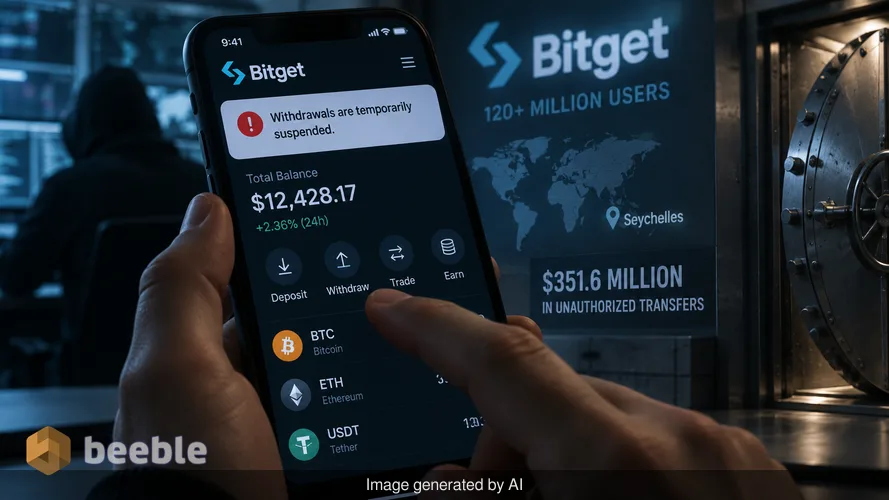
The app opens. The balance appears. The screen refreshes. You tap the withdraw button. Nothing happens. The screen is static. A notification banner slides down from the top. Withdrawals are temporarily suspended. This is the exact moment when the abstract idea of a cyberattack becomes a tangible financial reality for an individual. It is the moment the glass bank vault slams its heavy door.
Bitget, one of the largest cryptocurrency exchanges in the world with over 120 million users, recently faced this scenario. On Thursday, the company noticed unauthorized transfers from its internal wallets. The total loss sits at approximately $351.6 million. In response, CEO Gracy Chen announced a total pause on customer withdrawals. The company remains based in the Seychelles and serves a global audience that relies on these digital gateways for daily transactions. While Chen maintains that all user funds are safe and the loss is covered by Bitget’s own reserves, the incident exposes the fragile link between personal digital ownership and institutional custody.
The morning your digital wallet goes quiet
For a retail investor, a crypto exchange often feels like a standard banking app. You check your balance while waiting for coffee. You move funds to pay for a weekend trip. The interface is smooth. The buttons work. In everyday terms, the exchange acts as a convenient layer over a complex technological system. But when a hack occurs, that layer of convenience vanishes. The user experiences a sudden loss of agency. You own the assets, yet you cannot touch them.
Financially speaking, this creates a specific kind of anxiety. It is not just about the value of the assets. It is about the loss of liquidity. Liquidity is the ability to turn an asset into spendable cash quickly. When an exchange freezes withdrawals, your liquidity drops to zero. You might have $10,000 on your screen, but you cannot use it to pay your rent or buy groceries. This friction highlights the inherent risk of keeping assets in a centralized location. The exchange provides the tools, but it also holds the keys.
Inside the mechanics of an unauthorized transfer
Cybercriminals move fast. They exploit small vulnerabilities in code or social engineering gaps to access private keys. These keys are the digital signatures required to move money on the blockchain. Once the attackers gain access, they initiate transfers to wallets they control. In this specific case, the $351.6 million vanished in a series of rapid movements. These transfers are permanent. There is no "undo" button on a public blockchain.
Bitget identified these transfers on a Thursday. The security team triggered a manual override. They halted the outflow of all assets. This action is a standard emergency protocol. It prevents the attackers from draining more funds. However, it also traps the funds of every legitimate user. The exchange must then conduct a forensic audit. They check every wallet. They verify the integrity of their security layers. Consequently, the user waits. The "security precaution" mentioned by Gracy Chen is a necessary clinical step, but it feels like a systemic failure to the person on the other side of the screen.
The persistent shadow of the billion dollar heist
Zooming out, this event is part of a larger pattern in the digital asset market. Hackers target exchanges because that is where the money is concentrated. Last year, the exchange Bybit lost $1.5 billion in a similar breach. The FBI later linked that specific theft to North Korean hacking groups. These groups use sophisticated methods to bypass traditional firewalls. They treat crypto exchanges as high-value targets in a global game of digital cat and mouse.
North Korea denies these allegations. Yet, the data from blockchain analytics firms often points to their door. Criminals move stolen cryptocurrency across borders in minutes. They use automated tools to mix the funds and hide their origin. They avoid the mainstream financial system entirely. This behavior creates a systemic challenge for regulators. In the traditional banking world, a bank robbery involves physical barriers and local police. In the crypto world, a $350 million heist happens in a quiet office in one country while the victims sleep in another. The interconnected nature of the internet makes every exchange a neighbor to potential attackers.
When the protection fund becomes a psychological anchor
Bitget claims the loss is covered by its own funds. Many large exchanges now maintain a Protection Fund or a Secure Asset Fund for Users. These are pools of capital set aside to act as insurance during a crisis. The existence of these funds is a psychological necessity. They reassure the market that the exchange is solvent. They prevent a mass panic that could lead to a permanent bank run.
In practice, these funds are the exchange's way of saying they have enough skin in the game. They use their own profits to buffer the mistakes of their security teams. Bitget’s move to cover the $351.6 million loss is an attempt to maintain trust. If a user believes the exchange will pay them back, they are less likely to leave the platform once withdrawals resume. Trust is the primary currency of any financial institution. Once it is gone, the technology behind the platform no longer matters. The Protection Fund is the emergency brake on a runaway train of fear.
The illusion of instant liquidity in a central exchange
At its core, the Bitget hack reveals the paradox of the "glass bank vault." The blockchain itself is transparent. Anyone can look at the ledger and see the $351.6 million moving to an unauthorized address. The vault is glass; we can see the money leaving. However, the exchange is the entity that holds the physical key to that vault. When you use a centralized exchange, you are not interacting with the blockchain directly. You are interacting with a private company that promises to interact with the blockchain on your behalf.
This distinction is vital for everyday financial health. Many people buy crypto for the promise of decentralization. They want to move away from the control of central banks. Yet, by keeping funds on an exchange, they move into the control of a different central authority. This authority has its own rules, its own security flaws, and its own power to stop you from accessing your wealth. The exchange is a bridge, but the bridge has a toll booth and a gate that can be locked at any moment.
Reclaiming control in a world of digital gatekeepers
On an individual level, these events serve as a reminder to evaluate how we store our value. We often trade security for convenience. It is easier to keep money on an exchange than it is to manage a private hardware wallet. We trust the institution because we do not want the responsibility of being our own bank. But that trust comes with a price. When the exchange fails, the individual pays that price in time, anxiety, and lost opportunity.
Practically speaking, the Bitget hack is a prompt for financial mindfulness. It is a moment to look at your digital accounts and ask how much of your wealth is behind someone else's gate. Diversification is not just about which coins you buy. It is also about where you keep them. Spreading assets across different storage methods reduces the impact of a single failure. It ensures that a Thursday morning notification does not become a personal financial catastrophe.
Ultimately, the financial system is moving toward more transparency, but the path is not a straight line. Market corrections and security breaches are like forest fires. They clear out the dead wood of weak code and poor management. They force companies to build better structures. For the user, the lesson is to remain observant. The digital wild west is becoming more regulated and more insured, but the risk of the "greyed out button" remains a structural reality of the modern age.
Food for thought
- How would a 48-hour freeze on your primary liquid assets change your immediate living situation?
- Does the convenience of a centralized app outweigh the security of a private wallet for your specific financial goals?
- How much of your trust in a financial platform is based on their marketing versus their historical response to a crisis?
- When was the last time you verified the insurance or protection policies of the platforms that hold your money?
Sources
- Bitget Corporate Press Release and CEO Statement via X.
- Reuters Market Data and Security Incident Reporting.
- FBI Cyber Division Annual Report on Cryptocurrency Thefts.
- Blockchain Analytics Data regarding Bybit 2025 Breach.



See you on the other side.
Our end-to-end encrypted email and cloud storage solution provides the most powerful means of secure data exchange, ensuring the safety and privacy of your data.
/ Create a free account
