


The end of the patch cycle as a reliable defense

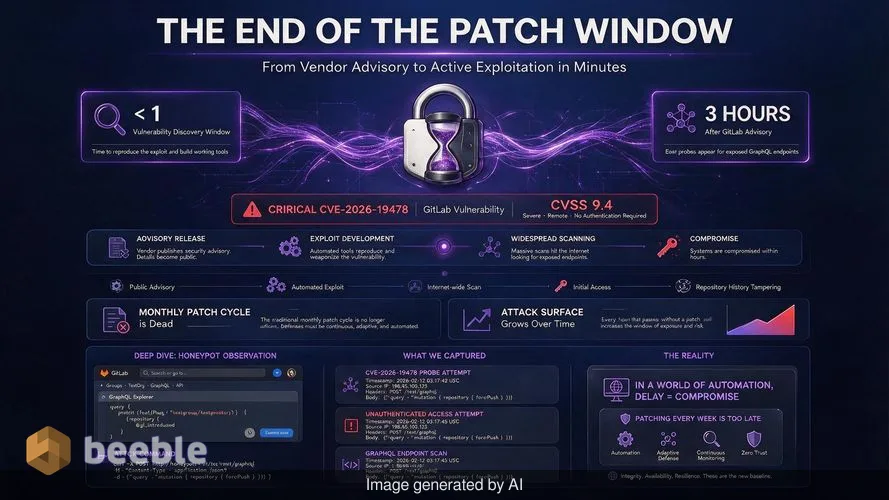
Do you know exactly how long it takes your team to move a security update from a vendor advisory into a production environment? If your answer is measured in weeks or even days, your defensive posture is already obsolete. The disclosure of CVE-2026-19478 in GitLab proves that the window between a vulnerability release and active, widespread exploitation has vanished. Security researchers and malicious actors now use automated tools to reproduce exploits within minutes of a patch release. This reality turns the traditional monthly patch cycle into a liability.
I spent yesterday evening reviewing the logs from a small honeypot network I maintain for research purposes. Within three hours of the GitLab security advisory, the first probes for GraphQL endpoints appeared. These were not manual attempts by curious researchers. They were automated scans seeking to verify the presence of the @gl_introduced directive in the API. This vulnerability carries a CVSS score of 9.4 because it allows an unauthenticated attacker to rewrite the history of a repository. It is a direct assault on the integrity of the software supply chain.
The architecture of a code injection flaw
The technical failure behind CVE-2026-19478 exists within the GitLab GraphQL API. Specifically, the flaw involves how the system processes certain directives. Directives in GraphQL are used to change the execution behavior of a query or to provide additional metadata to the server. In this case, an attacker can craft a malicious directive that the server executes without verifying the permissions of the requester. This is a classic example of an architectural paradox where a feature designed for flexibility becomes a gateway for unauthorized access.
Because the vulnerability requires no authentication, anyone with network access to the GitLab instance can send these requests. The exploit does not rely on complex memory corruption or obscure configurations. It is a logic flaw in the API handler. When an attacker sends a specially crafted GraphQL request, they gain the ability to modify or delete projects that are publicly accessible. In some scenarios, this capability extends to rewriting repository data, which allows an attacker to alter the source code itself without leaving a trace in the standard user audit logs.
Why supply chain integrity is the real victim
We often focus on data theft during a breach, but this vulnerability targets integrity. If an attacker deletes a repository, the damage is obvious and usually recoverable from backups. The more insidious risk is the ability to forge merge records. In a modern DevOps environment, the merge record is the digital signature that says a piece of code was reviewed and approved. If an attacker can forge these records, they can inject malicious code into a project and make it appear as if a trusted maintainer approved the change.
This bypasses the fundamental premise of peer review. An attacker could introduce a back door into a production application, and the security team would see a clean audit trail. This transforms the repository from a source of truth into a toxic asset. When you cannot trust the history of your code, every deployment becomes a gamble. The ability to ban project maintainers adds a layer of denial-of-service to the attack, as it prevents legitimate users from reclaiming control of their projects during an active incident.
The arrival of the ai-accelerated threat
Security researchers at watchTowr observed that AI tools now compress the time required to weaponize a vulnerability. In the past, a sophisticated exploit might take days to develop after a patch was reverse-engineered. Now, large language models and automated code analysis tools can identify the delta between a vulnerable version and a patched version almost instantly. This allows attackers to generate functional exploit code before most organizations have even finished reading the security advisory.
This speed creates a systemic problem for defenders. If an attacker can automate the reproduction of a flaw, they can launch global scan-and-exploit campaigns before a human administrator has time to log into a server. We are moving toward a state where the only effective defense is an automated one. Relying on manual intervention for mission-critical patches is no longer a viable strategy for internet-facing infrastructure.
Forensic indicators and log hunting
For organizations running self-hosted GitLab instances, the first step is to check for signs of unauthorized activity. You must search your web server logs and GitLab application logs for specific strings related to the exploit. The most prominent indicator is the presence of the @gl_introduced directive in requests sent to the /api/graphql endpoint. If you see this string in your logs accompanied by a 200 OK response status from an unauthenticated IP address, you must assume the instance is compromised.
Beyond simple log searching, you should audit the recent merge history of your public projects. Look for commits or merges that occurred outside of normal business hours or from accounts that do not usually contribute to those specific repositories. Because the exploit allows for the forgery of records, you may need to compare the local git history of your developers against the server-side history to identify discrepancies. Any difference in commit hashes between the developer's machine and the server is a red flag for history rewriting.
Immediate mitigation and structural defenses
If you have not yet updated your GitLab instance, you are at extreme risk. The vulnerability affects Community Edition and Enterprise Edition versions starting from 18.2. Specifically, if you are running any version between 18.2 and 18.11.10, 19.0.7, 19.1.5, or 19.2.3, you are vulnerable. The fix is available in versions 18.11.11, 19.0.8, 19.1.6, and 19.2.4. Patching is the only permanent solution to this issue.
| Affected Version Range | Minimum Patched Version |
|---|---|
| 18.2 to 18.11.10 | 18.11.11 |
| 19.0.0 to 19.0.7 | 19.0.8 |
| 19.1.0 to 19.1.5 | 19.1.6 |
| 19.2.0 to 19.2.3 | 19.2.4 |
In cases where immediate patching is impossible due to strict change management policies, you must implement temporary countermeasures. The most effective workaround is to restrict access to the /api/graphql endpoint at the reverse proxy or firewall level. You should limit access to this endpoint to known, trusted IP addresses or require a valid VPN connection. Additionally, changing public projects to internal or private status reduces the attack surface, as the exploit primarily targets projects that are accessible without authentication.
The necessity of a zero trust approach to devops
Securing a development environment is like managing a VIP club where the bouncer checks ID at every internal door. We can no longer assume that the internal network is safe or that the API is robust enough to handle malicious input. A zero trust architecture for DevOps requires that every action, especially those involving repository modification, is verified against a strong identity provider. This incident shows that even a well-maintained platform like GitLab can harbor flaws that bypass traditional security boundaries.
To build a resilient defense, organizations should move away from long-lived credentials and toward short-lived, identity-based access tokens. They should also implement mandatory code signing. If every commit must be signed with a developer's private key, an attacker rewriting history on the server will be unable to produce valid signatures for their forged commits. This creates a technical barrier that remains effective even if the platform itself is compromised.
Summary of defensive actions
To protect your environment from CVE-2026-19478 and similar AI-accelerated threats, you should take the following steps immediately:
- Upgrade GitLab CE/EE to version 19.2.4, 19.1.6, 19.0.8, or 18.11.11.
- Scan web logs for the string
@gl_introducedto identify attempted or successful exploitation. - Restrict unauthenticated access to the
/api/graphqlendpoint using a web application firewall or reverse proxy. - Audit public projects for unexpected changes in membership, merge history, or repository settings.
- Enable mandatory commit signing to ensure the integrity of the source code history.
Waiting for the next scheduled maintenance window is no longer a safe option. The speed of the modern threat actor requires a reactive speed that matches the pace of automation. If your infrastructure is internet-facing, the time to act is now.
Sources
- GitLab Security Advisory (2026-08-17)
- watchTowr Labs: Vulnerability Reproduction Report on CVE-2026-19478
- MITRE ATT&CK Framework: T1190 (Exploit Public-Facing Application)
- NIST Special Publication 800-204: Security Strategies for Microservices-based Applications
Disclaimer
This article is for informational and educational purposes only. The information provided does not replace a professional cybersecurity audit, forensic investigation, or incident response service. Always follow your organization's security policies and consult with qualified professionals before making structural changes to your network.



See you on the other side.
Our end-to-end encrypted email and cloud storage solution provides the most powerful means of secure data exchange, ensuring the safety and privacy of your data.
/ Create a free account
