


The grand illusion of free connection and the growing movement to reclaim the internet

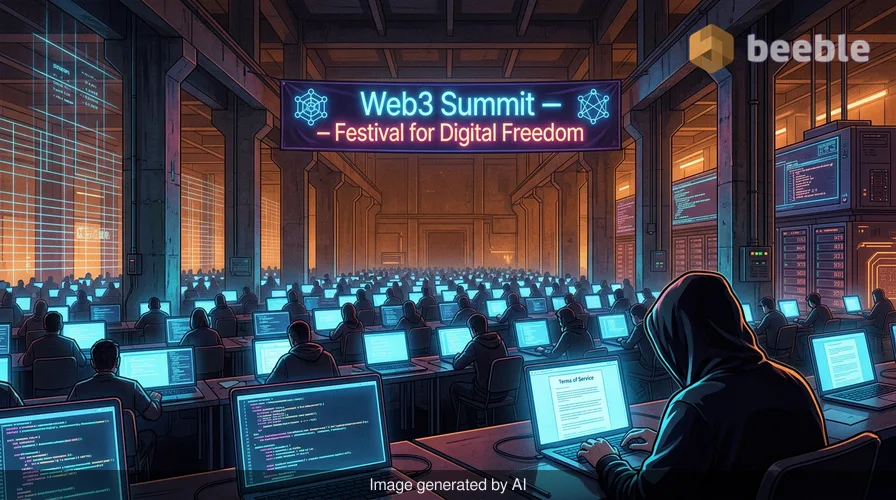
The air inside the Kraftwerk building in Berlin has a specific weight. It is the smell of cold concrete, old industrial grease, and the faint ozone of hundreds of high-end laptops running at full capacity. This cavernous former power station now hosts the Web3 Summit, a gathering that its organizers call a festival for digital freedom. On the surface, it looks like any other tech conference. People in black hoodies carry reusable water bottles. They gather around whiteboards to scribble lines of code that look like modern hieroglyphics. Behind the scenes of this trend is a visceral sense of exhaustion with the current state of the digital world.
The internet began as a sprawling promise of borderless knowledge where every voice had a platform and every user was a pioneer in a digital frontier of infinite possibilities. This vision persists in our marketing materials and political speeches unless we examine the architecture of the apps that occupy our waking hours. Real connection requires a subscription. Discovery is algorithmically curated. Freedom is inevitably constrained by the terms of service of three or four global corporations. This is the digital illusion. We feel like masters of our screens, yet we are data tenants on land we do not own.
The cost of a digital ghost
In everyday terms, we often treat our digital presence as a series of fleeting interactions. We post a photo, like a comment, or search for a symptoms of a cold. These actions feel ephemeral. Linguistically speaking, we use the word "free" to describe the services that facilitate these moments. Bill Laboon, the vice president of technical operations at the Web3 Foundation, challenges this vocabulary. He argues that personal data is one of the most valuable assets in the modern economy. Over a digital lifetime, a person gives approximately $162,000 worth of value to companies without knowing it. This is a staggering realization for the average user.
We are essentially walking data mines. Every click and every pause in our scrolling history is a resource for extraction. This process is often opaque. As artificial intelligence becomes more pervasive, the stakes for this data ownership increase. AI models require massive amounts of information to function. Laboon notes that the danger in AI is the data it gets from the individual. The summit focuses on building systems where the technology does not know your specific identity. This is a shift from a culture of blind trust to one of verifiable truth. The phrase "less trust, but more truth" is a key theme here. It suggests that we should rely on mathematics and code rather than the promises of corporate CEOs.
From markets to technofeudalism
On a macro level, the debate is about the power structures that govern our society. Yanis Varoufakis, the economist and former Greek finance minister, provides a sharp sociological critique of our current path. He argues that we have moved past traditional capitalism into a phase he calls technofeudalism. In this system, big tech companies do not just compete in a market. They own the market itself. They are the digital lords who charge rent to everyone else.
This shift creates a profound sense of atomization. We are connected through these platforms, but we are isolated in our interactions with them. Each user sits in their own hall of mirrors, seeing a version of reality that the algorithm chooses for them. Varoufakis remains skeptical that technology alone can fix this problem. He states that every political regime that favors the few over the many requires democratic action. Through this lens, blockchain and decentralized tools are useful only if they are part of a broader social movement. The technology is a tool, not a savior. It is a way to build infrastructure that is harder for a single entity to control.
The archipelago of collective code
While some see Web3 as a playground for financial speculation, others view it as a site for social experimentation. Joshua Davila, who operates under the name The Blockchain Socialist, looks at the technology from a different angle. He believes blockchain can help communities build new forms of collective ownership. He draws inspiration from the solidarity economy, such as cooperative banks and credit unions. In practice, this means building applications where interest generated from money supports local causes rather than distant shareholders.
This is a move away from the hyper-individualism of the early crypto era. Instead of focusing on how a single person can get rich, these developers ask how a community can sustain itself. Paradoxically, the very technology that many associate with extreme capitalism is now used to explore socialist and cooperative models. This is an attempt to turn the digital world from a series of private fiefdoms into a collective archipelago. Each project is a small island of autonomy that connects to others through shared protocols. These systems prioritize the needs of the many over the profits of the few.
The sociological shift in our daily routines
Zooming out, we can see how these technical debates reflect a deeper change in our habitus. Our daily routines are now inextricably linked to digital systems. We no longer just use the internet; we live inside it. This creates a state of liquid modernity, a concept developed by Zygmunt Bauman. Life is characterized by constant change and the erosion of stable structures. Our jobs, our relationships, and our identities are all mediated through screens that we do not control.
This leads to a pervasive sense of anxiety. We know that our data is being used, but we feel powerless to stop it. The movement to reclaim the internet is a response to this feeling of helplessness. It is a systemic effort to build an anchor in the middle of digital chaos. By moving data ownership back to the individual, Web3 proponents hope to give people a sense of permanence and agency. They want to turn the user from a passive product back into an active participant. This is a fundamental change in the social contract of the digital age.
Reclaiming the digital self
Ultimately, the summit in Berlin is about more than just blockchain or AI. It is about the human desire for autonomy in an increasingly automated world. We are at a crossroads where we must decide if we are comfortable being tenants in our own lives. The struggle for data ownership is a struggle for the right to exist without constant surveillance. It is a demand for a digital world that respects the complexity of the human experience.
As we navigate these changes, it is helpful to look at our own digital habits. We can ask ourselves who benefits from our attention and our data. We can seek out tools that prioritize privacy and collective well-being. This does not require a complete withdrawal from society. It requires a more mindful engagement with the systems we use every day. The goal is to build an internet that serves as a tool for human flourishing rather than a mechanism for extraction. This is a difficult path, but it is a necessary one if we want to remain the masters of our own stories.
Food for thought
- Consider the digital services you use for free. What is the actual price you pay in terms of personal information and attention?
- How would your daily routine change if you had full control over the data you generate?
- Reflect on the difference between being a consumer of a platform and a member of a digital community.
- Question the degree to which your online experiences are shaped by algorithms versus your own conscious choices.
Sources:
- Web3 Foundation. Technical operations and data value reports.
- Varoufakis, Y. Technofeudalism: What Killed Capitalism.
- Davila, J. The Blockchain Socialist. Research on the solidarity economy and decentralized finance.
- Bauman, Z. Liquid Modernity.
- Zuboff, S. The Age of Surveillance Capitalism.
- Web3 Summit Berlin. 2026 Proceedings and thematic documentation.



See you on the other side.
Our end-to-end encrypted email and cloud storage solution provides the most powerful means of secure data exchange, ensuring the safety and privacy of your data.
/ Create a free account
