


The Illusion of the Private Prompt: Why Your Teen’s AI Chats Are No Longer a Secret

For a teenager in 2026, the smartphone is less of a communication device and more of a private sanctuary—a digital bedroom where the door is always locked and the curtains are permanently drawn. Within this sanctuary, Meta AI has become a ubiquitous companion, serving as a homework tutor, a fashion consultant, and a sounding board for late-night existential queries. To the teen, these interactions feel ephemeral and isolated; to the parent, they have long been a black box of unknown influences.
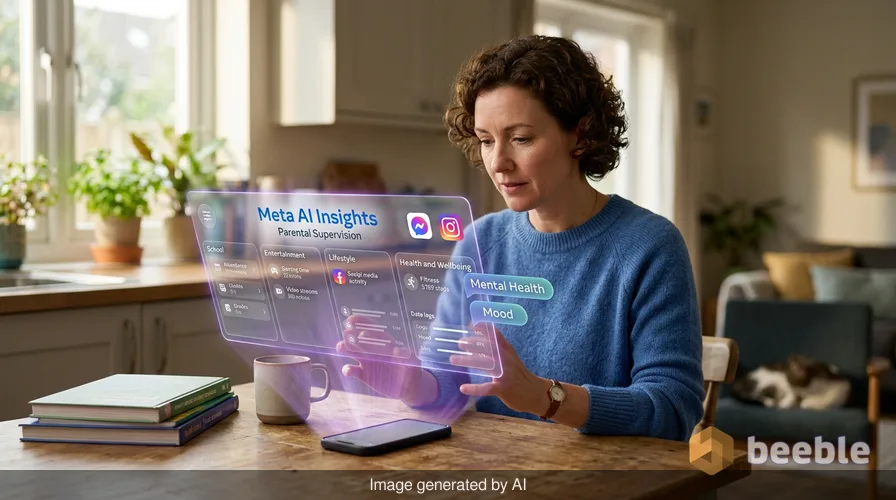
Meta’s recent rollout of “Insights” within its supervision hub marks a profound shift in this dynamic. For the first time, parents in the U.S., U.K., and other major markets can see a categorized summary of what their children are discussing with the company’s flagship AI. While the interface is streamlined and ostensibly helpful, it represents a significant pivot in how we conceive of digital privacy for minors. The silent agreement that a conversation with a machine is a private act is being rewritten; the engineering of the chat interface is being reconfigured to include a third, invisible seat at the table for parental oversight.
The Shift from Human to Machine Supervision
In the early days of social media, the primary concern for parents was the "anonymous stranger"—a flesh-and-blood predator lurking in the fragmented corners of chat rooms. Today, the concern has shifted toward the algorithm itself; parents are less worried about who their children are talking to and more concerned with what the generative model is feeding back to them. Meta’s new tools reflect this evolution in anxiety. By providing a weekly breakdown of topics—ranging from "School" and "Entertainment" to more sensitive areas like "Health and Wellbeing"—Meta is attempting to bridge a gap that has grown wider as AI integration has become more robust.
Technically speaking, this feature does not offer a full transcript of the conversation, which would likely trigger a massive user revolt among privacy-conscious Gen Alpha and Gen Z users. Instead, it relies on semantic categorization to distill hundreds of messages into high-level metadata. Meta’s business motive is clear: by offering parents a window into the AI’s influence, they hope to mitigate the mounting pressure from regulators; simultaneously, their engineering execution must remain lightweight enough to avoid the clunky experience of a full-scale surveillance suite.
Under the Hood: The Metadata of a Conversation
To understand how these insights work, we have to look at the way modern large language models (LLMs) handle data. When a teen asks Meta AI for advice on a fitness routine or help with a history essay, the system doesn't just process the text for an answer. Behind the screen, the prompt is analyzed, tokenized, and often categorized for safety and performance reasons. Meta is now surfacing these internal classifications to the Supervision Hub.
Think of it as a restaurant where the parent cannot see the actual meal being eaten, but the waiter provides a receipt showing the food groups consumed. The parent knows their child had "Protein" and "Vegetables," but they don’t know if it was a steak or a salad. In this analogy, Meta’s APIs act as the restaurant waiters, relaying specific data points from the kitchen (the AI model) to the customer (the parent). This middle-ground approach is a pragmatic attempt to balance child safety with a semblance of user autonomy, yet it highlights how deeply our personal data is being parsed even in seemingly casual interactions.
The Legal Catalyst and the Death of AI Characters
This update didn't emerge from a vacuum; it is a direct response to a legacy of litigation that has finally caught up with the social media giant. Historically, Meta operated under a “move fast and break things” philosophy that prioritized engagement over almost everything else. Paradoxically, this same drive for engagement led to the launch of “AI characters”—digital personas voiced by celebrities like Snoop Dogg and Paris Hilton—which were specifically designed to foster parasocial relationships with users.
However, the technical debt of safety proved too high. Following a landmark lawsuit in New Mexico where Meta was held legally liable for child safety failures, the company abruptly suspended teen access to these interactive characters. The removal of these personas wasn't just a content update; it was a fundamental admission that the company could not yet guarantee a safe environment for minors within a role-playing AI framework. Consequently, the new “Insights” tool is a more sanitized, controlled version of AI interaction—one where the machine is an assistant first and a personality second.
The Illusion of Choice in the Walled Garden
There is a certain irony in Meta providing “suggested conversation starters” for parents. While the company provides the tools for oversight, it also dictates the vocabulary of the supervision. This is the essence of ecosystem lock-in: Meta provides the AI, the chat platform, and the supervision tools, creating a closed loop where all interaction is mediated by their proprietary code.
As a developer might observe, this is a form of “soft” governance. Instead of blocking access to the AI entirely—a move that would hurt Meta’s daily active user metrics—they have created a more transparent, albeit curated, window. Through this user lens, the feature feels like a helpful addition to a parent’s toolkit; however, from a software architecture standpoint, it is a sophisticated method of data labeling that serves both the user and the company’s internal safety metrics. The subcategories under "Lifestyle," such as fashion and food, are the same labels used to build advertising profiles, reminding us that in a proprietary ecosystem, safety and data harvesting often share the same technical foundation.
The Challenge of Nuance in Algorithmic Labels
One of the most profound issues with topic-based reporting is the loss of nuance. When a parent sees that their teen has been discussing "Mental Health" with Meta AI, it could mean anything from a query about stress-management techniques to a deeper, more concerning cry for help. The software is designed to be streamlined, but human emotion is famously fragmented and messy.
If the AI miscategorizes a benign joke about a "toxic" video game character as a "Health and Wellbeing" concern, it creates unnecessary digital friction between the parent and the child. Conversely, if a truly dangerous conversation is buried under the generic label of "Entertainment," the tool provides a false sense of security. This is the inherent risk of relying on automated insights: the code is resilient and fast, but it lacks the human context required to understand the weight of a conversation. Ultimately, we are trusting a set of algorithms to summarize the inner lives of our children, a task that no amount of robust engineering can fully master.
Reclaiming the Human Connection
Zooming out to the industry level, Meta’s move is likely to become the de facto standard for all AI providers. As we move away from the wild-west era of generative models, we are entering a phase of “regulated intimacy,” where our interactions with AI are monitored not just by the companies themselves, but by our social circles and legal guardians. This isn't necessarily a negative shift—safety is a non-negotiable requirement for software used by minors—but it does change the nature of the tool.
| Feature | Old Model (Pre-2025) | New Model (Post-2026) |
|---|---|---|
| Teen AI Access | High (Celebrity Personas) | Controlled (Utility Assistant) |
| Parental Visibility | Zero (Private DMs) | High (Topic-level Insights) |
| Regulatory Stance | Reactive | Proactive/Compliant |
| Primary Goal | Engagement/Time Spent | Safety/Supervised Utility |
In everyday terms, this update reminds us that there is no such thing as a truly private conversation with a corporate-owned AI. Every prompt is a data point, and every data point is now a potential report for a parent to review. While Meta AI might feel like a friend, it is actually a highly sophisticated, multi-layered software product that must answer to shareholders, regulators, and now, the dinner table.
Ultimately, parents should view these "Insights" not as a replacement for conversation, but as a prompt for it. The real value isn't in the data Meta provides, but in the human dialogue it might spark. Rather than just checking the Supervision Hub to see if a teen is talking about "Lifestyle" or "Travel," the most resilient approach is to ask them directly why they find the AI useful in the first place. As we navigate this new era of supervised intelligence, we must remember that while code can categorize our topics, it cannot understand our motivations. The goal of technology should be to facilitate connection, not just to provide a dashboard for monitoring it.
Sources:
- Meta Newsroom Official Release: "New Tools to Help Parents Guide Teens’ AI Experiences."
- Legal Filings: State of New Mexico v. Meta Platforms, Inc. (Child Safety Liability Case).
- Meta AI Developer Documentation: Privacy and Safety Guidelines for Generative AI.
- Industry Report: The Evolution of Parental Control Systems in LLM Ecosystems (2025-2026).



See you on the other side.
Our end-to-end encrypted email and cloud storage solution provides the most powerful means of secure data exchange, ensuring the safety and privacy of your data.
/ Create a free account
