


The invisible brain in your tractor is keeping global food prices from spiraling

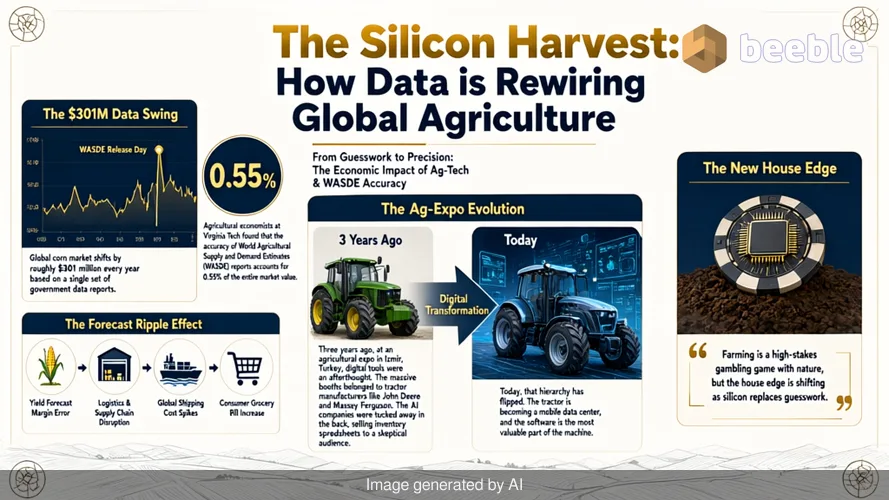
The global corn market shifts by roughly $301 million every year based on a single set of government data reports. Agricultural economists at Virginia Tech found that the accuracy of World Agricultural Supply and Demand Estimates (WASDE) reports accounts for 0.55% of the entire market value. When yield forecasts are off by even a small margin, the cost ripples through logistics, shipping, and eventually your grocery bill. Farming is a high-stakes gambling game with nature, but the house edge is shifting as silicon replaces guesswork.
Three years ago, at an agricultural expo in Izmir, Turkey, digital tools were an afterthought. The massive booths belonged to tractor manufacturers like John Deere and Massey Ferguson. The AI companies were tucked away in the back, selling inventory spreadsheets to a skeptical audience. Today, that hierarchy has flipped. The tractor is becoming a mobile data center, and the software is the most valuable part of the machine.
The end of farming by intuition
For centuries, crop monitoring relied on a farmer’s gut feeling. A farmer walked the rows, looked at the leaves, and guessed if a fungus was taking hold or if pests were moving in. By the time a human eye spots a yellowing leaf or a chewed stem, the damage is often systemic. The infestation is already winning.
Modern monitoring uses drones and satellite imagery to feed computer-vision models. These systems identify heat signatures and color changes invisible to humans. They detect fungal outbreaks days before a physical symptom appears. When farmers combine this with soil sensors, they stop treating the whole field with chemicals. They apply protection only where the data shows a problem. This targeted approach reduces chemical runoff and lowers the overhead costs of a harvest.
Yield forecasting as a logistics engine
Predicting the future is a requirement for a functional food supply. Farmers must book trucks, silos, and retail contracts months before the first plant leaves the ground. If a harvest is smaller than expected, the farmer pays penalties for empty shipping containers. If it is larger, the excess food often rots because there is no way to move it.
Syngenta recently developed a generative AI model that predicts yields with 95% accuracy. The system does more than count ears of corn. It provides seed placement recommendations based on historical weather patterns and soil composition. Accurate forecasting allows farmers to frontload their logistics. They provide retailers with precise numbers, which reduces the waste that typically inflates consumer prices. The Virginia Tech study showed that yield estimates alone contribute $188 million in annual value to the corn market by narrowing the gap between supply and demand.
Robots are taking the labor out of the rows
Agricultural robotics is moving faster than the development of self-driving cars in cities. A field is a controlled environment compared to a busy intersection, making it the perfect laboratory for automation. John Deere is currently transitioning its fleet toward full autonomy, but smaller, specialized machines are already doing the heavy lifting.
Carbon Robotics produces a machine called the LaserWeeder. It has 24 lasers, 36 cameras, and 24 NVIDIA GPUs. It identifies and destroys up to 10,000 weeds every minute across 100 different crop types. The system trained on 150 million plant images collected across 15 countries. In the past, weeding required intensive manual labor or heavy herbicide use. This robot eliminates the need for both. It moves through a field and zaps weeds with thermal energy, leaving the crops untouched. This shift from chemicals to lasers is a foundational change in how organic and conventional food reaches the shelf.
Precision irrigation and the science of water
Water is the most volatile resource in modern industry. Historically, irrigation was a blunt instrument. A farmer turned on the pumps based on a schedule or a simple rain gauge. Sensor-fusion systems now combine data from soil moisture probes, canopy temperature sensors, and hyper-local weather forecasts to automate the process.
These systems are cutting water use by 30% in large-scale deployments. In Indian sugarcane fields, this specific technology led to a 40% gain in yield despite using significantly less water. By keeping the plant in a state of optimal hydration rather than a cycle of flooding and drying, the quality of the produce improves. For the consumer, this translates to more resilient supply chains in regions prone to drought. The audit trails created by these systems also help farmers meet new environmental regulations without hiring a team of consultants.
Wearable technology for the barn
Managing a large livestock operation makes individual animal care difficult. A sick cow might not show physical symptoms until it is too late to treat it without heavy antibiotics. Livestock AI uses wearable sensors, similar to a fitness tracker for humans, to monitor heart rates and movement patterns.
Accelerometers and biometric monitors catch signs of illness days before a fever or a cough appears. This allows a veterinarian to isolate one animal rather than treating an entire herd with preventative medicine. Retailers and consumers are increasingly demanding meat and dairy produced with fewer antibiotics. This technology provides the transparency needed to verify those claims. It improves animal welfare and reduces the risk of drug-resistant bacteria entering the food chain.
The bottom line for your budget
AI in the field acts as a tireless intern, processing millions of data points that no human could manage. While the technology sounds expensive, its primary purpose is to remove the massive costs of waste and uncertainty.
For the average person, these industrial changes are mostly invisible until you look at the price of a loaf of bread or a gallon of milk. When robots reduce the need for expensive herbicides and AI reduces the amount of rotted grain in a silo, the floor price of food stabilizes. The shifting climate makes traditional farming methods less reliable every year. These digital tools are the only way to maintain current production levels without drastically increasing costs. You might not see the drones or the lasers, but you will notice the availability of fresh produce during a drought year.
Sources: National Corn Growers Association, Virginia Tech Department of Agricultural and Applied Economics, Syngenta Group, Carbon Robotics, John Deere Forestry and Agriculture.



See you on the other side.
Our end-to-end encrypted email and cloud storage solution provides the most powerful means of secure data exchange, ensuring the safety and privacy of your data.
/ Create a free account
