


The Quiet Disappearance of Technical Sovereignty and the Rise of the AI Public Stake

In the mid-twentieth century, the collective imagination was fueled by the construction of physical commons—great public libraries, sprawling transit networks, and shared electrical grids that promised a unified path forward; today, that same imagination feels increasingly atomized, fractured by the invisible borders of proprietary software and the opaque logic of private algorithms. While our ancestors wrestled with the tangible monopolies of steel and oil, we find ourselves drifting within a digital archipelago—densely packed with data but isolated by the terms of service that dictate our every interaction. The shift from public infrastructure to private platforms has been so subtle that we barely noticed when the ground beneath our feet became a subscription service, yet the current discourse in Washington and Brussels suggests we are reaching a systemic tipping point.
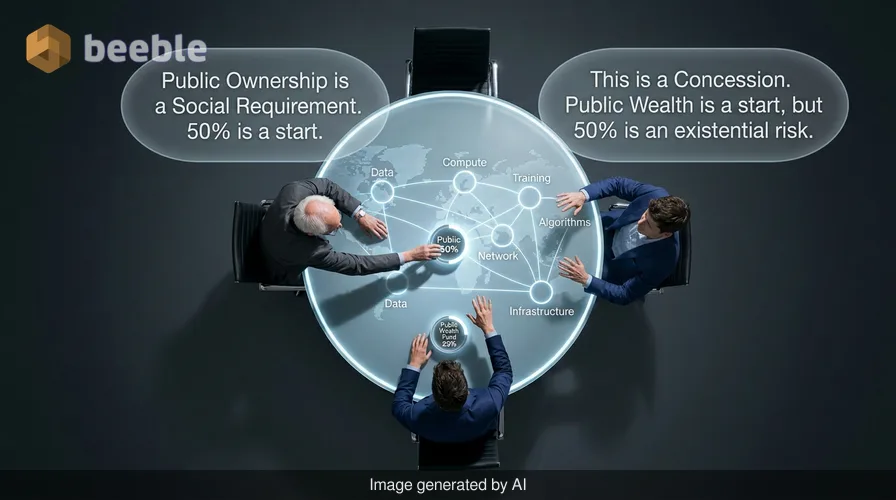
At its core, the debate over the public ownership of artificial intelligence is not merely a question of economics, but an existential inquiry into who owns the future of human cognition. When OpenAI CEO Sam Altman sat down with Senator Bernie Sanders in early June 2026, the conversation was emblematic of a profound cultural shift. Sanders, ever the proponent of democratic socialist principles, proposed a 50% public ownership stake in AI giants; Altman, while recoiling from the specific percentage, conceded the general principle of a public wealth fund. This meeting of minds—however tentative—signals that even the architects of the AI revolution are beginning to realize that a technology this ubiquitous cannot remain a purely private concern without risking a total breakdown of the social contract.
The Unlikely Convergence of Rivals
Paradoxically, the most striking aspect of this movement is its bipartisan resonance. We live in an era characterized by fragmented political identities, yet on the tarmac of Air Force One, Donald Trump echoed sentiments that were nearly indistinguishable from those of his most vocal critics. By describing a potential partnership where the American people become partners in the AI revolution, Trump is tapping into a visceral desire for collective agency. Linguistically speaking, the word "partnership" here acts as a bridge between the radical redistribution proposed by the left and the nationalistic protectionism of the right. It reflects a shared recognition that the wealth generated by large language models is built upon the collective data—the digital habitus—of the entire population.
On a macro level, this alignment is less about ideology and more about the structural reality of the technology itself. Unlike the software of the 1990s, which functioned as a discrete tool, AI functions as a foundational layer of society. It is the invisible scaffolding of our hospitals, our energy grids, and our security systems. Consequently, the prospect of this scaffolding being owned by a handful of individuals in Silicon Valley has created a rare moment of consensus. When the Trump administration took a 10% stake in Intel last year through an $8.9 billion investment, it wasn't seen as a move toward socialism, but as a pragmatic necessity for national resilience in a shifting global landscape.
Lessons from the Railroads and the Post-War Recovery
Historically, this is not the first time we have found ourselves standing at the crossroads of innovation and public interest. Zooming out to the late 19th century, the expansion of the railroads mirrors our current digital expansion with uncanny precision. Back then, the "robber barons" controlled the literal paths of commerce, charging punishing rates to the marginalized while consolidating power in ways that threatened the very fabric of the republic. The resulting Sherman Antitrust Act was not just a legal document; it was a symbolic reclamation of the public square.
In Europe, the precedent for public control is even more deeply rooted. Following the Second World War, the necessity of rebuilding a shattered continent led governments to treat essential services as a collective trust. In France, the nationalization of energy and banking under Charles de Gaulle was a response to a system so fragmented that competing companies in the same city couldn't even agree on the type of current to provide. To put it another way, when a technology becomes essential for survival, its private fragmentation becomes a liability. Today, the European Commission’s move to bar American tech giants from sensitive government contracts and triple its own data center capacity is a modern echo of that post-war pursuit of sovereignty.
The Human Cost of the Digital Fast-Food Diet
Behind the scenes of this trend lies a profound sense of modern anxiety. During my informal field research observing students in university libraries and workers in transit, I have noticed a recurring pattern of behavior: a constant, restless scrolling that resembles a digital fast-food diet—quick and accessible, but lacking in deep emotional or intellectual nutrition. This is the attention economy in practice. For the 70% of college students who, according to recent polls, view AI as a threat to their future, the technology isn't a miracle; it’s an ephemeral force that threatens to render their skills obsolete.
From a societal standpoint, the lack of public ownership means that the dividends of AI—both financial and functional—are being privatized while the risks are being socialized. When a data center consumes a city's water supply or drives up electricity rates, the local community bears the cost. When an algorithm displaces a workforce, the state pays for the retraining. The argument for a public stake is an attempt to rebalance this equation. It is a quest for transparency in a system that has become increasingly opaque, ensuring that the "success" of AI is measured not just in stock prices, but in the resilience of the communities it inhabits.
Reclaiming the Commons in a Liquid Modernity
Ultimately, we are navigating what sociologist Zygmunt Bauman called "liquid modernity," a state where nothing is fixed and every social structure is in a state of constant flux. In such a world, our everyday routines—the way we communicate, work, and learn—are being rewritten by technologies we do not control. The push for a public wealth fund or a sovereign AI fund is a way of creating an anchor in this systemic chaos. It suggests that if we are to live in a theater stage designed by algorithms, we should at least have a hand in writing the script.
Curiously, the resistance to this shift often comes from a place of nostalgia—a cultural anesthetic that makes us fear government intervention more than private monopolization. Yet, if we look at the evolution of language and culture, we see that the most enduring parts of our society are those we hold in common. The internet itself began as a public project before it was carved into the private fiefdoms we see today. Reclaiming a stake in AI is, in essence, an act of remembering that we are not just consumers, but citizens.
Food for Thought
As we stand on the precipice of this tech revolution, it is worth shifting our perspective from that of a passive user to that of a collective stakeholder. Consider the following as you navigate your own digital routine:
- The Data Contribution: Reflect on how your daily digital interactions—the emails you write, the photos you post, and the queries you search—serve as the raw material for the AI systems of tomorrow. If your life is the fuel, what should your return on investment look like?
- The Transparency Gap: When using an AI tool, ask yourself whose values are baked into its responses. Does the lack of public oversight make the tool more of a "hall of mirrors," reflecting only the biases of its creators?
- The Local Impact: Consider the physical footprint of the cloud. Research where the data centers powering your favorite apps are located and how they impact the local environment and resources of those communities.
- The Sovereignty of Silence: In a world where every thought is being indexed to train a model, reclaiming moments of private, unrecorded reflection becomes a radical act of personal sovereignty.
In the end, the debate in Washington isn't just about billions of dollars or percentage points. It is a struggle to ensure that as we build these vastly intelligent systems, we do not lose the very thing that makes us human: our ability to own and shape our collective destiny.
Sources
- Historical data on the Sherman Antitrust Act and the 1887 Interstate Commerce Act.
- Reports on the European Commission's 2026 data center and procurement proposals.
- Polling data from the Institute of Politics at the Harvard Kennedy School (2025/2026).
- Transcripts of recent White House and Senate briefings regarding the Sovereign AI Fund and tech investments.
- Sociological frameworks derived from Zygmunt Bauman’s "Liquid Modernity" and Pierre Bourdieu's concept of "Habitus."



See you on the other side.
Our end-to-end encrypted email and cloud storage solution provides the most powerful means of secure data exchange, ensuring the safety and privacy of your data.
/ Create a free account
