


The quiet end of the three-day wait and what it means for your money

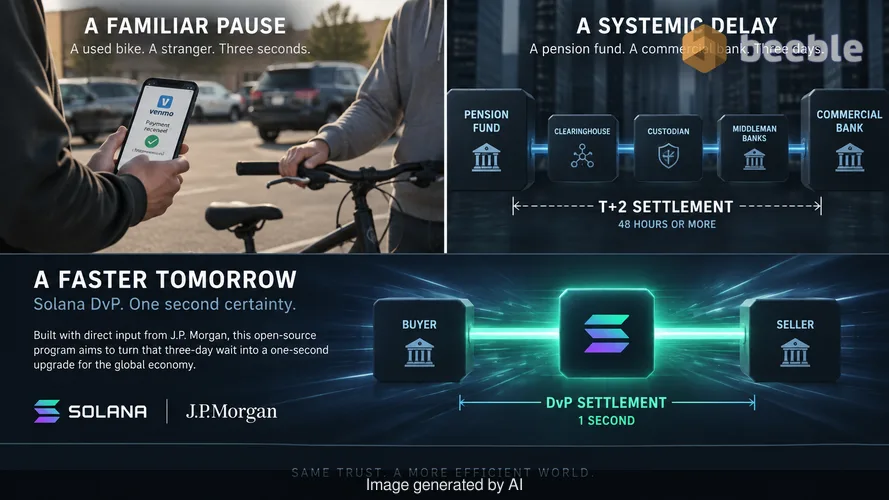
Have you ever sold a used bike or a laptop to a stranger through an online marketplace? You meet in a parking lot. You feel a familiar, mundane anxiety. You wait for the Venmo notification to hit your screen before you let go of the item. That three-second pause is a micro-version of a systemic problem that governs the global economy. In those seconds, you are managing counterparty risk. You are waiting for settlement. You are hoping the other person is honest.
When you scale this up to the world of institutional finance, that three-second pause becomes a three-day ordeal. When a pension fund buys a bond from a commercial bank, they do not just swap the assets and walk away. They enter a fragmented maze of clearinghouses, custodians, and middleman banks. This process, known as T+2 settlement, means the money and the asset are in limbo for forty-eight hours or more. This delay is not just a nuisance. It is a structural inefficiency that ties up trillions of dollars in capital every single day.
On a macro level, this friction is the ghost in the machine of modern finance. Consequently, the recent launch of Solana DvP is less about a new crypto tool and more about a fundamental upgrade to the way money moves. Built with direct input from J.P. Morgan, this open-source program aims to turn that three-day wait into a one-second certainty.
The invisible friction in your bank account
Most people assume that when they buy a stock on a Tuesday, the transaction is over the moment they click the button. In reality, the digital display in your brokerage app is a symbolic promise. Behind the scenes, a complex chain of institutions works to ensure that the shares actually move from the seller to the buyer and the cash moves in the opposite direction. This delay exists because traditional systems are opaque and deeply rooted in 20th-century technology.
This gap between the trade and the settlement creates risk. If a bank fails during those two days, the entire trade can collapse. This is why financial institutions require enormous amounts of collateral to act as a buffer. In everyday terms, it is like having to keep an extra hundred dollars in your pocket just to prove you can afford a ten-dollar lunch. This inefficiency is pervasive, and it drives up costs for everyone, from the retail investor to the global asset manager.
Solana DvP, which stands for delivery-versus-payment, addresses this by creating an atomic transaction. In the world of computer science, an atomic action is one that is indivisible. Either the whole thing happens, or none of it happens. There is no middle ground where you lose your asset but do not receive your payment. This is a profound shift in how we handle trust.
A digital handshake with J.P. Morgan
The involvement of J.P. Morgan in the development of an open-source tool for the Solana blockchain is symptomatic of a larger trend. Major banks have spent years experimenting with private, walled-garden blockchains. However, these private networks often lead to more fragmentation. By providing input on a tool for a public network like Solana, J.P. Morgan is acknowledging that the future of finance requires a shared, transparent standard.
The program is released under the MIT license. This means any bank or developer can use, modify, and build upon it without paying royalties or asking for permission. This creates a resilient framework for institutional trades. Rhodel D'souza, the head of markets digital assets at J.P. Morgan, noted that a shared standard for atomic settlement is the foundational infrastructure market participants require.
Through this economic lens, we see a move away from bespoke, secret smart contracts. In the past, every bank tried to build its own version of a digital settlement tool. The result was a digital wild west where nothing worked together. Solana DvP offers a standardized API, which acts as a universal adapter for the global financial system.
The mechanics of the glass bank vault
To understand how this works, think of the blockchain as a glass bank vault. In a traditional bank, the vault is hidden in a basement, and only the bank knows exactly how much money is inside. In the glass vault of a public blockchain, everyone can see the assets, but only the owner has the key.
Solana DvP acts as a secure, temporary compartment within that vault. When two parties want to trade, they both place their assets into this compartment. The program checks that the bond is real and the cash is present. Once both conditions are met, the compartment opens, and the assets swap owners instantly. The entire process takes seconds.
This removes the need for a central clearinghouse to act as the trusted middleman. The code is the middleman. Because the program has undergone external security audits, institutions can trust the math rather than the reputation of a counterparty. This is a multifaceted improvement over the current system. It reduces the need for capital buffers and eliminates the risk of a trade failing during the multi-day waiting period.
Why three days is two days too many
Zooming out, the transition to instant settlement has tangible effects on liquidity. Liquidity is simply how easily an asset can be converted into spendable cash. In a T+2 world, your money is essentially frozen while the settlement process runs its course. This is a transient state of poverty where you have the wealth on paper but cannot use it to pay your bills.
In a volatile market, this delay is dangerous. If the price of an asset drops sharply while you are waiting for a trade to settle, you are stuck. You cannot sell what you do not technically own yet. By moving to atomic settlement, the Solana Foundation is trying to make the financial system more interconnected and responsive.
This launch builds on the momentum of other major players. BlackRock recently launched a tokenized money market fund on Solana, and Kraken uses the network for tokenized U.S. stocks. These are not speculative experiments. They are structural changes to how assets are issued and traded. The goal is to move beyond the opaque systems of the past and into a transparent, real-time economy.
The shift from trust to verification
On an individual level, the move toward institutional settlement on a public blockchain might seem distant from your daily grocery bill. Yet, the costs of the current system are baked into every financial product you use. Higher fees for stock trades, lower interest rates on savings, and the slow speed of international wire transfers are all results of the fragmented settlement process.
Paradoxically, the most decentralized technology is being used to fix the most centralized institutions. This does not mean banks are going away. Instead, their role is shifting. They are moving from being the keepers of the ledger to being the providers of the interface.
The Solana DvP program supports advanced features like Token-2022 extensions. These include permanent delegates and pausable tokens. These tools allow regulated issuers to maintain the control they need for legal compliance while benefiting from the speed of the blockchain. It is a nuanced balance between the freedom of decentralization and the requirements of the law.
Managing the psychological weight of instant money
As we move toward a world where transactions are final in seconds, our behavior as investors will likely change. The three-day settlement period provided a natural cooling-off period. It was a friction that, while inefficient, prevented some forms of impulsive behavior. When settlement is instant, the psychological pressure to act quickly increases.
This is where behavioral economics becomes central to the conversation. Market cycles are driven by the pendulum of greed and fear. In a high-speed environment, that pendulum swings faster. We must be mindful of how this speed affects our decision-making. The convenience of instant money comes with the responsibility of instant consequences.
Ultimately, the launch of Solana DvP is a sign that the infrastructure of the internet is finally catching up to the needs of global finance. It is a quiet, structural shift that replaces a collective belief system in middleman institutions with a transparent system of code. As these tools become ubiquitous, the way we think about the time-value of money will change. The three-day wait is becoming a historical artifact.
Practically speaking, this is a call for a shift in perspective. Observe how often you are forced to wait for your own money to move. Question why that delay exists. As the plumbing of the world changes, so does our relationship with our own wealth. We are moving toward a future where the financial snowball moves faster than ever, and understanding the mechanics of that movement is the best way to stay in control of your economic future.
Sources:
Solana Foundation Technical Documentation, Oct 2026.
J.P. Morgan Digital Assets Markets Report, Q3 2026.
BlackRock Digital Assets Fund Filing, Aug 2026.
Securities and Exchange Commission (SEC) Settlement Guidelines, 2024-2026.
Solana DvP Open Source Repository (MIT License).



See you on the other side.
Our end-to-end encrypted email and cloud storage solution provides the most powerful means of secure data exchange, ensuring the safety and privacy of your data.
/ Create a free account
