


The Real AI Revolution Isn't Happening on Earth—It’s Starting in Low Earth Orbit

Every time you check a high-resolution weather map, track a global shipping container, or monitor a wildfire on your phone, you are consuming a product that began as raw electromagnetic signals captured by a satellite. Historically, those signals have been treated like digital crude oil: bulky, unrefined, and expensive to transport. To make that data useful, satellites have to beam massive, unprocessed files down to ground stations, which then route them to terrestrial data centers for 'refining.' This process creates a bottleneck that adds minutes, or even hours, of delay to time-sensitive information.
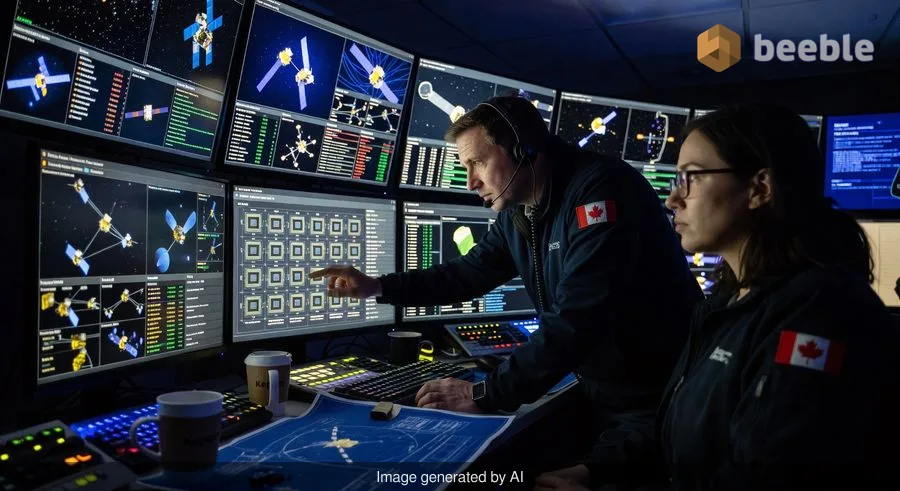
Looking at the big picture, the solution to this lag is to move the refinery to the source. This week, the foundation for that shift became operational. Kepler Communications, a Canadian satellite firm, has officially opened the doors to the largest compute cluster currently in orbit. By installing a network of Nvidia Orin edge processors across ten satellites, they are attempting to prove that the future of the internet doesn't just live in warehouses in Virginia or Ireland, but in the vacuum of space.
The Silicon Backbone in the Void
Under the hood, Kepler’s constellation currently boasts about 40 GPUs linked together by laser communication. For the average user, 40 processors might sound like a small number compared to the hundreds of thousands of chips powering ChatGPT on Earth. However, in the harsh environment of space—where radiation can fry circuits and there is no air to cool a humming engine—getting 40 chips to work in sync is a monumental engineering feat.
These chips are the digital crude oil refineries of the sky. Instead of sending a massive, blurry image of a forest back to Earth to find a fire, the satellite can now run AI algorithms locally. It processes the image, identifies the heat signature, and sends only the critical 'fire detected' alert. This drastically reduces the amount of data that needs to be transmitted, making the entire system more streamlined and responsive.
Solving the Heat Trap
One of the biggest hurdles to building a data center in space is a basic physics problem: heat. On Earth, we use massive fans or liquid cooling to keep servers from melting. In a vacuum, there is no air to carry heat away. This is where Sophia Space, Kepler’s newest partner, enters the frame. Sophia is developing a proprietary operating system designed to manage 'passively-cooled' computers.
Essentially, they are trying to build a system that can handle intense AI workloads without needing heavy, power-hungry cooling hardware. In their upcoming test, Sophia will attempt to launch and configure their software across six different GPUs spread over two separate spacecraft. If they succeed, it will be the first time a distributed operating system has managed hardware across multiple satellites like a single, cohesive computer. This is a foundational step toward making orbital computing scalable and cost-effective.
Why This Matters for Your Daily Life
While the idea of space-based GPUs sounds like science fiction, the practical implications are grounded in everyday reality. We are currently in a cyclical shift where our demand for real-time data is outstripping our ability to move it around the planet.
| Feature | Traditional Satellite Data | Orbital Compute (The New Model) |
|---|---|---|
| Processing Location | Ground-based data centers | Directly on the satellite |
| Latency (Delay) | High (Minutes to Hours) | Low (Seconds to Minutes) |
| Data Volume | Massive raw files | Small, refined insights |
| Cost Efficiency | Expensive downlink fees | Lower bandwidth requirements |
| Primary Use Case | Historical mapping | Real-time disaster/military response |
From a consumer standpoint, this technology will eventually trickle down into the apps we use for navigation, insurance, and environmental monitoring. When a hurricane is forming, or a supply chain is blocked, the speed at which that data is processed can have tangible impacts on global markets and personal safety. By processing data in orbit, we remove the middleman, turning satellites from simple cameras into intelligent, autonomous observers.
The Long Road to the Orbital Cloud
Curiously, Kepler doesn’t actually want to be the 'Amazon Web Services' of space. Instead, they view themselves as the infrastructure—the plumbing and the power lines that allow other companies to build their own applications. They are providing the network services that will eventually link satellites, drones, and high-altitude aircraft into a single, interconnected web.
On the market side, we are still in the early innings. Experts suggest that massive, SpaceX-scale data centers won't be a reality until the 2030s. What we are seeing now is a de-risking exercise. By proving that software can be updated and managed across a decentralized cluster of satellites, Kepler and Sophia are showing that the orbital economy is moving away from 'disposable' hardware toward resilient, software-defined systems.
Ultimately, this shift represents the democratization of space data. As the cost of processing drops, more startups will be able to launch services that were previously too expensive or technically impossible. We are witnessing the moment when space stops being a destination for exploration and starts becoming a functional layer of our global industrial backbone.
As you go about your week, take a moment to consider the invisible mechanics of the devices in your pocket. The map on your screen or the weather alert on your wrist is the result of a vast, silent infrastructure. We are moving toward a world where the 'cloud' is no longer a metaphor for a server farm in a distant desert, but a literal description of the silicon intelligence orbiting high above our heads. Observing how these first 40 GPUs perform will tell us everything we need to know about the next decade of the digital economy.



See you on the other side.
Our end-to-end encrypted email and cloud storage solution provides the most powerful means of secure data exchange, ensuring the safety and privacy of your data.
/ Create a free account
