


We Have Infinite Content, Yet Absolutely Nothing to Watch

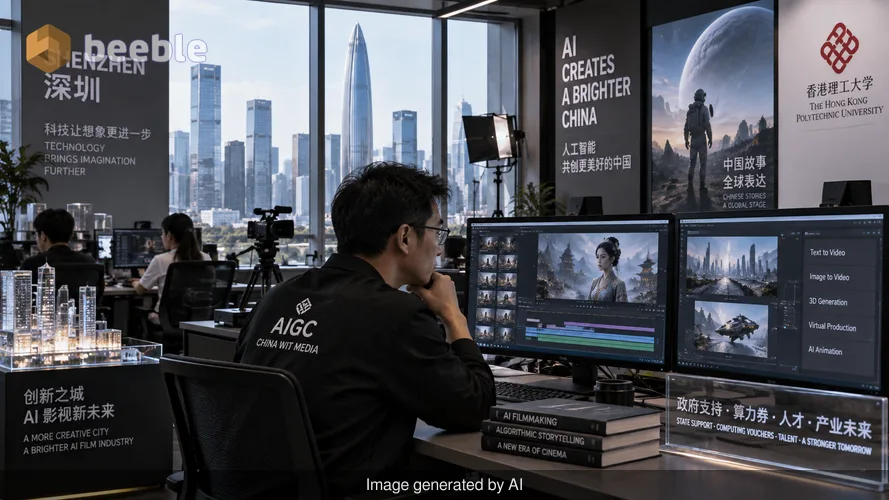
When Zhu Zhili searched for a location to establish an artificial intelligence film studio two years ago, the southern city of Shenzhen was his logical choice. The city has a tech ecosystem that supports rapid iteration. Today, the landscape is different. Zhu receives daily inquiries from officials across China. These representatives from major metropolitan areas and smaller localities all offer the same pitch: bring your AI film business to our district. This sudden demand reflects a coordinated state effort to integrate artificial intelligence into the national economy. China treats AI-generated content (AIGC) with the same strategic priority it once gave to electric vehicles and solar panels. The goal is to build a globally competitive industry through state-guided development.
We used to value cinema for its scarcity and the immense physical labor required to capture a single frame. Now we value the efficiency of the prompt and the speed of the render. We used to measure production value by the size of a physical set in Huairou. Now we measure it by the availability of computing vouchers and subsidized server time. This transition marks a fundamental shift in how media is manufactured. Shenzhen provides the workspace, the Hong Kong Polytechnic University provides the academic backing, and the local government provides the cheap rent. For creators like Zhu, who leads the AIGC department at China Wit Media, these incentives make China the most hospitable environment for algorithmic storytelling.
The production line moves to the cloud
The industrialization of film follows a familiar playbook. In previous decades, China scaled up the production of consumer electronics and robotics by lowering the barriers to entry. The same mechanism is now at work in the audiovisual sector. Local governments offer subsidies to filmmakers and startups to lower the cost of entry. This approach turns artistic creation into an industrial output. Shanghai introduced measures in May to accelerate the production of AI micro-dramas. The city offers computing power and cloud-based models to help creators cut costs. Beijing maintains a 260 million yuan fund to support audiovisual technology. These are not merely cultural grants. They are investments in a supply chain designed to dominate the global market for digital entertainment.
From a creator's standpoint, the economic appeal is undeniable. Pan Xiaojun, a film-directing student in Hainan, illustrates the disparity in costs. A traditional wedding scene usually requires 60,000 yuan to shoot on location. With AI, Pan produces a surreal version of the same scene for 1,400 yuan. Subsidies from the Hainan government further reduce his computing expenses. When the cost of a minute of footage drops from 5,000 yuan to a few hundred yuan, the math of the industry changes. The financial risk of a flop disappears, but so does the barrier to mediocrity. This creates a streamlined path for content creation that requires less capital and fewer human hours.
A digital buffet with too many dishes
Fragmentation is the inevitable result of this hyper-production. When everyone has the tools to produce a film, everyone does. Douyin, the Chinese version of TikTok, saw the launch of 221,900 new AI shows in the first half of the year. This volume is massive, but the success rate is remarkably low. Only 1,055 of those shows reached 100 million views, which is a standard benchmark for success on the platform. The industry is already approaching a state of overcapacity. The supply of content far exceeds the capacity of the audience to consume it. This leads to a race to the bottom where creators compete for attention in an oversaturated market.
Streaming platforms like iQIYI are moving to integrate these tools into their core business. CEO Gong Yu stated the company is fully committed to AI integration. The platform offers subsidies to creators who use AI tools for content that streams on their service. This strategy treats the streaming library like an endless digital buffet. The goal is to keep the user engaged for as long as possible with a continuous stream of low-cost, algorithmically generated video. Paradoxically, as the volume of available content increases, the likelihood of finding something resonant decreases. The audience spends more time scrolling through thumbnails than watching the actual shows.
The friction between automation and artistry
Narratively speaking, the rise of AI film introduces a profound tension between efficiency and originality. Bona Film Group received a public-screening license for "Sanxingdui: Future Memories," a 90-minute science-fiction epic. This is the first AI film from a major Chinese studio to get regulatory approval for a theatrical release. While this is a technical milestone, the audience reception to AI content is mixed. Many consumers express frustration with the derivative nature of the visuals. Wen, a 22-year-old viewer, points out that some creators blend original characters or existing dance clips into AI content without credit. This practice creates a perception of plagiarism that damages the reputation of the medium.
Behind the scenes, the human element of the industry feels the pressure of automation. Chinese actors and voice artists raise concerns about the unauthorized use of their likenesses. The technology can replicate a person's voice and movements with seamless accuracy, which threatens the job security of traditional performers. China requires AIGC to be clearly labeled, but the legal framework for copyright is still developing. This lack of clear rules creates an opaque environment for creators and performers alike. The fear is that the industry will prioritize the low cost of synthetic actors over the nuanced performance of human ones.
The backlash of the handmade
Sometimes the audience pushes back against the ubiquity of the digital. The unexpected success of the film "Niu Lai" is a clear example of this trend. The film features crude, conventional animation rather than sophisticated AI-generated visuals. Its popularity suggests that viewers still crave something that feels human and imperfect. In everyday terms, this is like choosing a hand-knit sweater over a factory-made one. The imperfections are the proof of the labor behind the product. As AI video becomes more streamlined and polished, the clunky charm of traditional filmmaking becomes a rare commodity.
Director Cao Yiwen premiered her AI-animated film at the World AI Film Festival in Cannes and observed a distinct lead for China in this space. She noted that while Europe waits for clear regulations, China is moving forward with production. She views this as a potential Third Industrial Revolution. However, this revolution comes with the risk of aesthetic exhaustion. If every city in China succeeds in building an AI film cluster, the result will be a flood of content that lacks a unique voice. The infrastructure is being built at a record pace, but the cultural foundation remains thin.
Reclaiming the choice to watch
Zooming out to the industry level, the rush to turn AI video into an industrial power shows how entertainment is becoming a branch of data science. The focus has shifted from the quality of the story to the efficiency of the delivery system. We are surrounded by a content walled garden where the algorithm decides what we see based on what was cheapest to produce. This system values high volume and low cost over the profound connection that cinema used to provide. The viewer is no longer an audience member but a data point in a feedback loop.
Ultimately, the responsibility to find meaning falls back on the consumer. As the digital buffet grows larger and more derivative, we must become more intentional about our media consumption. We should look for the films that break the pattern and provide a resonant experience. We can acknowledge the technical achievement of AI while still demanding the originality that only a human perspective provides. The industry may provide the tools for infinite content, but the audience provides the value through their attention. Choosing what to watch is the only way to reclaim control over a digital landscape that is increasingly designed to watch us back.
Sources
- DataEye: H1 2026 AI short drama performance statistics.
- CCTV: Reports on AI short drama production costs in 2026.
- Bona Film Group: Press release on Sanxingdui: Future Memories theatrical release.
- iQIYI: Q2 2026 earnings call and CEO statements on AI strategy.
- Shanghai Municipal Government: Guidelines for AI micro-drama support measures.



See you on the other side.
Our end-to-end encrypted email and cloud storage solution provides the most powerful means of secure data exchange, ensuring the safety and privacy of your data.
/ Create a free account
