


Why a Muted Notification in Hanoi Explains the Global Redesign of Childhood

The internet exists as a boundless ocean of information where every child might discover a community or a calling. We are told that social media is a bridge between the local and the global that allows a teenager in a mountain village to witness the history of a distant continent. However, this freedom inevitably faces the walls of new regulations. Participation requires a digital signature from a parent. Visibility is algorithmically suppressed unless the user is over a specific age. The promise of the digital village has become a series of gated communities.
The silent experiment in Hanoi
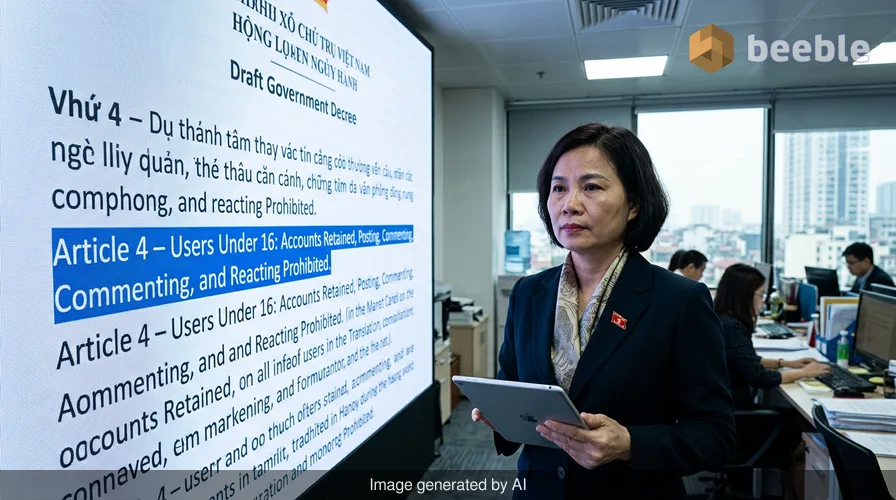
Vietnam is currently debating a proposal that treats the digital world like a library where children are allowed to browse but never to speak. Under a draft decree from the Ministry of Culture, Sports and Tourism, users under 16 would retain their social media accounts but lose the ability to post, comment, or react to content. They are effectively muted. This version of a youth social media ban is the most unusual yet because it focuses on silencing rather than removing. The proposal requires these accounts to be registered under a parent. This parent is then responsible for monitoring everything the child sees and how long they stay online.
I remember sitting in a small coffee shop on Hang Gai Street in Hanoi last year. Two teenagers sat across from each other, their faces illuminated by the blue light of their phones. They were communicating through reactions and comments on each other's posts while sitting two feet apart. This is the habitus of the modern adolescent. If the Vietnamese government adopts this decree, that specific social performance will stop. They will be logged in, but they will be spectators. On an individual level, this transforms the platform from a social space into a digital television.
The global shift toward digital guardianship
Vietnam is part of a larger movement that seeks to reclaim the digital landscape from the chaotic energy of the youth. Australia became the world’s first country to implement a comprehensive ban for children under 16 in December 2025. This law blocks access to major platforms like Facebook, Instagram, TikTok, and X. Companies that fail to comply face penalties of up to 49.5 million AUD. The Australian government insists that platforms must use multiple verification methods. They can no longer rely on a user simply entering their birth year.
Zooming out, this trend is a reaction to the atomization of modern life. In many cities, the traditional "third place" has vanished. The playground and the town square were once the primary sites of social development. When these physical spaces became less accessible or felt less safe, the digital feed became the new village green. Now, governments are closing that green as well. France passed a law on July 21 that bans social media for anyone under 15. The French government also plans to ban cell phones in high schools starting in September. This is an attempt to force a return to physical presence.
A map of the new restrictions
Many nations are moving toward similar legislative barriers. The logic is often the same: protection from cyberbullying, addiction, and the addictive design of social media. The following table illustrates the current state of these restrictions across the globe.
| Country | Age Limit | Status of Legislation |
|---|---|---|
| Australia | Under 16 | Implemented (Dec 2025) |
| France | Under 15 | Law passed (July 21) |
| UK | Under 16 | Proposed for 2027 |
| Greece | Under 15 | Starts January 2027 |
| Denmark | Under 15 | Target 2026 |
| Spain | Under 16 | Pending approval |
| Indonesia | Under 16 | Plan announced March 2026 |
| Vietnam | Under 16 | Draft decree (Muting policy) |
In Canada, the government introduced a digital safety bill in June that allows social media giants to avoid a ban only if they prove they have policies to protect young users. Meanwhile, in the UK, Prime Minister Keir Starmer announced a ban for children under 16 that would take effect by spring 2027. He acknowledges the enforcement challenges but remains committed to the policy. Curiously, messaging services like WhatsApp are often excluded from these bans. This suggests that governments view public-facing social media as the primary threat, while private digital communication remains a tolerable necessity.
The philology of the mute button
Linguistically speaking, the word "mute" has undergone a profound shift. It once described a physical inability to speak or a choice to remain silent. In the context of Vietnam’s proposal, it is a forced technical state. When a government mutes a generation, it changes the discourse of childhood. Social media is an archaeological site where we can see the evolution of language through slang and trends. If teenagers are no longer allowed to contribute to this site, the digital record of their lives becomes blank.
This policy reflects what sociologist Zygmunt Bauman called liquid modernity. Our social contracts are in a state of constant flux and uncertainty. The rules of the internet change as quickly as the algorithms. By muting children, the state is attempting to freeze one part of this liquid reality. They want to preserve a version of childhood that is passive and protected. Paradoxically, this may only drive the conversation further underground. History shows that when formal channels of communication are closed, informal and often more dangerous channels emerge.
Privacy and the cost of verification
Behind the scenes of this trend is a massive push for age verification. This is where the sociological meets the technical. To prove a user is over 16, platforms often require biometric data or government identification. Critics from organizations like Amnesty Tech argue that these measures are invasive. They suggest that such bans ignore the realities of younger generations who are already deeply integrated into digital life. For many children, their social identity is not a separate thing from their digital presence — it is one and the same.
Spain is taking this a step further. The Spanish government is seeking a law to make social media executives personally accountable for hate speech on their platforms. This is a shift from corporate liability to individual responsibility. It highlights a growing impatience with the lack of self-regulation within the tech industry. In everyday terms, this means the people who build these platforms are now being told to act like parents or face the consequences.
Reclaiming the digital playground
Vietnam’s approach to gaming is also a sign of systemic anxiety. The country wants to cap play for under-16 users at 60 minutes a day per game. This is a direct intervention into the daily routines of millions of families. It views technology as a fast-food diet that requires strict portion control. While the goal is to reduce addiction, it also removes the agency of the child to manage their own time.
Ultimately, these global bans are a collective coping mechanism for a society that is struggling to understand the impact of the attention economy. We are attempting to build digital fences around a generation that was born without them. The result is a fragmented experience of the world. Some children will have access, while others will be muted. Some will be supervised by parents, while others will find ways to bypass the filters.
As we watch these laws take effect from London to Hanoi, we should observe our own habits. We might ask if the silence we are imposing on the youth is a reflection of our own inability to find balance. Perhaps the solution is not a total ban, but a reconstruction of the physical spaces that social media replaced. We should consider reclaiming the mundane moments of face-to-face interaction that do not require a login or a parental monitor.
Food for thought
- How does the transition from a participant to a spectator change the way a teenager develops a sense of self?
- Is a technical mute button an effective substitute for parental guidance and open conversation about digital risks?
- If we remove the digital village green, what physical spaces are we providing in its place?
- Does the requirement for invasive age verification create a new set of privacy risks that are greater than the ones the bans aim to solve?
Sources:
- Ministry of Culture, Sports and Tourism, Vietnam (Draft Decree on Social Media and Gaming)
- Reuters (Reports on global tech regulation and Vietnam policy)
- Associated Press (Updates on Danish and French social media laws)
- Amnesty Tech (Analyses of digital privacy and age verification impacts)
- Liquid Modernity by Zygmunt Bauman (Sociological framework for modern uncertainty)



See you on the other side.
Our end-to-end encrypted email and cloud storage solution provides the most powerful means of secure data exchange, ensuring the safety and privacy of your data.
/ Create a free account
