


Why a single browser exploit is rewriting the rules of the PlayStation 5 ecosystem

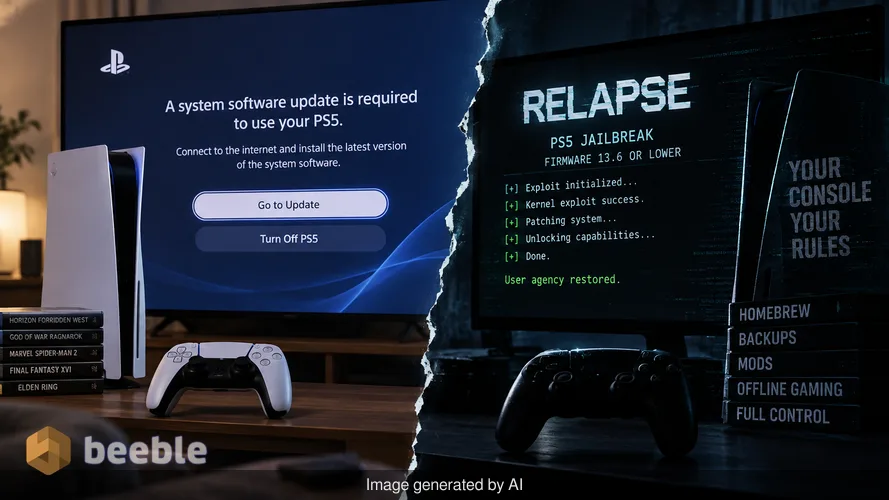
The PlayStation 5 is a technical marvel that promises a gateway to infinite worlds, and its hardware handles Ray Tracing and near-instant load times with ease. You navigate the sleek UI and browse the store with a feeling of total agency. You buy your games and you capture your clips. Except the console requires a connection to Sony servers to function. Until you download the latest update, you are locked out of your purchases. Inevitably, the user becomes a tenant in a digital space they paid to own. This dynamic defines the modern console era, where hardware is sold once but the control over that hardware is maintained through a constant stream of mandatory firmware updates.
This tension reached a new peak this past Tuesday. The release of the Relapse exploit changed the power balance for a significant portion of the player base. For years, the PS5 hacking community existed on the fringes, restricted to consoles that had been disconnected from the internet for years. Most users were stuck on the outside because their systems were up to date. The Relapse exploit is different. It functions on any PS5 running firmware version 13.6 or lower. Because Sony released firmware 14.00.00 in mid-September, a massive number of consoles currently in homes are now eligible for a full jailbreak. This is the most significant shift in console agency since the launch of the hardware.
The architectural flaw in the digital fortress
Hacking a modern console is like finding a loose brick in the architectural foundation of a fortress. Sony spends millions to ensure the system is opaque and secure. The goal is to prevent the execution of arbitrary code, which is any software not signed and approved by the manufacturer. However, every modern console includes a web browser. Even if the browser is hidden from the main menu, the system uses it to display manuals, login pages, and terms of service. This browser is the open window in the fortress.
The Relapse exploit makes use of a vulnerability in WebKit, the engine that powers the PS5 browser. This is a long-known weakness, but the community found a way to escalate that tiny opening into something much larger. By exploiting the way the system handles memory, the software gains write access to the PS5 kernel. The kernel is the core of the operating system that manages the relationship between hardware and software. Once a user has kernel access, the walls fall. The installation of an ELF loader follows, which allows the system to run homebrew apps and custom scripts.
Efficiency as a catalyst for adoption
Previous attempts to crack the PS5 were clunky and unreliable. Those earlier methods often resulted in system hangs or crashes that lasted up to 50 minutes per attempt. For the average user, this was a barrier to entry. A jailbreak that takes an hour to trigger is a hobby for the dedicated few. Relapse is different because it is streamlined. The process is faster and more stable, which makes it accessible to people who are not security researchers.
This efficiency matters because it changes the persona of the jailbreaker. We are no longer just talking about people who want to pirating games. We are talking about users who want to fix the mistakes of the industry. The modern gaming landscape is fragmented. Features are removed. Games are delisted. Performance is often throttled to meet the marketing goals of the next hardware iteration. When the process of reclaiming a console is fast, more people choose to do it.
Breaking the cycle of forced updates
Historically, the greatest enemy of the console hacker was the firmware wall. Most PS5 games require a specific firmware version to launch. If you buy a new blockbuster released in August, the disc or digital file checks your system. If your console is not updated to the version available at the time of the game’s release, the game will not start. This created a paradox for enthusiasts. To hack the console, you had to stay on old firmware. To play new games, you had to update and lose the hack.
Relapse works on firmware 13.6, which was the standard as recently as July. This covers a vast library of recent titles. Users can now maintain their system security while also having access to nearly every game released in the last three years. This expanded hardware availability is a blow to the secondary market. Previously, a PS5 on ancient firmware version 4.03 sold for twice the retail price on eBay. Now, the console sitting in a teenager's bedroom is likely a candidate for a jailbreak. The barrier to entry has moved from a financial one to a simple matter of whether the user clicked 'Update' in the last three weeks.
The quest for a better legacy
The immediate appeal of a jailbroken PS5 is the ability to run homebrew software. This includes emulators that turn the PS5 into a universal machine for gaming history. But the most resonant use case is the modification of existing games. Sony and third-party developers often abandon games once the initial sales window closes. A PS4 game might be locked at 30 frames per second on the PS5, even though the hardware is more than capable of doubling that performance. The developer has no financial incentive to release a patch, so the game remains clunky.
Jailbroken consoles allow the community to step in. Unofficial 60 fps mods for legacy titles are a staple of the scene. Through this audience lens, hacking is a form of digital restoration. It is an act of defiance against planned obsolescence. When a developer refuses to provide a seamless experience, the community builds it themselves. This is a conversation between the player and the developer. The player is saying that the product they bought should perform at its best, regardless of corporate roadmaps.
The dream of a primary computer
Beyond the screen of gaming, some developers are working toward a full Linux implementation for the PS5. The hardware inside the console is essentially a high-end PC with a custom architecture. If Linux runs on the PS5, the machine stops being a locked-down media box and becomes a powerful workstation. Currently, this level of control is limited to systems on firmware 7.61 or earlier. This is quite old compared to the 13.6 threshold for the Relapse exploit.
However, the progress made with Relapse provides a new architectural foundation for the Linux project. As hackers understand the kernel of version 13.6, they get closer to unlocking the full potential of the hardware. The goal is to remove the software shackles entirely. This would allow a user to use their console for word processing, video editing, or web browsing without Sony's oversight. This level of utility is what many people thought they were buying when they spent five hundred dollars on a computer.
Reclaiming the digital lounge
The entertainment industry is moving toward a future of total control. Streaming libraries are endless digital buffets where you own nothing. Digital storefronts can revoke your access to a movie or a game at any time. The PS5 jailbreak scene is a reaction to this loss of ownership. It is a messy, technical, and often frustrating pursuit, but it represents a fundamental human desire for sovereignty over our tools.
The Relapse exploit is not just a technical milestone. It is a reminder that the systems we use every day are built on layers of code that can be rewritten. We should observe our own media consumption habits and ask how much of our experience is curated by an algorithm or a corporate update. When you own a device, you should have the right to decide how it runs. The hackers behind this exploit are reclaiming that right, one firmware version at a time.



See you on the other side.
Our end-to-end encrypted email and cloud storage solution provides the most powerful means of secure data exchange, ensuring the safety and privacy of your data.
/ Create a free account
