


Why is Google building a custom brain for its AI models?

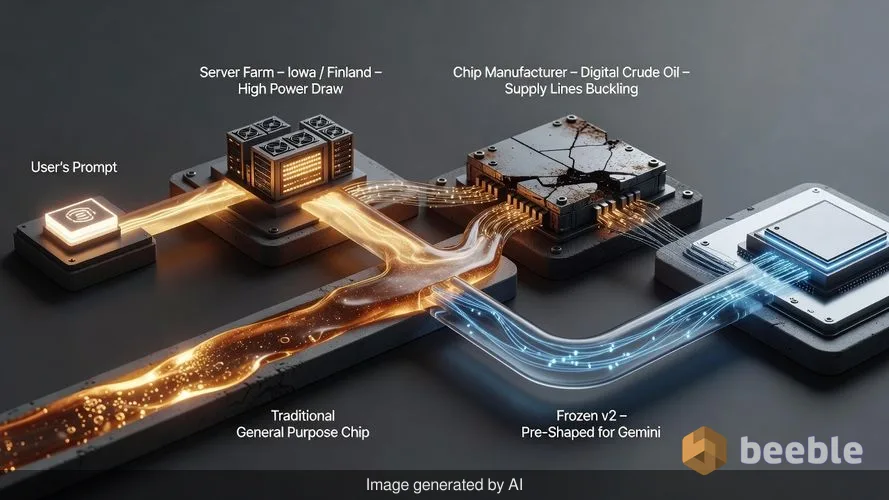
Every time you ask an AI to summarize a long document or generate a piece of code, a silent industrial process begins. The words on your screen are the final product, but the raw materials are electricity and silicon. To produce a single paragraph of text, a server farm in a place like Iowa or Finland draws enough power to run a household appliance for several minutes. These servers rely on chips that act as the digital crude oil of our era, fueling every search query and automated response.
Currently, the demand for these digital materials is so high that the supply lines are buckling. Google is now attempting to bypass this bottleneck by fundamentally changing how its hardware works. The company is developing a new server chip, informally named Frozen v2, that incorporates elements of its Gemini AI model directly into the physical hardware. This is a departure from how computers usually work. Traditionally, a chip is a general-purpose tool that runs whatever software you give it. Google is now building a chip that is, in a sense, pre-shaped to fit the specific logic of its own AI.
the cost of a digital thought
To understand why Google is taking this step, we must look at the efficiency of a single AI token. A token is roughly equivalent to a word or a part of a word. When a model like Gemini processes information, it moves these tokens through layers of mathematical calculations. In a standard setup, the hardware spends a massive amount of energy just moving data back and forth between the processor and the memory. This movement creates heat and consumes electricity, which translates to higher costs for the company and, eventually, the user.
Google Cloud recently turned away business from outside customers because it simply did not have enough computing power to go around. This capacity crunch is an industrial reality that most users never see. When a cloud provider says no to a contract, it is because their data centers are physically full or their energy bills are becoming unsustainable. The Information reports that these internal tensions are what pushed the development of Frozen v2. The goal is to make a chip that is six to 10 times more efficient than current models based on the number of tokens served per unit of power.
Practically speaking, if Google can serve 10 times more AI answers with the same amount of electricity, it solves two problems at once. It lowers the astronomical cost of running Gemini, and it allows the company to handle more users without building ten times as many data centers. For the average user, this might be the difference between a free AI tool and one hidden behind a twenty-dollar monthly paywall.
the cloud reaches its physical limit
Historically, tech companies solved speed problems by making chips smaller and packing more of them into a single room. We have reached a point where that strategy has diminishing returns. Modern AI models are so large that they require thousands of chips working in perfect synchronization. If one chip is slow, the whole system waits.
Google already uses its own Tensor Processing Units (TPUs) for much of its AI work. These are specialized chips, but they are still flexible enough to run many different types of models. Frozen v2 is different because it is less of a general-purpose tool and more of a specialized skeleton for Gemini. By hardwiring specific parts of the model into the silicon, Google reduces the need for the chip to "think" about how to process the data. The instructions are already there, etched into the hardware itself.
This approach has a significant trade-off. If the engineers change the Gemini model significantly in three years, a hardwired chip might become obsolete. It is a high-stakes bet that the current architecture of Gemini is the foundational design for the next decade. Engineers are still finalizing how much of the model information will be permanent in the hardware, a decision that will determine how rigid or flexible the chip is when it finally arrives in 2028.
how frozen v2 changes the chip game
On the market side, this move is a clear attempt to reduce reliance on outside vendors like Nvidia. While Google builds its own TPUs, much of the world still runs on Nvidia’s H100 and H200 processors. By creating a chip that is fundamentally inseparable from its software, Google creates a closed loop. This makes it very difficult for competitors to match their efficiency because the competitor only has the software, while Google has the software and the specialized engine built to run it.
| Feature | Standard TPU (Current) | Frozen v2 (Projected) |
|---|---|---|
| Primary Function | General AI training and inference | Gemini-specific optimized inference |
| Efficiency | Baseline | 6x to 10x higher per watt |
| Hardware Logic | Software-defined | Hardwired Gemini elements |
| Deployment Timeline | Active | 2028 and beyond |
| Target Use Case | Multi-model support | High-volume Gemini services |
Looking at the big picture, this project is a response to a volatile market where everyone is chasing the same limited supply of silicon. Alphabet shares rose 3.3% following the report, which shows that investors value self-sufficiency over almost anything else right now. The market recognizes that the company with the most efficient hardware wins the margin war. If it costs OpenAI five cents to answer a question and it costs Google half a cent, Google has a systemic advantage that is nearly impossible to overcome through software updates alone.
tracing the path from software to hardware
Zooming out, we can see how this affects the lifecycle of a product. In the early days of a new technology, software is fast and hardware is slow. Developers change their code every week, so the hardware needs to be a blank slate that can adapt. As a technology matures, the software settles into a stable form. This is the point where it makes sense to bake the software into the hardware.
We saw this with video games. In the 1990s, computers used general processors for everything. Eventually, companies created graphics cards (GPUs) that were hardwired to do one thing: calculate triangles and light. AI is currently undergoing that same transition. Frozen v2 is an emerging sign that AI is no longer an experimental software project. It is becoming a foundational utility, like electricity or water, where the priority is cost-effective delivery at a massive scale.
Curiously, Bloomberg recently reported that Google had to delay its latest Gemini model because it fell short of internal goals. This highlights the friction in this transition. If the software is not yet perfect, hardwiring it into a chip is a dangerous move. The delay suggests that Google is still refining the "shape" of its AI before it commits that shape to a multi-billion dollar silicon manufacturing run. A mistake in the hardware design cannot be fixed with a quick patch or an overnight update.
the long road to 2028
For the average user, 2028 seems like a long time to wait for a faster chatbot. In the world of industrial hardware, four years is a standard development cycle. Designing a chip, testing the architecture, and securing time at a fabrication plant like TSMC takes years of lead time. This means Google is making decisions today about the AI you will use at the end of the decade.
Behind the jargon, this is about resilience. Google is trying to ensure that its services remain available even if global chip supplies remain tight. By making their own specialized hardware, they are less vulnerable to the cyclical nature of the semiconductor industry. They are building their own power plant rather than buying electricity from the grid. This level of vertical integration is expensive, but it provides a level of control that most other tech companies lack.
From a consumer standpoint, you won't necessarily see a "Frozen v2" logo on your phone or in your browser. The impact will be invisible. You will notice that Gemini responds faster, handles longer documents without lagging, and perhaps offers more advanced features for free. The heavy industry happening in the background—the pouring of silicon and the optimization of power grids—is what makes the lightweight digital experience possible.
what this means for your monthly subscription
Ultimately, the development of Frozen v2 is a reminder that AI is not just a digital phenomenon. It is a physical one. As models grow more complex, the hardware must become more specialized to keep up. This is a practical shift toward a future where our devices are not just running AI, but are physically built of AI.
For now, the best way to prepare is to observe how these tools are integrated into your daily habits. As efficiency improves, AI will likely move from a standalone chat box into the background of every app you use. Pay attention to the costs. If hardware efficiency really does jump tenfold, we should expect to see the current trend of rising subscription prices level off or even reverse. You should look for services that can prove they are sustainable, as those will be the ones that survive the coming energy and capacity crunch. The invisible backbone of the internet is changing, and the result will be a more streamlined, though perhaps more closed, digital ecosystem.
Sources: The Information, Bloomberg News, Alphabet Investor Relations, Google Cloud Official Communications.



See you on the other side.
Our end-to-end encrypted email and cloud storage solution provides the most powerful means of secure data exchange, ensuring the safety and privacy of your data.
/ Create a free account
