


Why is your physical car key still taking up space in your pocket?

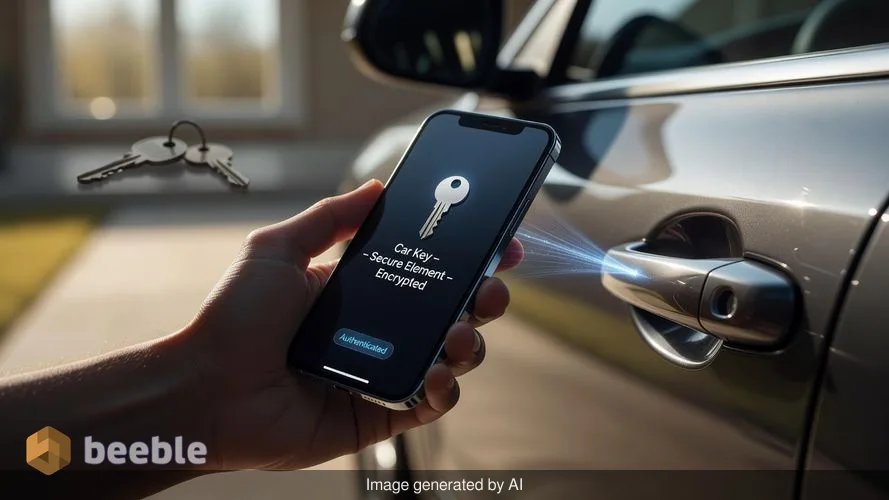
Have you ever walked out to your driveway only to realize you left your keys on the kitchen counter? It is a small frustration that Apple wants to eliminate. The tech giant is turning your iPhone into a master key for your vehicle. This shift is more than just a convenience. It is a fundamental change in how we interact with our most expensive pieces of hardware. Practically speaking, your car is becoming a high-speed peripheral for your smartphone. This transformation relies on technologies that have existed for years but are now finding a new, more practical home in your digital wallet.
The invisible tech behind your digital door lock
Apple’s digital car key works through a combination of Near Field Communication (NFC) and Ultra-Wideband (UWB) technology. NFC is the same system that handles Apple Pay. It requires you to hold your device very close to a reader, usually the door handle, to trigger an action. This is a short-range, high-security handshake. Under the hood, your iPhone contains a specialized piece of hardware called the Secure Element. This chip is isolated from the rest of the operating system. It stores your digital key in an encrypted state that even Apple cannot access. When you tap your phone to the door, the car and the Secure Element exchange a unique code to verify your identity.
For the average user, the newer Ultra-Wideband support is the real upgrade. This uses the U1 or U2 chip found in modern iPhones. Unlike NFC, UWB is spatially aware. It measures the time it takes for radio waves to bounce between your phone and your car. This allows the vehicle to know exactly how far away you are and in which direction you are moving. As a result, your car can unlock as you walk up to it and lock as you walk away. You never have to take the phone out of your pocket. This passive entry system is the digital equivalent of a high-end proximity key fob, but with much stronger encryption.
Which cars and phones actually work together
Compatibility remains the biggest hurdle for anyone looking to ditch their physical keychain. While the list of supported vehicles is growing, it is far from universal. Historically, BMW was the first to adopt this standard in 2020. Since then, brands like Hyundai, Kia, Genesis, and Rivian have joined the ecosystem. High-end manufacturers like Audi and Mercedes-Benz are also integrating the feature into their newer models. Curiously, many budget-friendly vehicles still lack the necessary hardware, as car makers often gate these features behind premium trim levels or tech packages.
On the hardware side, you need an iPhone XS or newer to use the basic NFC features. If you want the seamless UWB experience where the car unlocks automatically, you need an iPhone 11 or later. The Apple Watch is also a player here. Series 5 and newer models support NFC keys, while Series 6 and later support the more advanced UWB features. This means your watch can act as your primary key even if you leave your phone at home during a run or a quick trip to the store.
| Feature | Minimum iPhone Requirement | Key Benefit |
|---|---|---|
| NFC Tap-to-Unlock | iPhone XS / SE (2nd Gen) | Works even if the phone battery is dead |
| Ultra-Wideband Passive Entry | iPhone 11 (excluding SE) | No need to take phone out of pocket |
| Remote Locking/Unlocking | iPhone XS | Control car from a distance via Bluetooth |
| Key Sharing | iPhone XS | Send a temporary key via iMessage |
Keeping your vehicle secure in a digital world
Security is a valid concern for anyone moving their car's security to a cloud-connected device. Digital keys are actually more resilient than traditional physical fobs. A standard key fob emits a relatively simple radio signal that thieves can intercept and replay using cheap hardware. Apple’s system uses a rolling code system backed by the same security architecture that protects your credit card information. Each interaction between the phone and the car is unique. A thief cannot simply record the signal and use it later to steal the car.
From a consumer standpoint, the privacy protections are also noteworthy. Apple does not track when you lock or unlock your car. The transaction data stays between your device and the vehicle. If you lose your phone, the process of Revoking access is straightforward. You can use the Find My app on another device to mark your iPhone as lost, which instantly kills the digital key. This is significantly faster and cheaper than calling a locksmith to re-key a physical ignition or buying a replacement fob, which can cost hundreds of dollars at a dealership.
Practical steps to get started
The setup process is not standardized across every manufacturer, which can lead to some initial confusion. Generally, you start with the car manufacturer’s proprietary app. After you register your vehicle and prove ownership, the app provides an option to add the key to your Apple Wallet. In many cases, you must be sitting inside the car with both of your physical keys present to complete the pairing. This is a security measure to ensure that a valet or a temporary driver cannot secretly clone your key.
Once the key is in your Wallet app, it looks just like a credit card. You can tap it to see options for locking, unlocking, or starting the engine. If your car supports it, you might also see a button for the trunk or the panic alarm. This digital interface is intuitive and removes the guesswork of traditional fobs that often have identical-feeling buttons. Essentially, the phone becomes a more informative version of the hardware it replaces.
The reality of a dead battery and shared access
A common fear is what happens when your iPhone dies. Apple addressed this with a feature called Power Reserve. Your iPhone keeps a tiny amount of battery life set aside specifically for Express Mode items like transit passes and car keys. This reserve lasts for up to five hours after the phone screen goes black. You can still tap your phone against the door handle to get inside and start the engine. However, the UWB passive entry will not work in this state. You must physically tap the phone to the NFC reader, which is usually located in the door handle or the wireless charging pad inside the car.
Key sharing is another area where the digital version beats the physical one. If a friend needs to borrow your car, you can send them a key through iMessage. You can set limits on this digital key, such as a specific time window or restricted access to the trunk. For parents, this is a useful tool for managing a teenager's driving. You can revoke the key at any time with a single tap. This eliminates the need to meet in person to hand over a physical set of keys and ensures you always know who has access to the vehicle.
Shifting your perspective on car ownership
Adopting a digital car key requires a shift in daily habits. We are used to the weight of metal in our pockets as a sign of security. Moving that responsibility to a glass-and-aluminum slab feels risky until you use it for a week. The convenience of never fumbling for keys while carrying groceries is a tangible benefit that most users appreciate quickly. Looking at the big picture, this is the first step toward a future where the physical car key is an antique.
Ultimately, you should still keep your physical key in a safe place at home. Digital systems are robust but not invincible. Software updates can occasionally glitch, and hardware can fail. Treat the iPhone key as your primary tool, but keep the metal key as your insurance policy. As manufacturers continue to update their fleets, the digital key will become a standard feature rather than a luxury add-on. For now, it is an emerging technology that turns a repetitive daily task into a streamlined, invisible experience.
Sources
- Apple Support documentation on digital car keys and Express Mode.
- Car Connectivity Consortium (CCC) Digital Key Release 3.0 specifications.
- BMW Group press releases regarding Digital Key Plus and UWB integration.
- Hyundai and Kia technical bulletins on smartphone key compatibility.



See you on the other side.
Our end-to-end encrypted email and cloud storage solution provides the most powerful means of secure data exchange, ensuring the safety and privacy of your data.
/ Create a free account
