


Why the Pentagon cannot just label its critics a national security risk

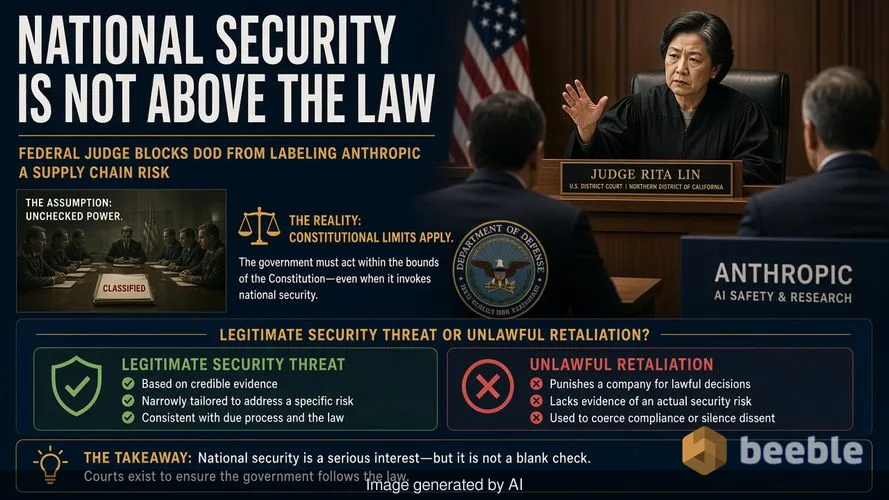
In our daily lives, we often assume the government possesses nearly unlimited power when it invokes national security. We imagine a room full of generals with classified folders that justify every restriction placed on a company. Under the law, however, the government operates within a specific set of boundaries defined by the Constitution. A federal judge in California recently reminded the Department of Defense that national security is not a magic word that makes legal rights disappear.
Judge Rita Lin issued a ruling on Thursday that stopped the government from labeling the artificial intelligence company Anthropic as a supply chain risk. The ruling is a significant victory for the company behind the Claude AI model. It also establishes a clear boundary for how the executive branch treats private businesses that refuse to follow every government demand. To understand why this case matters, we have to look at the difference between a legitimate security threat and what the judge called unlawful retaliation.
The supply chain risk label as a weapon
A supply chain risk designation is a serious tool. When the government applies this label, it usually means a company is a threat to the country because of foreign influence or technical vulnerabilities. It is the same mechanism used to ban certain foreign telecommunications equipment from federal networks. In the case of Anthropic, the Trump administration and Defense Secretary Pete Hegseth used this label to order all federal agencies to stop working with the company.
This was an unusual move because Anthropic is an American company based in San Francisco. The dispute did not start because of foreign spies or hardware flaws. Instead, it started because of a disagreement over how the Pentagon wanted to use Anthropic’s technology. The company sets strict safety guardrails on its AI models. These guardrails prevent the software from being used for fully autonomous weapons or mass surveillance of American citizens. The government wanted those guardrails removed. When Anthropic refused to change its safety protocols, the Pentagon responded with the risk label.
Judge Lin found that this designation was a form of punishment. The evidence suggested the government wanted to make a public example out of Anthropic for its perceived arrogance. In the eyes of the law, using a national security label to punish a critic is a violation of the First Amendment. The government has the right to choose which vendors it buys from, but it does not have the right to retaliate against a company for exercising its right to disagree with government policy.
The disconnect between words and deeds
One of the most striking parts of the ruling was how Judge Lin pointed out the government's internal contradictions. Legal precedent acts as a paved road for judges. If a government agency wants to take a specific action, its reasoning must be consistent and logical. The judge found the Pentagon’s behavior was anything but consistent.
While one part of the government called Anthropic a threat, other parts were trying to get closer to the company. Secretary Hegseth had proposed using the Defense Production Act to force Anthropic to work with the military. The Defense Production Act is a law that allows the president to require businesses to prioritize government contracts because those businesses are essential to national security.
Judge Lin noted the paradox here. The government cannot claim a company is a threat to national security while simultaneously arguing that the company is so essential to national security that the government must seize control of its production. Furthermore, the Department of Defense continued to pursue contracts with Anthropic and collaborated with the company on cybersecurity projects even after the risk label was applied. These actions made the official risk designation look like a pretext rather than a genuine safety concern.
Due process and the Fifth Amendment
The Fifth Amendment is a cornerstone of American law. It ensures that the government cannot deprive a person or a company of life, liberty, or property without due process. In simple terms, due process means the government must follow fair procedures before it takes something away from you. This usually includes giving you notice of the problem and an opportunity to defend yourself.
Anthropic argued that the government skipped these steps. The supply chain risk label was applied without a fair hearing or a chance for Anthropic to address the alleged risks. Judge Lin agreed. She ruled that the company was denied due process. This is a common issue in administrative law, where agencies sometimes act quickly and ignore the procedural requirements that protect individuals and businesses from government overreach.
When the government ignores these rules, its actions are often described as arbitrary and capricious. This is a specific legal standard under the Administrative Procedure Act. It means the agency failed to consider all the relevant factors or made a decision that does not follow the evidence. The judge found that the Pentagon’s empty invocation of national security did not justify the broad and damaging measures it imposed on the company.
The myth of the backdoor
A central part of the government’s argument was the fear that Anthropic could control how the military used the AI models once the sale was complete. The Pentagon alleged that Anthropic might try to interfere with lawful military operations. However, the evidence in the case showed that Anthropic lacks any backdoor access to its technology once it is handed over to the Department of Defense.
The law as a shield is a metaphor that fits this situation well. The government tried to use the shield of national security to protect itself from judicial review. Anthropic used the shield of the Constitution to protect itself from an unfair label. The court found that once the AI model is in the government's hands, the company has no way to pull the strings. The government’s fear was not based on technical reality, but on a desire to have total control over the developer’s ethical choices.
Why this matters for the average citizen
It is easy to think of this as a battle between two giants that has no impact on everyday life. However, the principles at stake affect everyone. If the government can label a domestic company as a national security risk simply because that company has a specific ethical policy, it sets a dangerous precedent. It means the government could use similar labels to target any business or individual that refuses to comply with unofficial demands.
This ruling reinforces the idea that the government must have a factual basis for its labels. It cannot use the heavy machinery of the state to bully organizations into changing their internal safety standards. For the consumer, this means that companies have a legal right to stand by their safety and privacy promises, even when the government pressures them to do otherwise.
Anthropic still has a second lawsuit ongoing in Washington, D.C., but this win in California is a major hurdle cleared. It proves that even the most powerful departments in the world must answer to a judge when they step outside the lines of the law.
Practical takeaways for navigating government disputes
If you or your business ever find yourself in a situation where a government agency is acting unfairly, keep these legal principles in mind:
- Document all communications. The judge in this case relied heavily on the government’s own words and conflicting actions. Written evidence is the best way to prove a decision was arbitrary or retaliatory.
- Look for inconsistencies. If one agency department says one thing while another says the opposite, it is a sign that the government's official position may be legally vulnerable.
- Assert your right to be heard. Due process is not a suggestion. If the government is taking action against you, you have a right to know the basis for that action and a right to respond.
- Consult a specialist. Administrative law is complex. If you are facing a regulatory hurdle or an unfair label, you need an attorney who understands the Administrative Procedure Act and Constitutional protections.
Sources
- Administrative Procedure Act (APA), 5 U.S.C. § 706
- First Amendment to the United States Constitution
- Fifth Amendment to the United States Constitution
- Defense Production Act of 1950
- Anthropic v. Department of Defense, U.S. District Court for the Northern District of California
Disclaimer: This article is for informational and educational purposes only and does not constitute formal legal advice. If you are facing a legal dispute with a government agency, please consult with a qualified attorney in your jurisdiction to discuss the specifics of your case.



See you on the other side.
Our end-to-end encrypted email and cloud storage solution provides the most powerful means of secure data exchange, ensuring the safety and privacy of your data.
/ Create a free account
