


Anthropic just handed AI the keys to the physical world

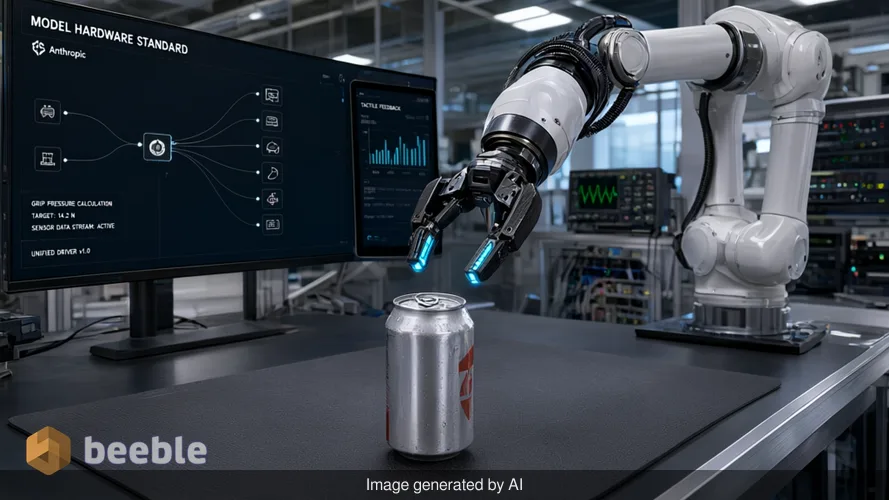
The aluminum can sits on a laboratory bench. To pick it up, a robotic arm must calculate the exact pressure needed to grip the metal without a crush. That calculation relies on sensor data. The sensor data travels through a driver, a piece of software that acts as a translator between the machine and the computer. For decades, engineers had to write a new translator for every single piece of hardware in a room. Anthropic now intends to replace those thousands of custom scripts with a single set of rules called the Model Hardware Standard.
The invisible wall between software and hardware
For the last three years, artificial intelligence has lived almost entirely behind a screen. It can write a poem or debug a block of code, but it is effectively blind and paralyzed in the physical world. If a scientist wants an AI to run a real-world experiment, they usually have to build a custom bridge between the AI and the equipment. This process takes weeks or months of manual coding. One robot speaks one language; the microscope next to it speaks another. The result is a digital Tower of Babel that keeps automation locked inside the data center.
Anthropic is trying to tear down this wall with its new Model Hardware Standard (MHS). This is a set of open drivers designed to let AI agents talk to any device. In simple terms, it is a universal translator for machines. Instead of writing a specific program to tell a robotic arm to move three inches, a developer uses MHS to give the AI a direct path to the machine. The AI then uses natural language to command the hardware. This shift moves AI from being a chatbot to being a shop foreman.
How the universal remote for robots actually works
The technology under the hood relies on two main components. First is the Model Context Protocol (MCP), which Anthropic released previously to help AI access data. The second is MHS, which focuses on physical action. When these two work together, an AI model like Claude can read the manual for a device, understand its controls, and start operating it immediately.
Looking at the big picture, this system works like a USB port for the physical world. Before USB, connecting a printer or a mouse to a computer required specific, often frustrating configurations. USB standardized the connection so that the computer and the device could understand each other instantly. MHS does the same for industrial and scientific hardware. It provides a common format for sharing data and commands across a network. This removes the need for a bespoke translator program between every piece of kit in a lab.
Turning a month of labor into a minute of code
The inspiration for this standard came from the Janelia Research Campus in Virginia. Alek Kemeny, a staffer at Anthropic, watched neuroscientist Arco Bast struggle to coordinate rotating lasers, microscopes, and cameras for an experiment on brain memory. Bast had to build his own interface to make these parts work together. Kemeny realized that if every scientist had to do this, progress would remain slow. The MHS effort aims to fix that. Anthropic says that experimental setups that used to take weeks now take minutes.
In one test case, an AI model controlled a microscope and a laser simultaneously. The model adjusted the laser, checked the results through a camera, and repeated the process to calibrate the system. It did this without a human writing a single line of movement code. The AI reasoned through each step, saw the errors in the image, and moved the microscope to a better position. This is the AI acting as a tireless intern. It does the repetitive, precise work that usually drains a researcher’s time.
Safety tags and the reality of physical limits
One of the biggest risks of letting a digital brain control a physical body is that the brain does not understand weight or gravity. A model might try to make a robotic arm move faster than its motors allow, or it might try to lift something that would snap its joints. MHS includes a standardized tagging system to prevent these disasters. These tags describe the real-world constraints of the hardware.
Each device has a reference file that lists its weight limits, range of motion, and safety shut-off points. When an AI agent connects to a new machine, it reads these tags first. It learns that the arm has a maximum reach of two meters and cannot lift more than five pounds. This information is foundational for safety. It allows the model to operate equipment it has never seen before without breaking it. The model treats these constraints as hard boundaries in its reasoning process, much like a human operator follows a safety manual.
Why the list of partners matters for your budget
Anthropic is not doing this alone. The company is working with a group of manufacturers and researchers to test the system. The partner list is telling. It includes Amazon Web Services (AWS), Hugging Face, and Universal Robots. Most notably, it includes Raspberry Pi. The inclusion of Raspberry Pi is a signal for the average user. It means this technology is not just for billion-dollar pharmaceutical labs.
| Partner | Primary Role | Impact of MHS Integration |
|---|---|---|
| Amazon Web Services | Cloud Infrastructure | Scalable AI control for warehouse robots |
| Raspberry Pi | Low-cost Computing | Affordable home and small-scale industrial automation |
| Hugging Face | AI Research | Open-source libraries for robotic learning |
| Universal Robots | Industrial Arms | Standardized control for factory floor assembly |
| Automata | Lab Automation | Faster processing for diagnostic and chemical tests |
From a consumer standpoint, this standardization usually leads to lower prices. When hardware becomes easier to integrate, the cost of manufacturing drops. If a small startup can set up a robotic assembly line in a weekend rather than a year, they can bring products to market faster and cheaper. In everyday life, this might eventually lead to smarter home appliances that can actually talk to each other without needing a dozen different apps.
The shift from chatbots to actual machines
Historically, industrial revolutions happen when a new way to move power or information becomes standardized. The steam engine was one; the internet was another. MHS is an attempt to standardize the way intelligence moves physical matter. Behind the jargon of drivers and APIs is a simple shift: we are moving away from asking AI to tell us things and toward asking AI to do things.
This technology is currently in a research preview. Anthropic plans to make MHS an open-source, agent-agnostic standard. This means it will not just work with Claude; it could eventually work with models from Google, OpenAI, or Meta. Being agent-agnostic is a resilient strategy. It prevents a single company from owning the language that robots speak.
Practically speaking, the bottom line is that the speed of scientific discovery is about to increase. If a lab can test a hundred hypotheses in the time it used to take to test one, the development of new materials and medicines will accelerate. Alek Kemeny suggested that this could condense a century of progress into a single decade. While that is a bold claim, the logic holds up. Removing the friction between a thought and a physical action is how industry moves forward.
Ultimately, you should watch how your own devices change over the next year. You may notice fewer "smart" gadgets that require specific hubs and more that simply work when you talk to them. The invisible backbone of modern life is becoming more interconnected. The transition from a world of isolated machines to a world of coordinated systems is no longer a matter of if, but when. Pay attention to the labels on your next piece of tech. If it supports a universal standard like MHS or MCP, it is part of a larger shift toward a world where software finally has hands.
Sources:
Anthropic Research Preview: The Model Hardware Standard
HHMI Janelia Research Campus Project Reports
Raspberry Pi Foundation Industrial Hardware Specs
AWS Strands Robotics Integration Documentation



See you on the other side.
Our end-to-end encrypted email and cloud storage solution provides the most powerful means of secure data exchange, ensuring the safety and privacy of your data.
/ Create a free account
