


Beyond the Firewall: Why Your Identity Cyber Score Is the Most Important Metric of 2026

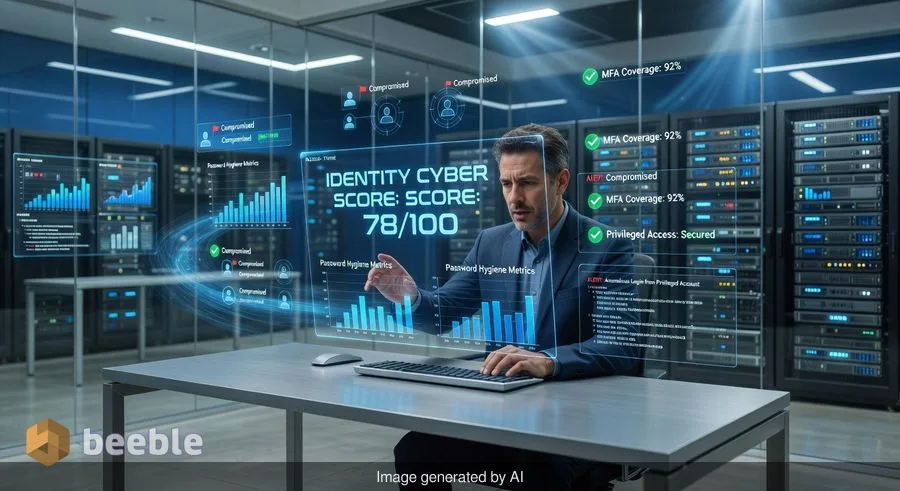
In the early 2020s, securing cyber insurance felt like a box-ticking exercise. If you had a firewall, ran antivirus software, and claimed to use multi-factor authentication (MFA), you were generally covered. But as we move through 2026, the landscape has undergone a fundamental shift. The perimeter is no longer a digital wall; it is a digital person.
Today, one in three cyber-attacks begins with a compromised employee account. This reality has forced insurers to move away from static questionnaires toward dynamic, telemetry-driven assessments. The result is the rise of the Identity Cyber Score—a real-time metric that determines not just your premium, but whether you are insurable at all.
The Shift from Perimeter to Persona
For decades, IT security focused on the network. We protected the 'pipes' through which data flowed. However, the mass adoption of hybrid work and cloud-native architectures has rendered the traditional network perimeter obsolete. In 2026, the identity of the user—whether a human employee, a service account, or an AI agent—is the only meaningful boundary left.
Insurers have taken note. They have realized that a company with a state-of-the-art firewall but poor identity hygiene is a much higher risk than a company with a modest network setup and rigorous identity controls. This has led to the 'Identity-First' insurance model, where your Identity Cyber Score acts much like a corporate credit score, fluctuating based on your daily security posture.
Deciphering the Identity Score: What Matters Most?
If you were to look under the hood of a modern insurance risk assessment, you would find that the 'black box' of identity scoring is built on three primary pillars:
- MFA Quality, Not Just Quantity: In 2026, insurers no longer give full credit for SMS-based or push-notification MFA, both of which are easily bypassed by modern 'adversary-in-the-middle' attacks. High scores are now reserved for organizations using phishing-resistant authentication, such as FIDO2-compliant passkeys or hardware security keys.
- The Shadow of Privileged Access: Privileged Access Management (PAM) is the most scrutinized area of the score. Insurers look for 'Just-in-Time' (JIT) access—where administrative rights are granted only for a specific task and then revoked—rather than 'standing privileges' that sit dormant and vulnerable.
- Identity Hygiene and Sprawl: This measures how well an organization manages the lifecycle of an account. Are 'ghost accounts' of former employees still active? Is there a mountain of unmanaged service accounts used by legacy applications? A high volume of stale or over-privileged accounts is a major red flag that can tank a score instantly.
The Telematics Analogy: Real-Time Risk
To understand how this works in practice, think of the telematics devices that car insurers use to track driving habits. If you brake hard or speed, your premium goes up. Identity Cyber Scores function similarly.
Modern insurance providers often require read-only access to an organization’s Identity Provider (IdP) telemetry. If the system detects a spike in failed login attempts from unusual geographies, or if a high-ranking executive disables their MFA, the risk profile updates. This transparency allows for 'usage-based' cyber insurance, where companies that maintain a high identity posture throughout the year are rewarded with monthly premium rebates.
The Financial Stakes of Identity Posture
The gap between a 'Good' and 'Poor' Identity Cyber Score is no longer just a few thousand dollars. In the current market, organizations with optimized identity postures are seeing premium reductions of up to 40%. Conversely, those who cannot demonstrate automated identity governance are facing 'identity exclusions'—clauses in their policies that refuse to pay out if the root cause of a breach was a compromised unmanaged account.
Furthermore, regulators have begun to align with these insurance standards. In many jurisdictions, a low Identity Cyber Score is now being used as evidence of a lack of 'reasonable security,' potentially increasing legal liability following a data breach.
Practical Steps to Improve Your Score
Improving your organization’s standing doesn't happen overnight, but there are clear steps to move the needle:
- Audit Your MFA Coverage: Move beyond the 'MFA is on' mindset. Map out exactly which systems are using legacy MFA and prioritize the transition to phishing-resistant methods for high-value targets.
- Implement Identity Threat Detection and Response (ITDR): Insurers value the ability to see an attack in progress. ITDR tools provide the telemetry that proves you are actively monitoring for credential theft and lateral movement.
- Clean Up Service Accounts: These are often the 'forgotten' identities. Use automated discovery tools to find service accounts that haven't been used in 90 days and disable them.
- Adopt Just-in-Time (JIT) Access: Eliminate permanent admin accounts. Moving to a model where privileges are requested and approved via automation is the single fastest way to boost a PAM score.
The Path Forward
As we look toward the end of 2026, the Identity Cyber Score will only become more influential. It is moving from a niche insurance metric to a standard benchmark for business-to-business trust. Just as you wouldn't partner with a company with a failing credit score, enterprises are beginning to vet the identity scores of their vendors and supply chain partners.
For the modern CISO, the goal is clear: identity is no longer just an IT function. It is a financial and strategic asset. By mastering the metrics that define the Identity Cyber Score, organizations can secure not only their data but also their financial resilience in an increasingly volatile digital economy.
Sources
- Microsoft Digital Defense Report 2025/2026 Trends
- Gartner: Top Strategic Technology Trends for 2026 - Identity-First Security
- Okta: The State of Secure Identity 2026 Report
- Cybersecurity & Infrastructure Security Agency (CISA): Phishing-Resistant MFA Guidance
- Marsh McLennan: Cyber Insurance Market Outlook 2026



See you on the other side.
Our end-to-end encrypted email and cloud storage solution provides the most powerful means of secure data exchange, ensuring the safety and privacy of your data.
/ Create a free account
