


Can Life Get Better by Doing Less? Why Researchers Are Shrinking the Genetic Code

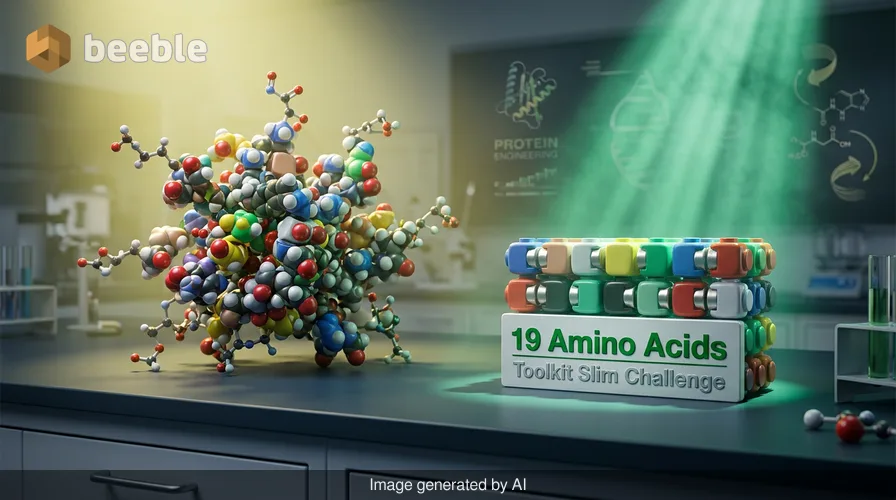
For as long as we have understood the mechanics of life, the number twenty has been a foundational constant. Every living thing on Earth, from the mold on your bread to the person sitting next to you, builds itself using a standard set of 20 amino acids. Think of these as the biological equivalent of Lego bricks. While they can be assembled into an infinite variety of proteins, the shapes of the bricks themselves haven't changed in billions of years. We have long assumed that this set of twenty was the optimized, perfect result of evolution—an immutable baseline for life.
However, a groundbreaking movement in synthetic biology is now challenging this narrative. While popular science often focuses on adding new features to life—like glowing plants or vitamin-enriched crops—a group of researchers is taking a contrarian approach. They aren't trying to add to the toolkit; they are trying to see how much of it they can throw away. By successfully engineering organisms that function with only 19 amino acids, these scientists are proving that nature’s "perfect" number might actually be a bit bloated.
Looking at the big picture, this isn't just a quirky laboratory trick. It is a fundamental shift in how we approach the industrialization of biology. To understand why someone would want to make life more limited, we have to look under the hood at how proteins are actually built.
The Biological Operating System
To grasp what is happening here, it helps to view the genetic code as an operating system. In this OS, your DNA provides the instructions, and amino acids are the physical materials used to execute those instructions. Each protein in your body is a long chain of these 20 amino acids, folded into a specific shape to perform a task—carrying oxygen in your blood, for instance, or digesting your lunch.
Every three letters of DNA (called a codon) acts as a command to "insert amino acid X here." Because there are 64 possible combinations of DNA letters but only 20 amino acids, the system has a lot of redundancy. It is a bit like having five different ways to say the word "blue" in a manual. For billions of years, life has just dealt with this inefficiency.
In simple terms, researchers are now going through that manual and deleting one of the words. They are taking a specific amino acid—for example, serine or leucine—and re-engineering the cell's machinery so it no longer recognizes that specific brick. They then replace every instance of that "deleted" brick with a similar one from the remaining 19. Essentially, they are streamlining the source code of life to run on a more restricted set of hardware.
Building the Genetic Firewall
Why go through the immense trouble of rewriting a genome to use fewer parts? The answer lies in security and industrial resilience. Currently, our most important medicines—like insulin and certain cancer treatments—are manufactured in giant vats of bacteria or yeast. These microscopic factories are highly efficient, but they have a massive vulnerability: they speak the same language as the rest of the world.
If a virus enters a traditional bioreactor, it can hijack the bacteria because both the virus and the bacteria use the same 20 amino acids. The virus uses the bacteria's own "3D printers" to make more of itself, destroying the batch and costing companies millions of dollars.
By cutting the code down to 19 amino acids, scientists are creating what they call a genetic firewall. An organism with 19 amino acids is essentially speaking a dialect that no natural virus can understand. If a virus enters a "19-acid" cell and demands it use the 20th brick to build a viral protein, the cell simply can't do it. The instructions become gibberish. This creates a robust, decentralized defense system that could make the production of life-saving drugs far cheaper and more reliable.
Beyond the Lab: What This Means for You
For the average user, the idea of a 19-amino-acid bacterium might feel like a distant academic pursuit. Practically speaking, however, this technology is the foundation for a more resilient supply chain in the pharmaceutical and materials industries.
Consider the volatility of drug prices. A significant portion of the cost of biological drugs comes from the extreme measures taken to keep production environments sterile and virus-free. If we can move toward "intrinsically safe" organisms that are immune to natural contamination by design, we shift the economics of medicine. We are looking at a future where the hardware of life is less fragile.
Furthermore, this research opens the door to truly synthetic materials. Once you have a cell that ignores one of the standard 20 amino acids, you can "reassign" that empty slot to a synthetic, man-made amino acid. This allows us to create proteins with properties that don't exist in nature—think of fibers as strong as spider silk but as flexible as rubber, or enzymes that can break down plastics in the ocean without being degraded themselves.
The Risks of Playing with the Foundations
Of course, whenever we tinker with the foundational logic of biology, a degree of skepticism is healthy. Critics of synthetic biology often point to the risk of "unintended consequences." If we create an organism that is immune to all known viruses, what happens if it escapes the lab?
Curiously, the 19-amino-acid approach actually offers a built-in safety mechanism. These engineered organisms are often designed to be "auxotrophic," meaning they are addicted to a specific synthetic chemical that doesn't exist in the wild. If they leave the controlled environment of the lab or factory, they simply stop functioning. Unlike traditional GMOs, which are just slightly modified versions of natural plants, these reduced-code organisms are so fundamentally different that they are biologically isolated from the rest of the planet's ecosystem.
A New Industrial Backbone
Looking at the market side, we are seeing a shift in where venture capital is flowing. The previous decade was about "reading" DNA (genomics) and "editing" DNA (CRISPR). The next decade is increasingly about "writing" entirely new systems.
Historically, heavy industry relied on chemistry and heat to build the world. Today, we are seeing biology emerge as the invisible backbone of modern manufacturing. Whether it is brewing jet fuel from algae or growing leather in a lab, the goal is to make these processes as predictable and scalable as a software update. Reducing the complexity of the genetic code is a disruptive step toward making biology a true engineering discipline rather than a series of lucky accidents.
| Feature | Standard Biology (20 Amino Acids) | Streamlined Biology (19 Amino Acids) |
|---|---|---|
| Viral Resistance | Vulnerable to natural viruses | Naturally immune to most viruses |
| Safety/Containment | Can often cross-breed with wild species | Biologically isolated/Genetic firewall |
| Industrial Use | High cost of sterilization | Potential for "open-air" bioprocessing |
| Material Diversity | Limited to natural proteins | Can incorporate synthetic building blocks |
| Complexity | High (evolutionary "spaghetti code") | Reduced (engineered for efficiency) |
Key Takeaways for the Consumer
- Cheaper Medicines: By making biomanufacturing more resilient to viral contamination, the overhead costs for producing insulin, vaccines, and biologics could drop significantly.
- Enhanced Bio-Safety: A 19-amino-acid organism is essentially trapped in a "genetic cage," making it much safer for industrial use than traditional genetically modified organisms.
- Next-Gen Materials: This tech is the precursor to "programmable matter," leading to new fabrics, biodegradable plastics, and more durable consumer goods.
- The End of "Nature Knows Best": We are moving past the era of simply using what nature provides and entering an era where we can optimize the very building blocks of life for specific human needs.
Ultimately, this research suggests that the constraints of nature are not as rigid as we once thought. By removing one small piece of the genetic puzzle, we aren't just making life simpler; we are making it more controllable, more resilient, and more useful for a modern industrial world. As a consumer, you may never see a 19-amino-acid cell, but you will almost certainly use the products they create. It is time to shift our perspective: sometimes, to move forward, we have to leave a piece of the past behind.
Sources:
- Ars Technica, "Researchers try to cut the genetic code from 20 to 19 amino acids" (April 2026).
- Nature Chemical Biology, "Recoded organisms and the future of biosecurity."
- Wyss Institute for Biologically Inspired Engineering, "Project 19: Synthetic Genome Recoding Reports."
- Synthetic Biology Coalition, "Market trends in biocontainment and pharmaceutical manufacturing 2025-2027."



See you on the other side.
Our end-to-end encrypted email and cloud storage solution provides the most powerful means of secure data exchange, ensuring the safety and privacy of your data.
/ Create a free account
