


Digital Sovereignty vs. The First Amendment: Navigating the Great Atlantic Tech Schism

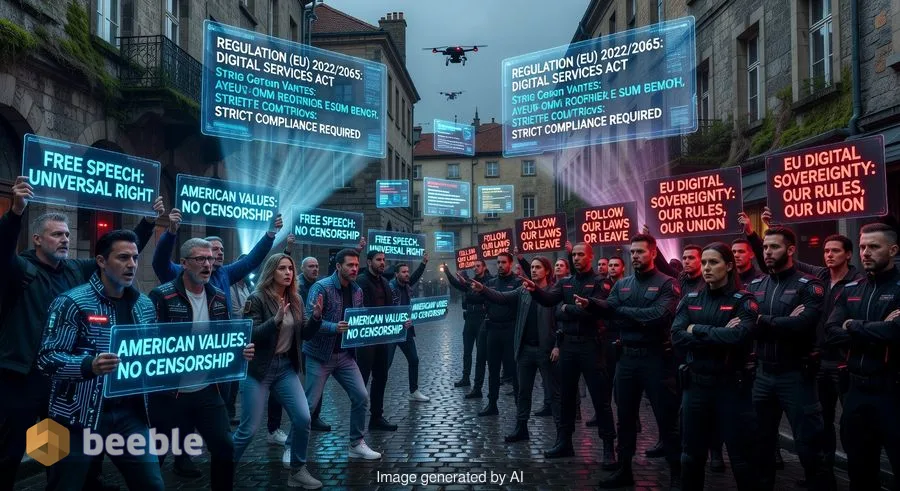
The tension between American tech giants and European regulators has reached a fever pitch. On one side of the Atlantic, the narrative is often framed through the lens of the First Amendment—an almost sacred commitment to the 'marketplace of ideas' where the remedy for bad speech is more speech. On the other, the European Union has constructed a formidable legislative fortress designed to protect citizens from systemic risks, disinformation, and market monopolization.
This isn't just a legal disagreement; it is a fundamental clash of philosophies. When American platforms decry 'censorship,' European officials often respond with a shrug and a simple ultimatum: 'Our house, our rules.' As we move deeper into 2026, this friction is no longer just theoretical—it is actively reshaping the tools we use every day.
Two Worlds, Two Definitions of Freedom
To understand the conflict, one must look at the foundational documents of both powers. In the United States, the First Amendment prohibits the government from 'abridging the freedom of speech.' Over decades, this has evolved into a culture where private companies have broad immunity under Section 230 to moderate—or not moderate—as they see fit, while the government remains largely hands-off.
In contrast, the European approach is rooted in the concept of 'human dignity' and 'digital sovereignty.' For the EU, freedom of speech is not an absolute right if it infringes upon the safety or democratic stability of the collective. The European perspective argues that a digital environment poisoned by hate speech or algorithmic manipulation isn't actually free—it's coercive. This philosophical divide explains why a tweet that is considered 'protected speech' in Texas might be flagged as 'illegal content' in Paris.
The Legislative Fortress: DSA and DMA
The primary tools in the EU’s arsenal are the Digital Services Act (DSA) and the Digital Markets Act (DMA). By 2026, these aren't just acronyms; they are the operational reality for every major tech firm.
The DSA mandates that platforms must aggressively police illegal content, provide transparency on their recommendation algorithms, and mitigate systemic risks like election interference. Failure to comply can result in fines of up to 6% of global annual turnover. For a company like Meta or Alphabet, that’s not just a cost of doing business; it’s a threat to their survival.
The DMA, meanwhile, targets 'gatekeepers'—the handful of companies that control access to the digital economy. It forces them to allow interoperability and forbids them from favoring their own services. While the US views this as an attack on successful American innovation, the EU views it as a necessary step to ensure that European startups have a fair chance to compete.
The Rise of the 'Feature Gap'
We are now seeing a phenomenon known as 'geofencing by regulation.' In 2024 and 2025, we saw the first major instances of tech companies withholding features from the European market due to regulatory uncertainty. Whether it was advanced AI integrations or new social media functionalities, European users found themselves behind a digital curtain.
This has led to a paradoxical situation. While European regulators claim they are protecting their citizens, some of those citizens feel they are being treated as second-class digital residents. Conversely, American users often enjoy the latest features but remain vulnerable to data harvesting and algorithmic biases that the EU has successfully curtailed. The 'Brussels Effect'—where EU rules become the global default—is facing its toughest test yet as companies decide that, in some cases, it’s easier to simply opt out of the European market for specific products.
The AI Act: The New Frontier
If the battle over social media was the first wave, Artificial Intelligence is the second. The EU AI Act, now in full effect, categorizes AI systems by risk level. High-risk systems, such as those used in recruitment or law enforcement, face stringent requirements. Most controversially, the Act places strict limits on generative AI models, requiring them to disclose when content is AI-generated and to respect copyright laws during training.
American developers often argue that these rules stifle innovation, creating a 'permission-based' culture that slows down the pace of discovery. The European response remains consistent: innovation without ethics is a liability. This has created a bifurcated AI landscape where European AI models are often more transparent but less 'unfiltered' than their American counterparts.
Practical Takeaways for the Global User
As the digital divide widens, users and businesses must adapt to a world where the internet is no longer a monolith. Here is how to navigate the current landscape:
- Understand Regional Differences: If you are a developer, 'Global Launch' now requires a multi-tiered compliance strategy. What works in the US may be illegal in the EU.
- Monitor Feature Availability: Be aware that 'Global' tech announcements often exclude the EU or have significant delays. Always check the regional availability list for new AI tools.
- Data Sovereignty Matters: For businesses, where your data is stored and processed is now a legal liability. Ensure your cloud providers are compliant with both GDPR and the newer Data Act.
- Expect a 'Splinternet': We are moving away from a single global web toward a series of regional 'walled gardens' governed by local values. Using a VPN may bypass some filters, but it won't change the underlying regionalized algorithms.
The Path Forward
The 'leave if you don't like it' sentiment from Europe and the 'you're killing innovation' cry from America are both oversimplifications. The EU is a market of 450 million affluent consumers; no sane American company wants to leave it. Simultaneously, Europe relies heavily on American infrastructure for its digital economy.
The future likely holds a messy, ongoing negotiation. We are moving toward a 'coordinated divergence,' where both sides agree to disagree on the philosophy while finding enough common ground to keep the cables connected. The tension isn't a bug in the system—it’s the new operating system of the global internet.



See you on the other side.
Our end-to-end encrypted email and cloud storage solution provides the most powerful means of secure data exchange, ensuring the safety and privacy of your data.
/ Create a free account
