


How a retired inventor and a team of students just saved 2,000 years of lost history

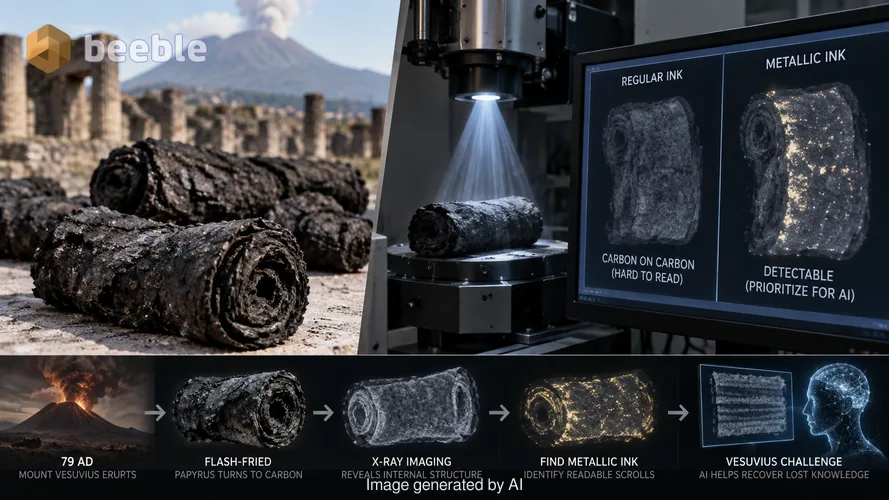
The scorched remains of the library at Herculaneum look like lumps of charcoal found at the bottom of a backyard fire pit. For centuries, these scrolls were the ultimate historical tease. We knew they contained the lost thoughts of Epicurean philosophers, yet touching them caused them to turn to dust. They survived the eruption of Mount Vesuvius in 79 AD because they were flash-fried by volcanic gas, which turned the papyrus into pure carbon. This preservation is a double-edged sword. To read the ink, we usually need X-rays to see through the material. But because the ink is also carbon-based, the X-ray sees carbon on carbon. It is like trying to read a black marker on black construction paper in a dark room.
A new study published in PLoS ONE reveals a breakthrough that changes this dynamic. A diverse team of researchers, led by a retired inventor and involving high school students, developed a method to identify which scrolls contain metallic ink. This discovery provides a roadmap for the Vesuvius Challenge, a global competition to read the scrolls using artificial intelligence. By using hardware found in industrial inspection labs, the team found a way to prioritize the most readable documents, moving us closer to recovering a lost library of the ancient world.
The chemistry of a 2,000-year-old problem
Ancient scribes typically used lampblack ink, which is essentially soot mixed with water and gum. This is the carbon-on-carbon problem that has stalled progress for decades. However, a theory emerged that some later scrolls might use ink containing lead. If lead is present, the letters would appear bright under an X-ray scan, much like bones appear bright against soft tissue. The challenge was proving that lead was there without unrolling the fragile papyrus.
Douglas Seiler, a retired inventor, approached the problem with a pragmatic filter. He assembled a group including chemists, archaeologists, and physicists to test how lead-based ink reacts to modern scanning. The team needed to know if a standard handheld scanner could detect these traces through layers of charred material. To do this, they had to recreate the ancient disaster under laboratory conditions.
Building a modern replica of an ancient disaster
The team purchased modern Egyptian papyrus, which is still manufactured using techniques similar to those of the Roman era. They also sourced traditional lampblack ink from Japan. To create a controlled experiment, they added specific amounts of lead nitrate to the ink. They then recruited high school students to write on the papyrus using reed styluses. Curiously, the students did not write ancient philosophy. They inscribed the scrolls with quotes from Star Wars, the Bible, and 1960s television shows.
Once the writing was dry, the researchers placed the scrolls in a high-temperature furnace. This process carbonized the papyrus and the ink, mimicking the volcanic heat of Herculaneum. The result was a collection of modern artifacts that were chemically and physically almost identical to the 2,000-year-old scrolls. This foundation allowed them to test scanning equipment without risking a single priceless original document. Looking at the big picture, this allowed the team to verify exactly how much lead is needed for a letter to become visible to a machine.
Using battery software to read philosophy
Under the hood, the technology used to see through these charred replicas is remarkably similar to what engineers use to inspect hardware. The team utilized micro-computed tomography, a non-invasive technique often used in cancer imaging and industrial quality control. One of the researchers, Michael Cyrus Daugherty, adapted a software program originally designed to inspect the "jelly rolls" inside lithium-ion batteries.
In a battery, the software looks for defects in the tightly wound layers of metal and chemicals. In this project, the software treated the charred papyrus as a damaged battery. It virtually unwrapped the layers, flattening the 3D scan into a 2D image that a human can read. When the scans hit the lead-based ink, the letters appeared with high contrast. This confirmed that if a scroll has even a small amount of lead, modern software can pull the text out of the digital noise. The AI acts as a tireless intern, scanning through thousands of virtual slices to find the exact moment a letter becomes legible.
Why handheld scanners change the game
One of the most practical outcomes of this research is the use of handheld X-ray fluorescence (XRF) scanners. These devices are common in scrap metal yards and environmental testing labs. They are portable and relatively easy to use. The team proved that a technician can simply point an XRF scanner at a charred scroll to determine if it contains lead. This is a systemic shift in how we approach archaeology.
Instead of sending every scroll to a massive particle accelerator for expensive scanning, researchers can now screen the collection in a basement. They can identify the most promising candidates for deep analysis in minutes. This streamlined approach saves millions of dollars and thousands of hours of computing time. For the average user, this means the pace of discovery is about to accelerate. We are no longer guessing which lumps of charcoal to scan; we are following a map of metallic signatures.
The broader impact on modern data science
This project is more than a win for history buffs. It represents a foundational shift in how we handle corrupted data. Think of these scrolls as a corrupted hard drive from the ancient world. The techniques developed here—the digital unwrapping, the neural network training, and the material analysis—have applications in fields far beyond archaeology.
In everyday life, these same algorithms help doctors identify tumors in complex scans or help manufacturers find microscopic cracks in airplane parts. The Vesuvius Challenge has democratized this high-level science by making the data public. This allows independent researchers and hobbyists to contribute to the deciphering process. The project proves that when we combine industrial hardware with crowdsourced intelligence, we can solve problems that were previously considered impossible.
Practical foresight for the digital age
As we look toward the future, the success of the Seiler team suggests that our understanding of history is volatile and subject to sudden updates. We often assume that the past is a fixed set of facts found in textbooks. In reality, thousands of documents are currently sitting in museum basements, waiting for the right sensor to make them talk. The bottom line is that the barrier between us and the ancient world is no longer physical fragility. It is now a matter of signal-to-noise ratios and processing power.
You should observe how these developments change our digital habits. The same machine learning that recognizes a Greek letter on charred papyrus is the technology that organizes your photo library or predicts your next purchase. Seeing it applied to a 2,000-year-old mystery reminds us that these tools are resilient and capable of handling extreme complexity. We are witnessing the birth of a digital forensic lab for the entirety of human history. This progress encourages us to appreciate the invisible industrial mechanics that turn raw data into meaningful stories.
Sources: NIST, PLoS ONE, University of Kentucky, Vesuvius Challenge Project Reports.



See you on the other side.
Our end-to-end encrypted email and cloud storage solution provides the most powerful means of secure data exchange, ensuring the safety and privacy of your data.
/ Create a free account
