


Inside the ‘Robot School’: How China is Using VR to Teach Humanoids the Art of Daily Chores

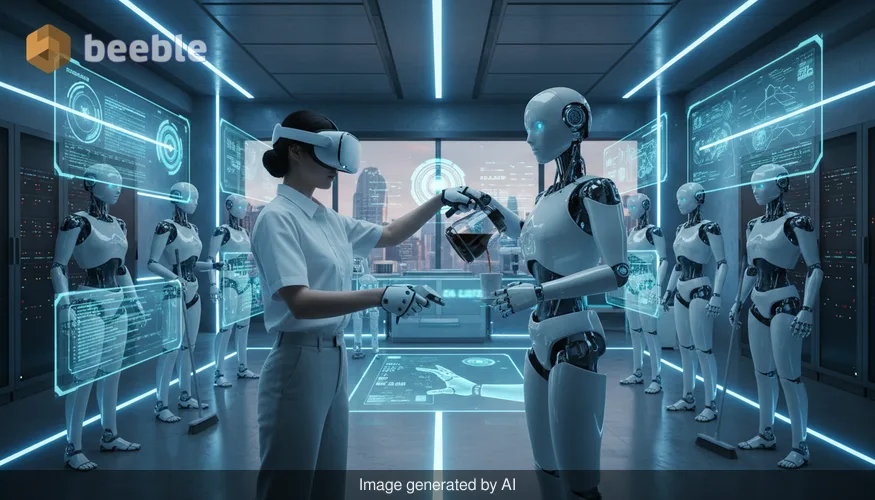
In a brightly lit laboratory in Wuhan, the future of domestic labor is being written—not through lines of code, but through the fluid movements of human teachers. This facility, often described as a "robot school," represents a shift in how we approach artificial intelligence. Instead of trying to program every joint rotation and torque calculation manually, engineers are using virtual reality (VR) to show robots how to live in a human world.
As of early 2026, the race for a general-purpose humanoid robot has moved from the "can it walk?" phase to the "can it be useful?" phase. China’s approach in Wuhan focuses on the latter, utilizing a method known as imitation learning to bridge the gap between mechanical potential and practical utility.
The Virtual Classroom: How Teleoperation Works
The process begins with a human trainer, such as Qu Qiongbin, donning a VR headset and grasping a pair of motion controllers. Through the headset, the trainer sees exactly what the robot sees. As the trainer moves their arms to reach for a coffee mug or fold a shirt, the humanoid robot standing across the room mimics those motions in real time.
This is more than just remote control; it is a sophisticated data-gathering mission. Every nuance of the human movement—the acceleration of the wrist, the pressure applied by the fingers, and the correction of a slight slip—is recorded.
"Our left and right hands are like the robot's left and right arms," explains Qu Qiongbin. "It will learn our postures by moving them. The data will be uploaded to the cloud. Once the data is approved, it will be uploaded to the robot, and it will learn from it."
From Mimicry to Autonomy
The goal isn't to have a human controlling the robot forever. The magic happens in the "cloud" phase mentioned by the trainers. Once thousands of hours of teleoperated data are collected, they are fed into neural networks. This allows the robot to move from simple mimicry to autonomous execution.
By observing different trainers perform the same task in various environments, the robot’s AI learns to generalize. It understands that a "cup" might be ceramic or plastic, and that it might be on a table or a kitchen counter. This data-heavy approach is what allows these machines to graduate from the lab to the real world, where conditions are rarely perfect.
The Rise of the AI Robot Trainer
This new industry has birthed a unique profession: the AI Robot Trainer. These individuals are part choreographer, part data scientist, and part educator. The emotional connection between the trainer and the machine is surprisingly strong.
Qu Qiongbin describes the sense of accomplishment as being akin to watching a child grow up. This human-centric teaching method is vital because human environments are designed for human bodies. By having humans "pilot" the robots through these spaces, engineers ensure the robots learn the most efficient and safe ways to navigate our homes and workplaces.
Why This Matters in 2026
China has set ambitious goals to mass-produce humanoid robots by 2027, viewing them as a solution to a shrinking labor force and an aging population. The Wuhan "robot school" is a critical piece of this puzzle. While Western companies like Tesla and Figure AI are pursuing similar paths, the sheer scale of data collection in Chinese labs provides a competitive edge in training speed.
| Feature | Traditional Robotics | Imitation Learning (Robot School) |
|---|---|---|
| Programming | Manual, rule-based code | Data-driven, neural networks |
| Adaptability | Low; struggles with new objects | High; learns through experience |
| Training Method | Mathematical modeling | VR teleoperation and observation |
| Primary Use | Structured factory floors | Unstructured home/office settings |
| Speed of Deployment | Slow for complex tasks | Rapid, once dataset is established |
Practical Takeaways: What This Means for the Future
As these technologies move from the lab to the consumer market, here is what we can expect in the coming years:
- The "App Store" for Skills: Much like downloading an app, future robot owners may download "skill sets" (e.g., "Deep Cleaning" or "Barista Mode") trained by professional trainers in facilities like the one in Wuhan.
- Lower Hardware Costs: As the software (the "brain") becomes more efficient at handling data, the hardware requirements for robots may stabilize, making them more affordable for middle-class households.
- New Career Paths: The role of "Data Labeler" is evolving into "Physical AI Trainer," a job that requires physical coordination and an understanding of spatial logic rather than a degree in computer science.
Looking Ahead
The sight of a robot learning to make coffee via a VR headset might seem like science fiction, but it is the current reality of the robotics industry. By treating robots like students rather than tools, researchers are unlocking a level of dexterity and common sense that was previously thought impossible. The "graduates" of the Wuhan robot school may soon be the ones helping us with our daily chores, proving that the best way to build an artificial person is to have a real person show them the way.



See you on the other side.
Our end-to-end encrypted email and cloud storage solution provides the most powerful means of secure data exchange, ensuring the safety and privacy of your data.
/ Create a free account
