


Meta is using AI to turn its failed app factory into a high-speed assembly line

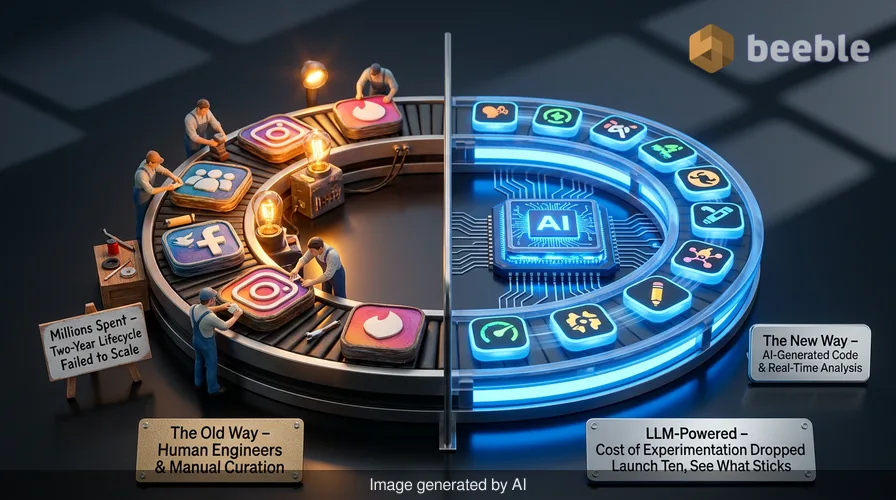
For over a decade, Meta followed a predictable cycle of creative destruction. The company would launch a small, experimental social app like Paper or Slingshot, fail to find an audience, and quietly shut the project down within two years. These efforts resembled a digital lottery where the company spent millions of dollars hoping to stumble upon the next big thing. Historically, these experiments failed because building and maintaining standalone apps required too many human engineers and too much manual curation to scale.
Looking at the big picture, the company has now replaced that manual process with artificial intelligence. During a recent earnings call, CEO Mark Zuckerberg explained that large language models (LLMs) allow Meta to build and ship software at a pace that was previously impossible. Instead of hiring hundreds of designers to guess what users want, Meta uses AI to generate code and analyze trends in real time. This shift is not just about speed. It is about the cost of experimentation. When the price of building an app drops, a company can afford to launch ten niche products to see which one resonates with the public.
The graveyard of social experiments
To understand why this AI shift is significant, we have to look at the history of Meta’s internal incubators. In 2014, the company formed Creative Labs. This group produced Paper, a news reader that many tech critics loved but regular users ignored. They followed it with Slingshot, an ephemeral photo app meant to compete with Snapchat, and Rooms, an anonymous chat service. By 2015, every one of these apps was dead. The company simply could not justify the resources needed to support products that lacked massive, immediate growth.
In 2020, Meta tried again with the NPE Team (New Product Experimentation). This group launched a flurry of apps including a dating tool called Spark, a music maker called BARS, and a couples app named Tuned. Practically speaking, these apps felt like side projects. They lacked the polish of Instagram and the reach of Facebook. Most were shut down by 2022 because they could not gain enough traction to survive the internal competition for engineering talent. The company found itself stuck in a pattern where its core apps grew larger while its new ideas withered in isolation.
How AI acts as a tireless developer
Under the hood, Meta is now using LLMs to solve the two biggest problems in app development: writing the code and finding the audience. Zuckerberg told investors that AI is helping teams speed up product development by handling the repetitive tasks of software engineering. This allows a small team to build a standalone app like Forum or Seller in a fraction of the time it took five years ago. Essentially, AI serves as an automated assembly line for digital products.
Once an app exists, the next challenge is getting people to use it. In the past, a new app had to build its own recommendation engine from scratch to show users relevant content. Today, Meta uses a unified AI recommendation system. When a user opens the new Marketplace-focused app, Seller, the AI already knows their shopping habits from Facebook. When they open the new gaming app, the system understands their preferences from Instagram Reels. This interconnected data allows new apps to feel personalized from the very first minute a user logs in.
The Threads blueprint for success
Meta now has a successful model for this strategy in the form of Threads. While previous experiments struggled to reach one million users, Threads reached 500 million monthly active users in record time. The company did this by leaning on its existing user base and using AI to fill the feed with interesting posts. Meta CFO Susan Li noted that LLMs make these systems smarter by understanding what content is actually about, rather than just looking at hashtags or keywords.
Behind the jargon, this means the AI reads every post and watches every video to determine the tone and topic. Earlier this year, Meta confirmed that every Reel and Feed post on Instagram is processed through an LLM. This analysis helps the system decide which content to push to new apps. For the average user, this results in a feed that feels more intuitive and less repetitive. It also means that Meta no longer needs to wait for a new app to become popular before it becomes useful. The content is already there, waiting to be organized by the AI.
Niche apps for a fragmented internet
Meta is currently moving away from the idea of one giant app that does everything. Instead, the company is launching specialized tools for specific tasks. Forum is a standalone app for Groups, designed for people who want community discussions without the clutter of a Facebook news feed. Seller provides a dedicated space for Marketplace power users. Instagram Instants focuses on fast, ephemeral sharing.
This strategy mimics how a specialized tool kit works. Instead of using a Swiss Army knife for every job, users can pick the specific tool that fits their immediate need. On the market side, this allows Meta to capture more of a user's time without making their main apps feel overwhelmed with features. Zuckerberg suggested that these new consumer products are arriving soon, signaling a wave of AI-generated software that will hit app stores in the coming months.
The cost of rapid expansion
From a consumer standpoint, this new era of app development brings both convenience and complexity. On one hand, specialized apps usually offer a cleaner interface and better performance than the bloated main Facebook app. On the other hand, it means users may end up with half a dozen Meta-owned apps on their home screens. Each of these apps collects data and feeds it back into the central LLM, making the company’s understanding of your habits even more precise.
Curiously, this rapid expansion happens at a time when investors are closely watching Meta’s spending. Building and running LLMs is expensive. The company has to justify the billions spent on Nvidia chips by showing that AI actually improves the bottom line. By launching more apps and keeping users engaged for longer, Meta can show more ads in more places. Ultimately, the goal is to make the cost of acquiring a new user lower than the revenue that user generates through AI-targeted advertising.
What this means for your digital habits
As Meta continues this push, you will likely see more prompts within Instagram and Facebook inviting you to try these new standalone experiences. These are not random experiments like the ones from 2014. They are data-driven products designed to keep you within the Meta ecosystem. If you find yourself frustrated by the clutter of the main social apps, these niche alternatives might offer a more streamlined experience.
Practically speaking, you should observe how much storage and attention these apps demand. While AI makes the software better, it also makes it more addictive by perfectly tailoring the content to your mood. You can expect your digital life to become more fragmented as social platforms break apart into specialized functions for shopping, gaming, and community chat. Pay attention to the permissions these new apps request, as they are the sensors that feed Meta's growing AI brain.
Sources: Meta Q2 2024 Earnings Call Transcript, Meta Newsroom, Instagram Engineering Blog, NPE Team Project Archive.



See you on the other side.
Our end-to-end encrypted email and cloud storage solution provides the most powerful means of secure data exchange, ensuring the safety and privacy of your data.
/ Create a free account
