


The Cost of Conflict: Why ChatGPT Uninstalls Surged 295% Following DoD Deal

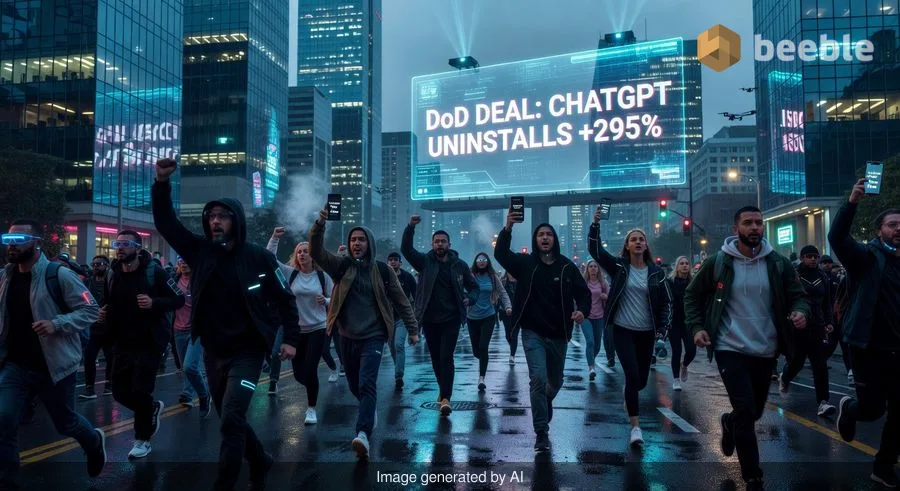
For the better part of three years, OpenAI’s ChatGPT has been the undisputed heavyweight champion of the consumer AI world. However, recent data suggests that even the most dominant tech giants are not immune to the volatility of public sentiment. Following the announcement of a major partnership between OpenAI and the U.S. Department of Defense (DoD)—recently rebranded as the Department of War—the mobile app experienced a staggering 295% surge in uninstalls in a single day.
This mass exodus, occurring on Saturday, February 28, marks a significant pivot point for the company. While OpenAI has navigated controversies regarding data scraping and copyright in the past, the backlash to its direct involvement with military infrastructure represents a new kind of friction: a fundamental disagreement between a service provider and its user base over the ethical boundaries of artificial intelligence.
Breaking Down the Numbers
According to market intelligence provider Sensor Tower, the 295% jump in uninstalls is an extreme outlier. To put this into perspective, ChatGPT’s typical day-over-day uninstall rate has hovered around 9% over the last month. A leap of nearly 300% suggests that this wasn't a gradual churn of disinterested users, but a coordinated or spontaneous protest by a significant portion of the American public.
While download numbers often grab the headlines, the "uninstall" metric is a more visceral indicator of brand health. It represents an active choice by the consumer to remove a tool from their personal space. In this case, the data suggests that for hundreds of thousands of users, the utility of the AI no longer outweighed the discomfort of its new associations.
From Productivity to Procurement
The catalyst for this shift was the confirmation of a sweeping deal between OpenAI and the Department of War. Under the Trump administration’s rebranding of the DoD, the department has taken a more assertive stance on integrating emerging technologies into the national defense apparatus. The deal reportedly involves the integration of large language models (LLMs) into strategic planning, logistical operations, and potentially, battlefield decision-support systems.
For many users, this feels like a betrayal of OpenAI’s founding ethos. The company was originally established with a mission to ensure that artificial general intelligence benefits all of humanity. While the transition from a non-profit to a "capped-profit" entity was the first crack in that image, the leap into military contracting is, for many, the final break. It transforms the AI from a creative assistant or a coding partner into a component of state-sponsored conflict.
The Ethics of Dual-Use Technology
To understand why users are hitting the delete button, we have to look at the concept of "dual-use" technology. Just as GPS was developed for the military before becoming essential for civilian navigation, AI has clear applications in both worlds. However, AI is unique because it mimics human reasoning and decision-making.
When a user interacts with ChatGPT, there is a level of perceived intimacy. People use it to write personal letters, brainstorm business ideas, and even seek mental health support. The realization that the same underlying engine is being tuned to optimize military strikes or war games creates a cognitive dissonance that many find impossible to reconcile. It is the digital equivalent of finding out your favorite librarian has taken a second job as a munitions expert.
The Political Rebranding Factor
The timing of the surge is also linked to the political climate. The rebranding of the Department of Defense back to its pre-1947 name, the "Department of War," has been a polarizing move. By aligning itself with the department under this specific nomenclature, OpenAI has waded into a charged political atmosphere. For a segment of the population, the uninstall is not just an ethical stance on AI, but a political statement against the current administration’s defense policies.
What This Means for the AI Landscape
OpenAI’s loss may be its competitors' gain. In the wake of the February 28 surge, alternative AI platforms like Anthropic’s Claude and decentralized, open-source models have seen a notable uptick in engagement. Anthropic, in particular, has long marketed itself on the pillars of "AI Safety" and "Constitutional AI," positioning itself as the more ethical alternative to the more aggressive expansionism of OpenAI.
If this trend continues, we may see a balkanization of the AI market. Users may begin to choose their tools based not just on performance or features, but on the "moral compass" of the parent company. This could force tech companies to be far more transparent about their government contracts and the specific ways their models are being utilized.
Practical Takeaways for Users
If you are reconsidering your use of ChatGPT in light of these developments, here is how you can navigate the transition:
- Export Your Data: Before uninstalling, use OpenAI’s data export feature to save your chat history. This ensures you don't lose valuable prompts or information you've generated.
- Evaluate Alternatives: Look into platforms like Claude (Anthropic), Gemini (Google), or Perplexity. Each has different terms of service and ethical guidelines regarding government and military use.
- Explore Local Models: For those concerned about privacy and corporate overreach, running open-source models (like Llama 3 or Mistral) locally on your own hardware ensures that your data—and your tool—remains entirely under your control.
- Read the Fine Print: This event serves as a reminder to periodically review the "Terms of Use" for the apps you rely on. Changes in corporate partnerships are often reflected in these documents before they hit the news.
As of now, OpenAI has not issued a formal response to the Sensor Tower data. Whether this is a temporary blip or the start of a long-term decline remains to be seen, but one thing is clear: the era of "neutral" AI is over.



See you on the other side.
Our end-to-end encrypted email and cloud storage solution provides the most powerful means of secure data exchange, ensuring the safety and privacy of your data.
/ Create a free account
