


The Great AI Capacity Wall Is Now Forcing Tech Giants To Ration Power

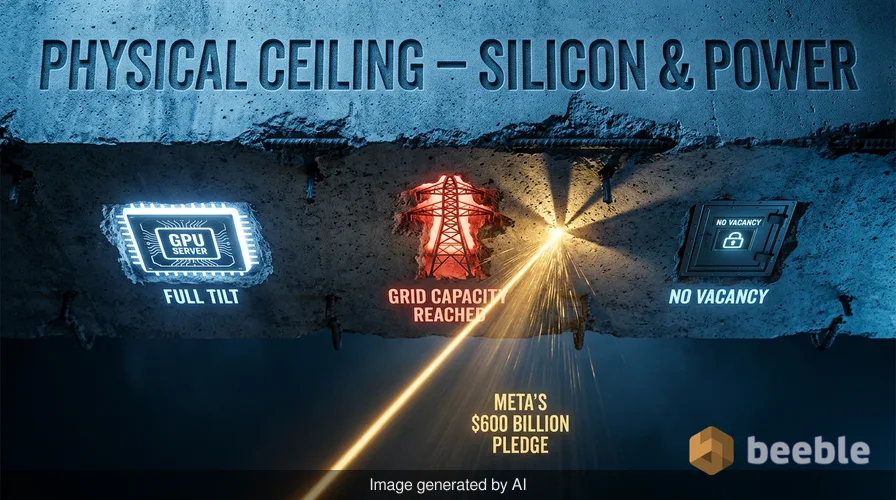
While popular narratives suggest that Silicon Valley has infinite resources to power the AI revolution, the reality is far more fragile. Meta, a company with a market cap in the trillions, recently found itself locked out of Google’s AI tools because there was not enough electricity and silicon to go around. This incident marks a significant shift in the tech world. It proves that even the architects of the digital age are hitting a physical ceiling.
Meta recently exceeded its allocated computing capacity on Google’s Gemini AI model. Google responded by capping Meta’s usage. This news is surprising because Meta is not a small startup with a limited budget. It is a massive corporation that has pledged $600 billion toward cloud computing over the next two years. However, money cannot always solve a supply chain problem. If there are no chips available and the data centers are at full tilt, the work stops. This bottleneck is now affecting how Meta handles everything from customer service to harmful content removal.
Why Mark Zuckerberg needed Google in the first place
It seems counterintuitive that Meta would pay a direct competitor like Google for AI services. Meta has its own family of models called Llama. These models are popular in the developer community and are open source. In simple terms, Llama is Meta’s home-grown engine. However, when it came to specialized tasks like advanced coding, scam detection, and complex customer service chatbots, Meta found that Google’s Gemini performed better.
Meta also uses Anthropic’s Claude for similar purposes. Essentially, the company is acting like a contractor that owns its own tools but rents more powerful equipment for difficult jobs. Behind the jargon, this means Meta’s own technology was not yet efficient enough or accurate enough to handle its massive internal workload. By March, Meta’s reliance on Gemini became so heavy that Google issued a warning. Google told Meta that the limits were firm. Meta then had to tell its own employees to use AI tokens more efficiently to avoid a total shutdown of these services.
The tireless intern and the power bill
Think of an AI model as a tireless intern. This intern can read a thousand pages of code in a second or chat with ten thousand customers at once. But this intern needs a very expensive desk to sit at. In the tech world, that desk is a server equipped with high-end graphics chips. These chips require massive amounts of electricity. When Meta asks Gemini to perform a task, it uses a certain amount of computing power measured in tokens.
Looking at the big picture, the world is running out of these digital desks. Data centers take years to build. Power grids are struggling to keep up with the demand for electricity. The shortage is so severe that Google itself had to look outside its own walls for help. Google recently signed a deal to pay SpaceX $920 million a month to use xAI data centers. This move was necessary because Google’s own infrastructure could not handle the extra weight of Gemini Enterprise. When the provider of the service has to rent space from a third party just to keep its own product running, the system is under extreme stress.
The rising cost of the token economy
To understand why this matters for the average user, we have to look at the economics of a single AI query. Historically, a Google search cost the company a fraction of a penny. An AI query is far more expensive. It requires more time from the processor and more energy. Analysts now point out that companies like OpenAI are not yet profitable because the revenue they earn from subscriptions is much lower than the cost of the electricity and hardware.
| Industry Player | Strategy for AI Capacity | Primary Challenge |
|---|---|---|
| Meta | Rents Gemini and Claude while building $600B in data centers | Own models lack accuracy for specific tasks |
| Rents capacity from SpaceX/xAI to support Gemini Enterprise | Internal infrastructure cannot meet global demand | |
| OpenAI | Relies on Microsoft Azure | High operational costs exceed current revenue |
| Everyday User | Pays for monthly subscriptions | Rising token prices lead to feature limits |
In everyday life, this means the era of free or cheap AI is coming to an end. Token prices have surged recently. This is the digital equivalent of a gasoline price hike. As a result, companies are backing off. They are limiting how many questions you can ask an AI in an hour. They are also moving toward smaller, less capable models to save money. Meta’s instruction to its employees to use tokens more efficiently is a preview of what consumers will experience.
What this means for your digital habits
For the average user, the consequences of this capacity crunch are already appearing in subtle ways. You might notice that your favorite chatbot is suddenly more repetitive or less helpful. This often happens because the company has switched to a cheaper, more streamlined version of the model to preserve computing power. Practically speaking, the "limitless" feeling of AI is a marketing illusion.
From a consumer standpoint, there are three tangible shifts to watch for. First, subscription prices for AI tools will likely increase or introduce more restrictive tiers. Second, features that were once free will move behind a paywall to cover the cost of tokens. Third, there will be a push for on-device AI. This means tech companies will try to make your phone or laptop do the heavy lifting instead of their data centers. This shifts the electricity cost from the company’s bill to your battery life.
Looking under the hood, this capacity crisis is a systemic issue. It is not just about Meta or Google. It is about a world that wants more intelligence than it has the hardware to produce. The infrastructure of the internet is shifting from a library of stored information to a factory of generated content. This factory requires a physical foundation of copper, silicon, and power lines that cannot be scaled at the speed of software.
Zooming out to the hardware backbone
Historically, tech cycles move faster than the physical world can adapt. We saw this with the early internet and the fiber optic boom. Now, we see it with the AI revolution. Heavy industry is the invisible backbone of this movement. Without new power plants and cooling systems, the most advanced software in the world is useless. The fact that Meta had to be capped shows that we have reached a volatile point in this cycle.
Ultimately, the digital crude oil of our time is computing power. Just as oil prices affect the cost of groceries and travel, the price of computing power affects the cost of every digital service we use. The bottleneck at Google and Meta suggests that the rapid expansion of the last two years is hitting a wall. This is not necessarily a bad thing. It will likely force companies to move away from bloated, inefficient models toward more resilient and specialized technology.
For now, the situation remains opaque for the casual observer. But the bottom line is clear. The AI boom is no longer limited by human imagination. It is limited by the number of plugs in the wall. This reality will dictate which companies survive the next five years and which ones go broke trying to keep the lights on.
Practical foresight for the savvy consumer
As a user, you should shift your perspective on these tools. Do not view AI as a permanent, free utility like a basic web search. Instead, treat it as a premium resource. Observe your digital habits and notice when a service starts to lag or offer less detailed responses. These are signs of backend rationing.
Appreciate the invisible industrial mechanics that make your smartphone work. Every time you generate an image or ask a complex question, a server in a data center thousands of miles away consumes a measurable amount of water and electricity. If you rely on these tools for work, consider diversifying. Do not put all your data or workflows into a single model. As Meta discovered, even the biggest players can lose access when the grid gets tight. Transitioning to a local, small-scale model for basic tasks can save you from the volatility of the cloud-based token market.
Sources: Financial Times, Meta Investor Relations, Google Cloud Infrastructure Reports, SpaceX/xAI Commercial Agreements.



See you on the other side.
Our end-to-end encrypted email and cloud storage solution provides the most powerful means of secure data exchange, ensuring the safety and privacy of your data.
/ Create a free account
