


The High Cost of Independence is Forcing Anthropic to Build Its Own Silicon

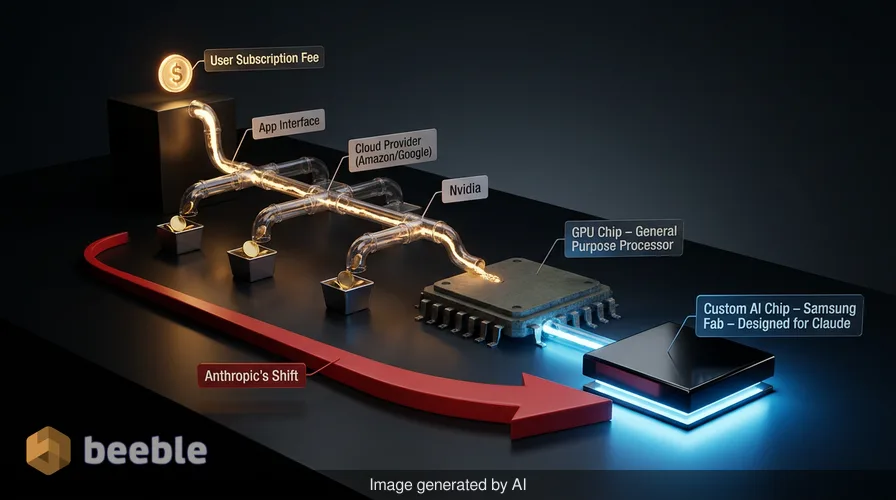
Every time you ask an artificial intelligence to summarize a long document or write a line of code, a sequence of financial events triggers behind the scenes. A tiny fraction of your monthly subscription fee travels from the app interface through a cloud provider like Amazon or Google, eventually reaching the balance sheet of Nvidia. This is the tax of the modern tech world. For a company like Anthropic, these costs are a constant pressure on their business model. To change this dynamic, Anthropic is now looking at the physical source of its power. The company is in early discussions with Samsung to design and manufacture its own custom AI chips.
This shift moves Anthropic from being a software company that rents computer power to a hardware designer that controls its own destiny. While the partnership is still in the exploration phase, it marks a significant change in how the AI industry operates. The goal is simple: reduce the massive bills paid to external chip providers and gain the ability to build hardware that runs Claude, Anthropic's flagship AI, more efficiently than general-purpose chips. Looking at the big picture, this is a transition from buying a generic tool to building a specialized machine for a single task.
the invisible math of custom silicon
To understand why Anthropic wants its own chip, we have to look at how these systems function. Most AI today runs on Graphics Processing Units, or GPUs, made by Nvidia. These chips are the digital crude oil of the 21st century. They are powerful and versatile, but they are also expensive and consume vast amounts of electricity. Because Nvidia designs these chips to work for thousands of different companies and use cases, they carry overhead that a specialized company might not need.
Anthropic is exploring a different path. By working with Samsung, they can design a chip that ignores the tasks Claude never performs. This stripped-down approach allows for better performance-per-watt. In the world of data centers, electricity is often the highest recurring cost. If a custom chip uses 30% less power to generate the same sentence, that translates directly into higher profit margins or lower prices for the end user. Practically speaking, this is the difference between driving a heavy luxury SUV to deliver a single envelope and using a dedicated bicycle courier. Both get the job done, but one is vastly more efficient for that specific goal.
why samsung is the chosen partner
Samsung is one of the few companies on Earth with the infrastructure to turn Anthropic's blueprints into physical reality. While Nvidia designs chips, they do not actually bake the silicon themselves. They rely on foundries. Samsung is a giant in this space and has been expanding its capacity specifically for AI. They already manufacture high-bandwidth memory, a specialized type of RAM that AI chips need to process data at high speeds.
By partnering with Samsung, Anthropic gains access to a vertically integrated supply chain. Samsung produces the memory, manages the foundry, and has the engineering talent to assist with the complex packaging required for modern processors. Curiously, Samsung also works closely with Nvidia, providing the very components that Anthropic hopes to eventually rely on less. This creates a complex web of relationships where Samsung acts as a supplier to everyone in the race, ensuring they win regardless of which AI model comes out on top.
On the market side, this partnership helps Samsung compete with TSMC, the Taiwanese giant that currently dominates the high-end chip market. If Samsung can successfully help Anthropic launch a competitive chip, it proves they are a viable alternative for other tech firms looking to escape the Nvidia ecosystem. This competition is healthy for the industry because it prevents a single company from holding a total monopoly on the hardware that powers our digital lives.
the rivalry with openai and jalapeno
Anthropic does not operate in a vacuum. Their primary rival, OpenAI, recently announced its own custom processor named Jalapeño in collaboration with Broadcom. The timing of the Anthropic news is likely not a coincidence. In the tech industry, if your competitor builds their own engine, you cannot continue to rent yours forever without falling behind on speed and cost.
OpenAI claims that Jalapeño is an inference processor. In plain English, inference is the act of the AI "thinking" and giving you an answer. Training is the initial phase where the AI learns from data. Training requires massive, expensive clusters of chips, while inference is what happens every second of every day as millions of users prompt the bot. If Anthropic focuses its Samsung partnership on an inference chip, they are targeting the part of their business that scales with their user base.
Historically, companies that control both the software and the hardware have a massive advantage. Apple is the prime example of this strategy. By designing the chips inside the iPhone, Apple makes the hardware and software work in perfect harmony, resulting in better battery life and faster performance than competitors using generic parts. Anthropic and OpenAI are now trying to apply this same logic to the cloud. They want Claude and ChatGPT to run on silicon that was born to run them.
what this means for the everyday user
For the person using an AI app to write an email or plan a vacation, these corporate maneuvers might seem distant. However, the impact is tangible. Currently, the high cost of running AI models is why many of the best features are locked behind $20-a-month subscriptions. As companies like Anthropic move toward custom silicon, the cost to generate a response drops.
| Feature | Generic GPU (Nvidia) | Custom AI Chip (Proposed) |
|---|---|---|
| Power Consumption | High | Optimized for specific tasks |
| Availability | Limited by global shortages | Controlled by the company |
| Cost per Prompt | Expensive due to high margins | Lower over the long term |
| Performance | Versatile but broad | Fast for specific AI models |
In everyday life, this could lead to a future where AI is integrated into more devices without requiring a constant internet connection or a heavy subscription fee. If the chips become efficient enough, we might see high-quality AI running locally on laptops or even household appliances. From a consumer standpoint, the Samsung-Anthropic deal is a step toward making advanced intelligence a cheap, invisible utility rather than a luxury service.
Ultimately, the success of this project depends on Anthropic's ability to define what they actually need. According to reports, they are still deciding on the chip’s exact power and server configuration. Hardware is a slow and unforgiving business. Unlike software, where you can fix a bug in minutes, a mistake in a chip design takes months and millions of dollars to correct. Anthropic is taking a massive risk by entering the silicon arena, but the alternative is staying dependent on a supply chain they do not control.
Looking ahead, you should expect to see more of these partnerships. The era of the general-purpose computer is slowly giving way to an era of hyper-specialized machines. As a user, you will benefit from this through faster response times and more resilient services. The next time your AI assistant answers a question instantly, the reason might be a custom piece of silicon manufactured in a Samsung factory in South Korea. This is how the digital backbone of the modern world is being rebuilt, one custom chip at a time.
Sources: Reuters, The Information, TechCrunch, Samsung Electronics Investor Relations.



See you on the other side.
Our end-to-end encrypted email and cloud storage solution provides the most powerful means of secure data exchange, ensuring the safety and privacy of your data.
/ Create a free account
