
The illusion of the clean app store

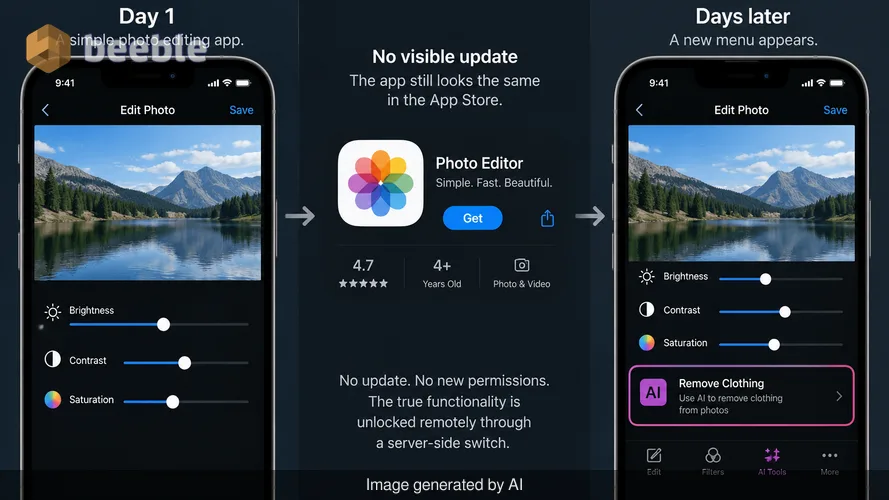
A user downloads a basic photo editing utility from the App Store. The interface is simple. It has three sliders for brightness, contrast, and saturation. For several days, the app performs exactly as the description promises. Then, without a visible update from the App Store, the layout shifts. A new menu appears. This menu offers a tool to remove clothing from photos using generative artificial intelligence. This is the bait-and-switch. The innocent utility was a Trojan horse. It bypassed the initial review process by hiding its true functionality behind a server-side switch. This specific deception is the target of Apple's latest developer guideline update.
The mechanics of the hidden payload
Under the hood, these applications use a technique known as remote configuration or feature flagging. This is a standard practice in professional software development. Generous use of feature flags allows developers to test new layouts on a small percentage of users or to turn off a broken feature without a full app submission. In a legitimate context, this is a tool for stability. In the hands of bad actors, it is a disguise. The app submitted to Apple’s reviewers contains dormant code. This code only activates when the app receives a specific signal from the developer's server. Because the reviewer is on a corporate network in Cupertino, the server sends the "safe" version of the interface. Once the app is on a thousand devices in the wild, the server flips the switch to reveal the prohibited content.
Apple’s updated guidelines now explicitly ban this behavior. The policy states that apps containing hidden or undocumented features are prohibited. This includes any app that misrepresents its purpose during the review phase. Technically speaking, this is a response to the rising tide of "nudification" software. These tools use deep-learning models to synthesize realistic but fake imagery. By masquerading as regular utilities, these apps bypass the safety filters that usually catch offensive content. Historically, the App Store has relied on a combination of automated static analysis and human reviewers. The automated tools look for known malicious libraries or private API calls. The human reviewers check the user interface for policy violations. The bait-and-switch exploit defeats both layers by ensuring the offensive logic is either fetched from the cloud or unlocked after the human has finished their check.
Zooming out to the industry level
This policy shift is part of a larger tension between tech giants and local regulators. In July, the San Francisco City Attorney, David Chiu, ordered both Apple and Google to remove nudification apps from their storefronts. The city accused these companies of profiting from the exploitation of others through store fees. This legal pressure coincided with a report from the Tech Transparency Project. The report was a detailed analysis of how these apps often carry ratings that suggest they are suitable for minors. This suggests a failure in the metadata labels that parents use to judge safety. When a tool for creating non-consensual imagery is labeled as a "Photo and Video" utility for ages four and up, the system has broken down.
Apple revealed that its review process blocked over 150,000 apps from reaching users last year. It also removed 193,000 developer accounts for fraud and abuse. These numbers are massive. Yet, the existence of these nudify apps suggests that even a hundred-billion-dollar infrastructure has blind spots. The App Store review process is like a city’s building inspection department. It can check the blueprints and the initial construction. It has a harder time monitoring what happens behind closed doors once the tenants move in. As generative AI becomes more compact and efficient, the ability to hide powerful, offensive models inside small app packages grows.
The technical debt of moderation
In practice, Apple is now requiring developers of apps with user-generated content to implement robust filtering. This requirement covers more than just the bait-and-switch apps. Any app that allows users to upload or create content must have a way to report offensive material. It must also allow users to block abusive accounts. This is a heavy lift for small developers. They must now integrate moderation APIs or hire manual moderators to satisfy the guidelines. This creates a barrier to entry. Paradoxically, the rules that keep the store safe also make it more difficult for independent developers to compete with large corporations who already have moderation teams in place.
Behind the screen, the definition of "offensive content" is evolving. Apple has updated its legal section to reinforce bans on apps that promote human trafficking or the exploitation of children. This is a move toward absolute liability. By tightening the language, Apple is signal-boosting its role as a moral gatekeeper. This role is controversial in the open-source community. Proponents of open platforms argue that the operating system should be like a utility, neutral to the content it carries. Apple takes the opposite view. They treat the iPhone as a curated experience where the company is responsible for the quality of every interaction. This proprietary approach is the foundation of their business model.
The ai catalyst
Curiously, the surge in these apps is a direct result of the democratization of artificial intelligence. A few years ago, creating a nudify app required a sophisticated understanding of neural networks and a fleet of expensive servers. Today, open-source models like Stable Diffusion are available to anyone with a high-end laptop. Developers can take these pre-trained models and fine-tune them for specific, often harmful, tasks. They then package these models into mobile apps. The software architecture of a modern AI app often involves a small client-side interface and a powerful backend API. This separation makes it remarkably easy to change the app's capability without changing the code on the device.
If the server sends a "cat" prompt, the app looks like a pet photo generator. If the server sends a different prompt, the output changes entirely. This fluidity is the core of the problem for Apple’s reviewers. They are no longer just reviewing a static piece of compiled code. They are reviewing a portal to a dynamic, ever-changing cloud service. Consequently, the review process must become more proactive. Apple has indicated they will remove any app that adds features not present in the version submitted for review. This suggests a shift toward ongoing monitoring rather than a one-time check.
Reclaiming control of our digital tools
Ultimately, these guideline updates serve as a reminder of how much we rely on invisible gatekeepers. We trust the little blue checkmark or the "Get" button to mean a piece of software is safe. This trust is a form of digital friction. When we stop questioning what an app is doing under the hood, we become vulnerable to these bait-and-switch tactics. The App Store is a curated garden, but even a garden has weeds that look like flowers until they bloom. The responsibility for digital literacy falls back on the user. We must observe how our apps change over time. If a calculator suddenly asks for access to your photo library, that is a red flag. If a photo editor needs a persistent internet connection to perform basic tasks, the logic is likely happening on a remote server you cannot see.
This update is a step toward transparency, but it is not a final solution. As long as software is dynamic, there will be ways to hide its true intent. We should view our smartphones not as static appliances, but as evolving ecosystems. Question the permissions you grant. Read the update notes when an app’s behavior feels different. The goal of a tech-literate society is not just to have the most powerful tools. The goal is to understand the mechanics of those tools well enough to know when they are being used against us.
Sources
- Apple Developer Documentation: App Store Review Guidelines Update Oct 2026
- Tech Transparency Project: Report on Generative AI Apps in Mobile Storefronts
- Office of the San Francisco City Attorney: Press Release regarding David Chiu's order to Apple and Google
- Apple Newsroom: 2025 App Store Fraud Prevention Report



See you on the other side.
Our end-to-end encrypted email and cloud storage solution provides the most powerful means of secure data exchange, ensuring the safety and privacy of your data.
/ Create a free account
