


The Strapi Deception: How 36 Malicious npm Packages Targeted Database Infrastructure

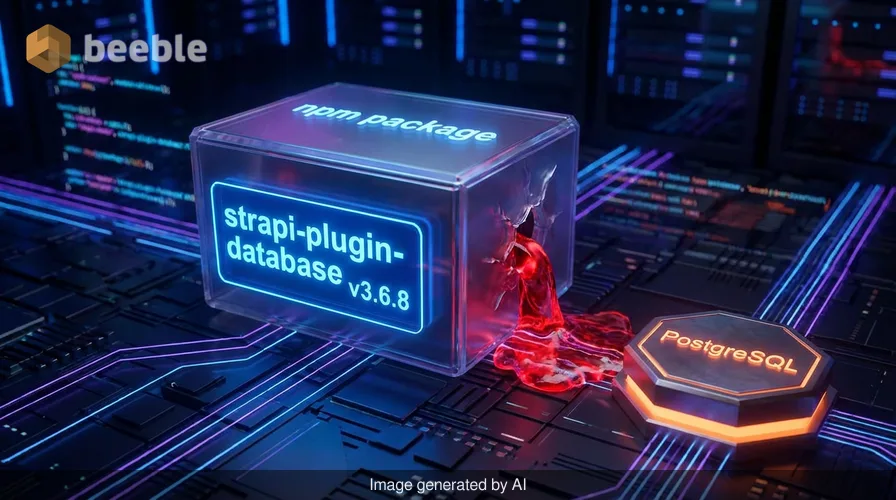
Within a mere 13-hour window, 36 malicious packages flooded the npm registry, masquerading as legitimate tools for the popular Strapi CMS. This was not a random act of digital vandalism; it was a calculated, systemic attempt to infiltrate mission-critical database environments. By the time security researchers at SafeDep identified the campaign, the threat actors had already established a sophisticated foothold, leveraging the inherent trust developers place in open-source ecosystems.
From a risk perspective, this incident highlights a precarious reality in modern software development: our supply chains are only as strong as their weakest dependency. The attackers utilized four sock puppet accounts—umarbek1233, kekylf12, tikeqemif26, and umar_bektembiev1—to distribute packages that appeared, at first glance, to be mature community plugins. However, behind the scenes, these packages were designed to act as a digital Trojan horse, carrying payloads capable of compromising Redis and PostgreSQL instances.
The Anatomy of the Deception
The attackers employed a clever naming convention to bypass the mental filters of busy developers. By prefixing their packages with strapi-plugin- and appending common functional terms like cron, database, or health, they mimicked the naming structure of the official Strapi ecosystem. Curiously, they also hardcoded the version number to 3.6.8 across all 36 packages. This was a deliberate choice to make the software appear as a mature, stable release rather than a suspicious new upload.
In my experience analyzing threat intelligence reports, this type of "typosquatting-adjacent" behavior is increasingly common. Attackers know that developers often search for functionality first and verify the publisher second. While the official Strapi plugins are strictly scoped under the @strapi/ namespace, the lack of a mandatory scope for community plugins creates a gap that malicious actors are all too happy to fill.
The Postinstall Hook: A Silent Executioner
At the architectural level, the primary vulnerability exploited here isn't a bug in Strapi or npm itself, but rather a feature of the npm lifecycle. Each of the 36 packages contained a postinstall.js script. In the npm ecosystem, a post-install script executes automatically as soon as the package is downloaded, requiring zero user interaction to trigger its payload.
Consequently, the malicious code runs with the same privileges as the user performing the installation. In a local development environment, this might mean access to personal files and environment variables. However, in a regulatory context where data integrity is paramount, the real danger lies in CI/CD pipelines and Docker containers. If an automated build process pulls one of these packages, the script effectively gains root access within that containerized environment, allowing it to pivot and attack internal infrastructure.
Exploiting the Data Layer
What makes this specific campaign particularly granular and dangerous is its focus on the data layer. The payloads were not generic; they were specifically tailored to exploit Redis and PostgreSQL. Once the postinstall script was triggered, it attempted to:
- Harvest Credentials: Scouring environment variables and configuration files for database connection strings.
- Deploy Reverse Shells: Establishing a persistent back-channel to the attacker's command-and-control (C2) server.
- Drop Persistent Implants: Ensuring that even if the initial process was terminated, the attacker maintained a foothold in the system.
Essentially, the attackers were looking for the keys to the kingdom. Databases are often the most sensitive part of an application’s architecture, containing everything from user PII to proprietary business logic. By targeting Redis and PostgreSQL, the attackers aimed to turn a simple package installation into a full-scale data breach.
The Human Firewall and Supply Chain Security
Looking at the threat landscape, we must acknowledge that patching aside, the human element remains a significant variable. I recall a case during a data leak investigation where a senior developer accidentally introduced a malicious dependency because they were working late and didn't verify the package's homepage. It happens to the best of us, but in a world of automated attacks, we can no longer afford such lapses.
From an end-user perspective, the impact of such a breach is often invisible until it is too late. To put it another way, a compromised dependency is like a slow leak in a ship's hull; you might not notice the water rising until the engines fail. In this case, the "engines" are your databases, and the "water" is unauthorized access to your mission-critical data.
Proactive Defense: How to Protect Your Pipeline
Ultimately, the responsibility for securing the software supply chain falls on both the platforms and the developers who use them. While npm works to remove these packages once reported, the 13-hour window of availability was more than enough time for automated systems to ingest the malicious code.
To build a more resilient posture, consider the following actionable steps:
- Enforce Scoped Packages: When using Strapi, prioritize plugins under the
@strapi/scope. Be extremely skeptical of unscoped packages that lack a description, repository, or homepage. - Disable Scripts by Default: Use the
--ignore-scriptsflag when runningnpm installin environments where you don't explicitly trust every dependency. This preventspostinstallscripts from running automatically. - Use Lockfiles and Audits: Regularly run
npm auditand usepackage-lock.jsonto ensure that your dependency tree is predictable and hasn't been tampered with. - Implement Network Egress Filtering: At the architectural level, your CI/CD runners and production containers should not have unrestricted access to the internet. Blocking unauthorized outbound connections can prevent reverse shells from connecting back to an attacker.
As a countermeasure against future attacks, we must treat every third-party dependency as a potential risk. By adopting a zero-trust approach to our package managers, we can turn our development pipelines into a robust defense rather than an open door for exploitation.
Sources:
- SafeDep Threat Research Team Analysis
- npm Registry Security Advisory Logs
- Strapi Official Documentation on Plugin Security



See you on the other side.
Our end-to-end encrypted email and cloud storage solution provides the most powerful means of secure data exchange, ensuring the safety and privacy of your data.
/ Create a free account
