


The Three-Word Ultimatum: Inside Anthropic’s High-Stakes Standoff with the Pentagon

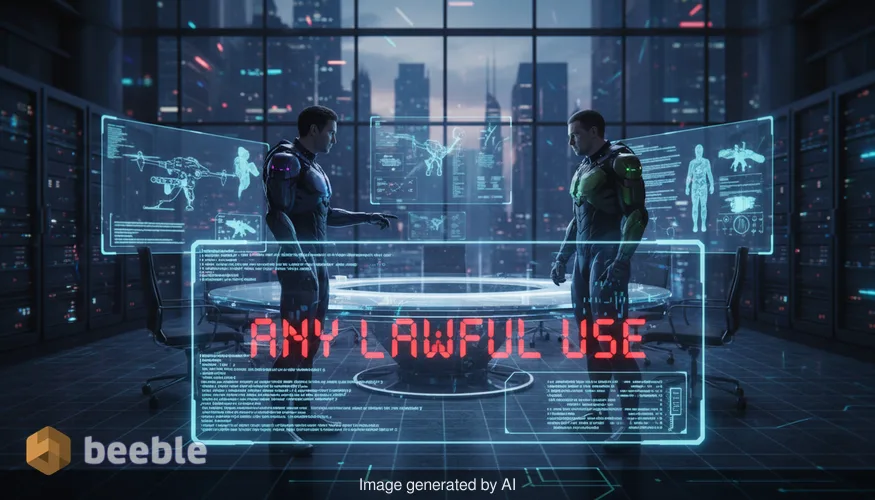
For years, the relationship between Silicon Valley’s AI pioneers and the Department of Defense (DoD) has been a delicate dance of mutual necessity. But as of February 2026, that dance has turned into a public and existential brawl. At the center of the conflict is Anthropic, the safety-focused startup now valued at an eye-watering $380 billion, and a seemingly simple three-word clause the Pentagon is demanding in its latest procurement contracts: “any lawful use.”
While the phrase sounds like standard legal boilerplate, it represents a fundamental shift in how artificial intelligence will be deployed in modern warfare. For Anthropic, agreeing to these terms would mean dismantling the very “Constitutional AI” framework that defines its brand. For the Pentagon, it is a matter of national security and ensuring that American AI isn't hamstrung by private-sector ethics in a global arms race.
The Clause That Changed Everything
The “any lawful use” provision is the new gold standard for the DoD’s AI integration. In essence, it requires AI providers to waive their specific “acceptable use” policies—the rules that usually forbid using AI for violence, surveillance, or weapons development—as long as the military’s application is deemed legal under international and domestic law.
Reports indicate that OpenAI and Elon Musk’s xAI have already quietly updated their terms of service to accommodate this requirement. By doing so, they have cleared the path for their models to be integrated into the “kill chain”—the process of identifying, tracking, and engaging targets. Anthropic, however, remains the lone holdout among the “Big Three” foundation model providers, leading to a weekslong battle played out through leaked memos and pointed social media exchanges.
Constitutional AI vs. The Battlefield
To understand why Anthropic is digging in its heels, one must look at how its models are built. Unlike other LLMs that are fine-tuned primarily through human feedback, Anthropic’s Claude models are governed by a “Constitution”—a set of written principles that the AI uses to supervise its own behavior.
If the Pentagon integrates Claude into a system designed for mass surveillance or, more controversially, Lethal Autonomous Weapons Systems (LAWS), the AI would face a logical paradox. Its core programming forbids it from assisting in harm or violating human rights, yet its operational commands would require exactly that.
“We aren't just talking about a policy change,” one unnamed Anthropic engineer noted in a recent forum. “We are talking about lobotomizing the safety architecture that makes our model what it is. You can’t have a ‘safe’ AI that is also authorized to autonomously decide to terminate a target.”
The Rise of Lethal Autonomous Weapons
The most significant friction point involves AI that can track and kill targets without a human “in the loop.” While the Pentagon officially maintains that humans will always make the final decision to use lethal force, the “any lawful use” clause provides the legal cover for a future where speed is the primary weapon. In a drone swarm scenario, for instance, a human operator may be too slow to authorize individual strikes, leaving the AI to manage the engagement.
Anthropic’s leadership argues that current AI models lack the “common sense” and situational awareness to distinguish between a combatant and a civilian in the chaos of a real-world battlefield. By refusing the Pentagon’s terms, Anthropic is effectively betting that the market—and the public—will eventually value safety over raw military utility.
A $380 Billion Dilemma
The standoff comes at a precarious time for Anthropic. With a $380 billion valuation, the pressure to generate massive revenue is immense. Government contracts are the largest untapped goldmine in the AI sector. By holding out, Anthropic risks being frozen out of the Joint Warfighting Cloud Capability (JWCC) and other multi-billion dollar initiatives, potentially ceding the entire defense market to OpenAI and xAI.
Critics of Anthropic’s stance argue that if the most “ethical” AI companies refuse to work with the military, the Pentagon will simply rely on less-aligned models, leading to a more dangerous outcome. Proponents, however, see Anthropic as the last line of defense against a “Black Mirror” style escalation of automated warfare.
What This Means for the Tech Industry
This negotiation is a bellwether for the entire software industry. It signals the end of the “move fast and break things” era for AI and the beginning of a period where tech companies must decide if they are neutral utilities or moral actors.
| Feature | Anthropic Position | OpenAI/xAI Position |
|---|---|---|
| “Any Lawful Use” | Rejected (Currently) | Accepted |
| Lethal Autonomy | Strictly Prohibited | Allowed under DoD oversight |
| Safety Mechanism | Constitutional AI (Hard-coded) | RLHF & Policy-based |
| Primary Goal | Alignment & Safety | Rapid Scaling & Utility |
Practical Takeaways for AI Stakeholders
As this battle continues to unfold, businesses and developers should consider the following:
- Review Your Dependencies: If your enterprise software relies on Claude, be aware that Anthropic’s refusal of defense contracts may impact its long-term capital access or lead to a pivot in its business model.
- Watch the Regulatory Shift: The outcome of this standoff will likely influence future AI regulations. If the DoD wins, expect “any lawful use” to become a standard requirement for all government-adjacent tech.
- Ethics as a Competitive Advantage: For companies in the civilian sector, Anthropic’s stance reinforces its position as the “safe” alternative, which may be more attractive to healthcare, legal, and education sectors.
The Path Forward
The negotiations between Anthropic and the Pentagon are about more than just a contract; they are a referendum on the soul of artificial intelligence. As we move deeper into 2026, the industry will be watching to see if Anthropic can maintain its moral high ground without sacrificing its financial future. For now, those three words—“any lawful use”—remain the most expensive words in the history of Silicon Valley.
Sources
- Anthropic Official Safety Policy and Constitutional AI Documentation
- Department of Defense AI Adoption Strategy (2025-2026 Update)
- Reports on OpenAI and xAI Government Contract Amendments
- International Committee of the Red Cross (ICRC) Position on Autonomous Weapons



See you on the other side.
Our end-to-end encrypted email and cloud storage solution provides the most powerful means of secure data exchange, ensuring the safety and privacy of your data.
/ Create a free account
