


Why a line of code in a Goldman Sachs server changes your path to property ownership

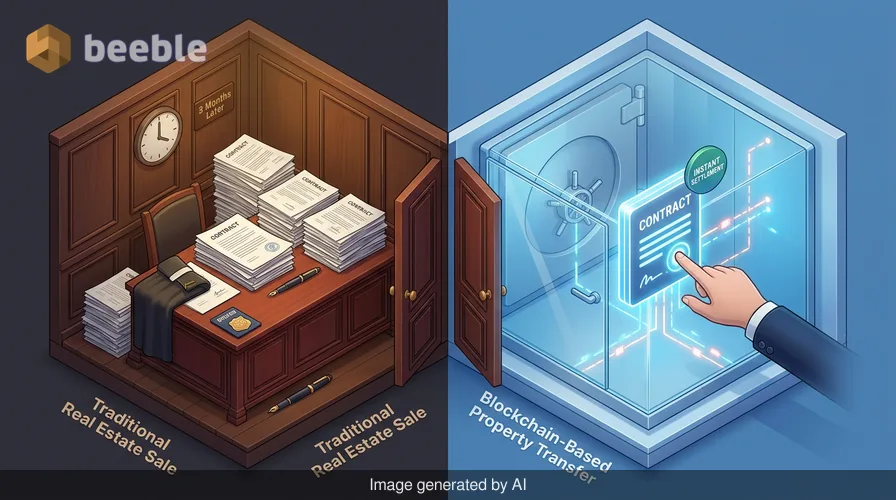
Imagine the physical effort of buying a home. You save for a decade; you battle rising interest rates; you navigate a labyrinth of paper contracts and bank appointments. For the average person, property ownership is a monolith of unattainable wealth. You save $500 a month while the price of a local apartment building rises by $5,000 every hour. This is the structural disconnect between stagnant wages and soaring asset prices. Historically, real estate was a game of giants; today, the market is a ledger of fragments. In the past, the barrier to entry was a six-figure down payment; currently, the threshold is a digital wallet.
The tall wall of traditional property
On an individual level, the dream of owning a home is often a source of deep financial anxiety. You look at a luxury high-rise and see a fortress of capital that excludes you. This feeling is not just a personal frustration; it is a symptom of a systemic shift in how wealth is stored. On a macro level, real estate has become the ultimate global reserve asset. Paradoxically, as property becomes more valuable to institutional investors, it becomes less accessible to the people who actually live in it. The stock market is often a global mood ring for corporate health, but real estate is the bedrock of individual stability.
Zooming out, the traditional method of investing in large-scale real estate is slow and opaque. If a pension fund wants to sell its stake in a commercial tower, the process takes months and involves a small army of lawyers and brokers. This lack of liquidity makes real estate a heavy asset. It is the opposite of the "glass bank vault" of the blockchain, where transactions are visible and instant. For decades, the financial plumbing of the property world was hidden behind mahogany doors. That architecture is now changing because the institutions themselves need a faster way to move money.
A digital blueprint for ownership
Goldman Sachs has now launched a tokenized property fund on its GS DAP platform. This is not a speculative experiment in a digital wild west; it is a regulated move by one of the oldest names on Wall Street. The initiative combines traditional fund structures with blockchain-based issuance. This means the ownership interests in a real estate fund are represented as digital units on a private blockchain. The fund remains subject to existing laws, but the way those shares move is fundamentally different. LRC Group is the fund manager, while Archax is the custodian for these digital securities.
In everyday terms, this is the equivalent of taking a massive, indivisible gold bar and turning it into a pile of recognizable coins. You can move a coin much faster than you can move a 400-ounce bar. Mathew McDermott, who leads digital assets at Goldman Sachs, notes that this method allows for greater precision in how people invest. This precision is the key to the future of your wallet. When assets are tokenized, they are easier to trade, easier to track, and easier to divide into smaller, more affordable pieces.
Behind the scenes of the Goldman fund
Technically, the structure involves several specialized players. Apex Group provides the management services through Fundrock LIS. Ownera is the bridge that connects the different market participants and distribution channels. These companies are building the new digital pipes for the global economy. By using the GS DAP platform, Goldman Sachs creates a pathway for fund units to be transferred with minimal friction. Semicolons and smart contracts replace the manual verification of yesterday; the technology handles the heavy lifting of compliance and record-keeping.
This shift is symptomatic of a broader institutional trend. It is no longer enough to own an asset; you must be able to move it. For a large bank, the cost of administration is a constant drain on profits. Tokenization reduces this cost by automating the mundane tasks of fund administration. While this sounds like a back-office optimization, the impact on the retail investor is profound. As the cost of managing these funds drops, the minimum investment required to participate often drops with it. This is the mechanism that eventually brings institutional-grade real estate to your smartphone.
The global migration toward on-chain property
This movement is not an isolated event in a New York boardroom. In May 2025, tokenized property sales in Dubai reached nearly $400 million. This accounted for 17.4% of all real estate transactions in the city for that month. The Dubai Land Department has already integrated its title deeds with digital platforms. In that market, residents can purchase fractional stakes in property for as little as $545. This is a radical departure from the traditional model where you either own an entire house or you own nothing at all.
| Project | Location | Entry Point | Technology Partner |
|---|---|---|---|
| GS DAP Fund | Global | Institutional | Archax / Ownera |
| Prypco Mint | UAE | $545 (AED 2,000) | Ripple / Ctrl Alt |
| Blocksquare | Global | Varies | IPFS / Ethereum |
Blocksquare, another infrastructure provider, surpassed $200 million in tokenized assets across 29 countries by mid-2025. This growth happened as the total value of tokenized real-world assets climbed past $65 billion. These numbers are a tangible record of a shifting belief system. We are moving away from the idea that ownership must be all-or-nothing. The blockchain acts as a transparent ledger that allows thousands of people to share a single asset without needing to trust one another personally.
The psychology of owning a fragment
Behavioral economics suggests that we value things more when we own them—a phenomenon known as the endowment effect. However, owning a digital fraction of a building feels different than holding a physical key. This creates a new psychological landscape for the modern investor. Is a tokenized fraction of a London office tower a real investment, or is it just a digital entry in a sophisticated game? Paradoxically, the more we digitize our assets, the more we crave the stability of something tangible like land.
From a consumer standpoint, tokenization is a response to the pervasive feeling of being left behind. When you cannot afford a house, you buy a fraction of a house because it feels like progress. It is a way to hedge against the inflationary pressure that erodes the cash in your savings account. Inflation is the invisible leak in your wallet; real estate has traditionally been the plug for that leak. By breaking these assets into smaller pieces, financial institutions are offering a new way for the middle class to protect their purchasing power. Consequently, the "digital landlord" is becoming a common retail identity.
A shift in the financial perspective
Ultimately, the launch of the Goldman Sachs fund is a signal that the infrastructure of the world is being rebuilt. We are witnessing the end of the era of paper titles and the beginning of the era of programmable equity. This change is not about the price of a specific token today or tomorrow. It is about the systemic move toward a more liquid, transparent, and fragmented financial system. The glass bank vault is being constructed one fund at a time.
As you look at your own finances, it is worth reflecting on how much of your wealth is tied to old, illiquid systems. The evolution of digital money is not just a trend for tech enthusiasts; it is a fundamental change in the rules of wealth. You might not buy a fraction of an office building today, but the technology that allows you to do so will eventually govern your bank account, your insurance, and your retirement fund. Financial mindfulness requires us to see these shifts before they become ubiquitous. The monolith of property is crumbling into digital dust, and in that dust, there is a new kind of opportunity for those who understand the mechanics.
Sources
- Goldman Sachs Digital Assets (GS DAP) platform internal reports and announcements.
- LRC Group real estate investment manager quarterly filings.
- Dubai Virtual Asset Regulatory Authority (VARA) 2025 market framework update.
- Dubai Land Department (DLD) transaction data, May 2025.
- Blocksquare Real-World Asset (RWA) 2025 milestone report.
- Apex Group and Fundrock LIS service agreements.
- Archax digital securities custody protocols.
- Ripple and Ctrl Alt partnership documentation for UAE real estate.



See you on the other side.
Our end-to-end encrypted email and cloud storage solution provides the most powerful means of secure data exchange, ensuring the safety and privacy of your data.
/ Create a free account
