


Why AI Must Be Grounded, Not Hyped, to Serve Europe's SMEs

The Reality Check Europe's Small Businesses Need
Artificial intelligence has become the buzzword of the decade, promising to revolutionize everything from customer service to supply chain management. Yet for Europe's small and medium-sized enterprises—businesses that employ roughly 100 million people and represent 99% of all EU companies—the AI revolution often feels more like noise than genuine opportunity.
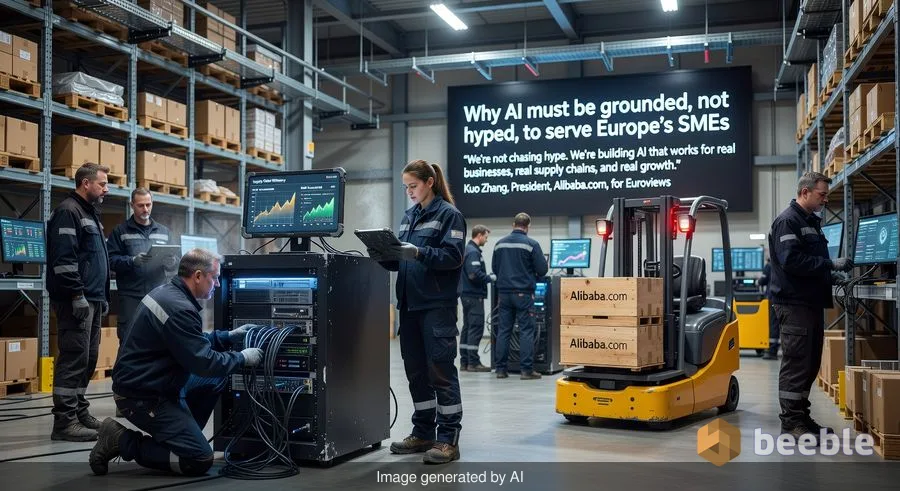
Kuo Zhang, president of Alibaba.com, recently articulated what many European business owners have been thinking: scepticism about AI is not only healthy, it's necessary. In an opinion piece for Euroviews, Zhang emphasized that his company isn't chasing hype but building AI tools designed for real businesses facing real challenges.
This perspective arrives at a critical moment. As we navigate 2026, European SMEs face mounting pressure to digitalize while dealing with economic uncertainty, supply chain complexity, and fierce global competition. The question isn't whether AI matters—it's whether the AI being offered actually solves problems or simply creates new ones.
The Gap Between Promise and Practice
The disconnect between AI marketing and AI utility has grown uncomfortably wide. Venture capital firms poured over €18 billion into European AI startups in 2024 and 2025 combined, yet adoption among SMEs remains stubbornly low. Recent surveys from the European Commission suggest that fewer than 25% of European SMEs have implemented any form of AI technology in their operations.
Why the hesitation? Small business owners cite several recurring concerns: unclear return on investment, lack of technical expertise, integration difficulties with existing systems, and most fundamentally, solutions that seem designed for Silicon Valley unicorns rather than family-owned manufacturers in Bavaria or textile exporters in northern Italy.
Consider a typical scenario: a Polish furniture maker with 45 employees receives pitches for AI-powered inventory management systems that require dedicated IT staff, months of implementation, and subscription costs that exceed their annual technology budget. The promise is compelling—optimized stock levels, predictive ordering, reduced waste. The reality is a solution built without consideration for how small businesses actually operate.
What Grounded AI Actually Looks Like
Grounded AI begins with understanding the specific challenges European SMEs face daily. These aren't abstract problems requiring cutting-edge machine learning models; they're practical obstacles that demand practical solutions.
Supply chain visibility remains a persistent headache. A Spanish olive oil producer needs to track shipments across multiple carriers and customs checkpoints, often dealing with language barriers and incompatible tracking systems. Grounded AI here means simple translation tools and unified dashboards that aggregate information—not sophisticated but unnecessary predictive analytics.
Customer discovery and market expansion present another genuine need. A German precision tools manufacturer wants to identify potential buyers in France and the Netherlands but lacks the resources for traditional market research. AI that can match products with verified business buyers based on purchasing patterns and industry classifications delivers tangible value.
Administrative automation represents low-hanging fruit. Processing invoices, generating customs documentation, and managing basic customer inquiries consume disproportionate time for small teams. AI tools that handle these tasks without requiring technical implementation reduce costs immediately and measurably.
The common thread? These applications solve existing workflow problems rather than creating new technology dependencies.
The Implementation Reality Check
Successful AI adoption for SMEs follows a distinctly different pattern than enterprise deployment. Large corporations can afford dedicated AI teams, lengthy pilot programs, and expensive consultants. Small businesses need solutions that work within weeks, not quarters, and require minimal technical overhead.
Several principles separate practical AI from hype-driven offerings:
Immediate usability: Tools must function with minimal configuration. A Bulgarian textile exporter shouldn't need to hire a data scientist to set up an AI chatbot that answers common product questions in multiple languages.
Integration simplicity: New tools must work with existing software—accounting packages, basic CRM systems, email platforms—without requiring complete digital infrastructure overhauls.
Transparent pricing: Subscription models should align with SME budgets, typically measured in hundreds rather than thousands of euros monthly. Hidden costs, usage-based pricing spikes, and mandatory premium tiers create justified wariness.
Measurable outcomes: Benefits must be clear and quantifiable. Did AI-assisted product matching generate qualified leads? Did automated translation reduce customer service response times? Vague promises of "optimization" or "efficiency gains" don't suffice.
Europe's Unique Position in the AI Landscape
European SMEs operate within a regulatory and cultural context that shapes how AI should be deployed. The EU AI Act, which entered into force in 2024 with phased implementation through 2026 and beyond, establishes clear guardrails around high-risk AI applications while allowing lighter regulation for lower-risk tools.
This framework actually advantages grounded AI approaches. Simple, transparent applications that assist rather than replace human decision-making face fewer regulatory hurdles than opaque algorithmic systems. An AI tool that suggests potential trade partners based on clear matching criteria is far easier to document and justify than a black-box system making autonomous procurement decisions.
European data protection standards, often criticized as burdensome, similarly reward straightforward implementations. AI tools that process minimal personal data and provide clear information about how they function align naturally with GDPR requirements, reducing compliance complexity for small businesses.
Practical Steps for SME AI Adoption
For European small business owners evaluating AI tools, several questions help separate substance from hype:
What specific problem does this solve? If the vendor can't articulate a clear, single workflow improvement in plain language, remain sceptical.
What does implementation actually require? Request detailed timelines, resource commitments, and prerequisite systems. Be wary of answers that downplay complexity.
How is success measured? Demand concrete metrics tied to business outcomes—more qualified leads, reduced processing time, lower error rates—not abstract "AI capabilities."
What happens to your data? Understand clearly where information is processed, who can access it, and whether it's used to train broader models. European businesses have both legal obligations and competitive reasons to maintain data control.
Can you pilot affordably? Legitimate tools designed for SMEs offer trial periods or limited implementations that allow testing before major commitments.
The Path Forward
The coming years will determine whether AI becomes a genuine driver of European SME competitiveness or remains a technology that primarily benefits large enterprises and tech vendors. The trajectory depends substantially on whether AI development prioritizes practical utility over technological sophistication for its own sake.
Platforms serving European small businesses have begun recognizing this reality. Alibaba.com's focus on applying AI to cross-border trade challenges—helping businesses find international partners, navigate logistics complexity, and overcome language barriers—represents one approach to grounded implementation. Similar patterns are emerging among European-grown platforms serving specific industries or regional markets.
What these approaches share is humility about what AI can accomplish and clarity about the problems being solved. They treat artificial intelligence as a tool for addressing specific friction points rather than a magical solution that transforms entire business models.
For Europe's 25 million SMEs, this grounded perspective isn't just preferable—it's essential. These businesses don't need to chase every technological trend. They need tools that work reliably, integrate simply, cost reasonably, and deliver measurable value.
The AI revolution for European small businesses will succeed not through hype and breathless promises but through unglamorous, practical applications that make daily operations marginally easier, customer reach slightly broader, and growth incrementally more sustainable. That's not the stuff of dramatic headlines, but it's precisely what real businesses need.
Sources
- European Commission statistics on SME demographics and employment
- EU AI Act official documentation and implementation timeline
- Euroviews opinion article by Kuo Zhang, Alibaba.com president
- European Commission surveys on SME digital adoption
- European Investment Fund data on AI startup funding



See you on the other side.
Our end-to-end encrypted email and cloud storage solution provides the most powerful means of secure data exchange, ensuring the safety and privacy of your data.
/ Create a free account
