


Why India wants Jack Dorsey’s Bitchat code offline

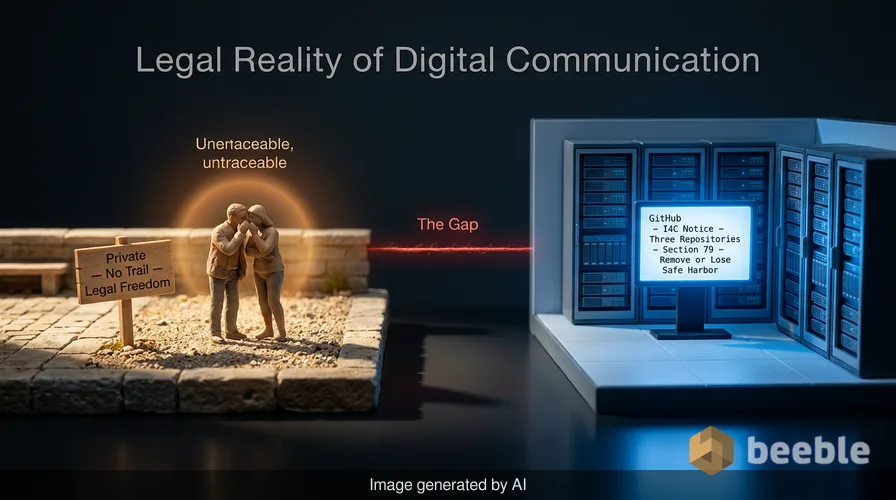
In a busy public square, two people share a secret. In the eyes of the law, that physical whisper is private and leaves no trace for the state to follow. But if those same people send that same secret through a smartphone app, the legal reality changes instantly. Governments expect a digital breadcrumb trail for every word we speak. This gap between the freedom of a whisper and the data requirements of a message is the center of a new legal battle in India. On July 23, 2026, the Indian government moved to erase the tools that make digital whispers possible.
The three-hour ultimatum to GitHub
The Indian Cyber Crime Coordination Centre, known as I4C, issued an urgent order to GitHub this week. The notice gave the Microsoft-owned platform exactly three hours to remove three specific code repositories. These repositories belong to Bitchat, a decentralized messaging app backed by former Twitter CEO Jack Dorsey. The agency did not just ask for the app to vanish from a store. It demanded the removal of the source code itself, citing Section 79 of the Information Technology Act. This section is a powerful tool that the state uses to compel internet companies to take down content that it deems a threat to public order.
The notice named three repositories under the permissionlesstech account. These include the main Bitchat project, the Android build files, and the releases page. The I4C stated that the app must be disabled without destroying any evidence. This type of legal demand puts platforms like GitHub in a precarious position. If they do not comply within the strict window, they risk losing their safe harbor protection. In simple terms, safe harbor is a legal shield that protects a platform from being sued for the actions of its users. Without it, GitHub becomes legally liable for every line of code on its site.
Why the government fears mesh networks
Bitchat is not a standard messaging app like WhatsApp or Telegram. It is a serverless system that uses Bluetooth mesh networking. Most apps send your data to a central computer in a warehouse before it reaches your friend. This central point is where the law usually steps in to intercept or monitor data. Bitchat removes this center entirely. Messages jump directly from one phone to another. This creates a web of connections that does not require the internet, a phone number, or a central account.
From a regulatory context, this technology is a nightmare for law enforcement. The I4C order argued that this design significantly impedes lawful interception and investigation. When a crowd uses a mesh network, the state cannot easily see who is talking to whom. There is no central office to serve with a warrant. The agency warned that such tools are dangerous during times of public disorder or internet shutdowns. They view the lack of a paper trail as an invitation for organized crime or terrorism. To the state, an app without a central server is like a city without a map.
Protests and the Cockroach Janta Party
The timing of this legal move is not a coincidence. India is currently seeing widespread protests led by students and young activists. The movement focuses on recent leaks of national exam papers, which have thrown the careers of millions into doubt. Protesters have gathered under the banner of the Cockroach Janta Party, a satirical name used to mock the resilience of the youth movement. As tens of thousands rallied in Delhi, the government responded by cutting mobile internet access around protest sites like Jantar Mantar.
Internet shutdowns are a common tactic used to stop the spread of information during unrest. However, Bitchat works without the internet. Demonstrators began using the app to coordinate their movements and share information even when cell towers were dark. By ordering the code offline, the government is attempting to remove the very tool that makes their internet kill switch ineffective. This is a battle over the control of communication in the physical world and the digital one. The law is being used here as a wall to block the flow of decentralized data.
Understanding Section 79 and the 2021 IT Rules
To understand why GitHub might comply with such a short deadline, we must look at the statutory framework of the IT Act. Section 79(3)(b) requires intermediaries to remove content upon receiving actual knowledge of an unlawful act. The 2021 IT Rules further expanded these requirements. These rules demand that platforms appoint local officers who are personally liable for compliance. If a company ignores an order from the Ministry of Home Affairs, its employees in India could face criminal charges.
The Internet Freedom Foundation has called this specific order unconstitutional. They argue that the government bypassed the standard procedures for blocking content. Usually, a committee must review a blocking order and give the content creator a chance to be heard. In this case, the I4C used emergency powers to skip those steps. Digital rights groups argue that the government is targeting the tool rather than any specific illegal message. This is like a city banning the use of all pens because someone might write a threatening letter.
The open source paradox and the Streisand effect
Attempting to delete open-source code from the internet is a difficult task. When a government tries to hide information, the effort often results in that information spreading even further. This is known as the Streisand effect. Within hours of the notice being made public, developers mirrored the Bitchat code to other platforms. One such platform is GitLawb, a decentralized alternative to GitHub that is harder for any single government to control.
Jack Dorsey responded to the order by stating that the Indian government does not like technology it cannot control. His company, Block, recently launched a platform called Buzz to reduce its own reliance on central services like GitHub. The legal reality is that while the state can pressure a corporation like Microsoft, it cannot easily stop a decentralized community. Once code is released to the public, it becomes a permanent part of the digital world. The law can make it harder to find, but it cannot make it cease to exist.
How to protect your digital rights
For the average person, this case is a reminder that digital privacy is a moving target. The laws governing what you can say and which apps you can use are changing rapidly. If you are concerned about your rights during a period of civil unrest or an internet shutdown, there are practical steps to take. First, always research whether an app uses end-to-end encryption. Second, understand that some tools require the internet to function while others do not. Third, keep a backup of essential communication tools on a physical drive.
The most important takeaway is that your right to speak is often tied to the tools you use. When the government targets the source code of an app, it is a signal that the technology has become an effective shield for privacy. Knowing the difference between a centralized app and a decentralized one is no longer just for tech experts. It is a fundamental part of being an informed citizen in the modern age. As this case moves through the courts, it will define the boundary between state security and individual privacy for years to come.
Key takeaways for consumers
- Intermediaries like GitHub must follow government orders within hours to keep their legal protections.
- Section 79 of the IT Act is the primary law used to remove online content in India.
- Decentralized apps use mesh networking to communicate without a central server or internet connection.
- The 2021 IT Rules allow the government to bypass certain reviews during emergencies.
- Open-source code is often mirrored across multiple sites, making a total takedown nearly impossible.
Sources
- The Information Technology Act, 2000 (Section 79)
- Information Technology (Intermediary Guidelines and Digital Media Ethics Code) Rules, 2021
- Bharatiya Nyaya Sanhita (Criminal Code)
- Official Notice from the Indian Cyber Crime Coordination Centre (I4C)
- Public Statements by the Internet Freedom Foundation
This article is for informational and educational purposes only and does not constitute formal legal advice. If you are facing a legal dispute regarding digital rights or the IT Act, please consult a qualified attorney in your jurisdiction.



See you on the other side.
Our end-to-end encrypted email and cloud storage solution provides the most powerful means of secure data exchange, ensuring the safety and privacy of your data.
/ Create a free account
