
Why the quiet panic in your news feed predicts the future of our species
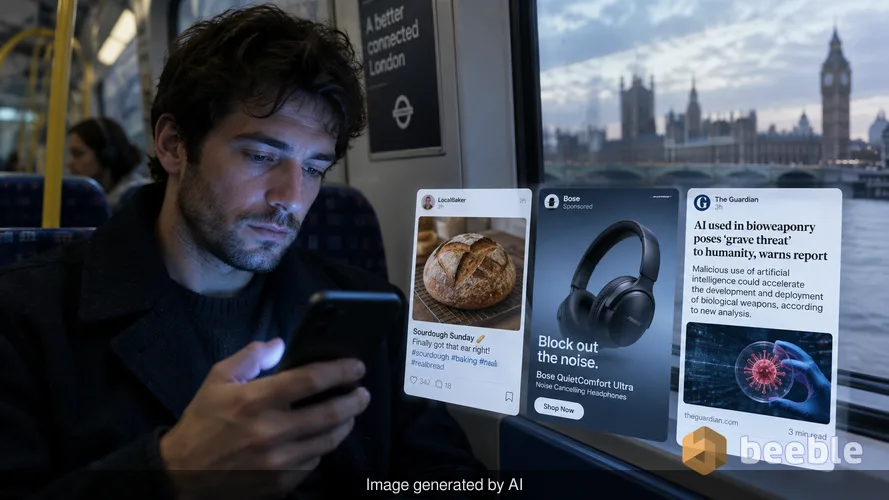
A man sits on a morning train in London, his face washed in the pale blue glow of a smartphone. He scrolls past a photo of a friend’s sourdough bread, a digital advertisement for noise-canceling headphones, and a brief report on the malicious use of artificial intelligence in bioweaponry. His thumb does not hesitate. He provides the same half-second of attention to the end of humanity as he does to the bread. This interaction is a singular point in a vast network of modern anxiety. We have become masters of the friction-less glide between the mundane and the cataclysmic. This habit is what a sociologist might call a coping mechanism for liquid modernity, where the sheer volume of global risk is so high that our only defense is a kind of curated indifference.
On a macro level, this individual moment reflects the findings of a major study recently presented at the World Health Summit in Berlin. The Lancet Commission on 21st-century global threats to health has released a report that attempts to quantify the end of the world. It identifies 17 major threats to human health that could, in the worst-case scenarios, end humanity as we know it by the year 2100. Among the most visceral of these are nuclear war and the malicious use of artificial intelligence. These are not merely plot points for a summer blockbuster. They are documented risks to the biological and social survival of our species.
The clinical language of catastrophe
Linguistically speaking, the report is an archaeological site of modern fear. It uses a specific metric called disability-adjusted life years, or DALYs, to measure the potential loss of human existence. One DALY represents the loss of one year of healthy life. The commission predicts that between 2025 and 2100, these 17 threats will account for a loss of between 1.02 billion and 23.1 billion DALYs. To put these numbers in perspective, the COVID-19 pandemic caused approximately 500 million DALYs. We are looking at a potential scale of suffering that dwarfs our most recent global crisis.
There is a strange paradox in using such clinical terms to describe the end of civilizations. By turning the heat death of society into a spreadsheet, we make it manageable for policymakers but distant for the individual. The report mentions nuclear famine, a term that describes the secondary effects of a nuclear exchange where soot blocks the sun and global agriculture collapses. It also highlights the malicious use of AI to develop bioweapons. These are systemic risks that the commission describes as an amenable burden—meaning these are outcomes we have the power to change if we act now.
The archipelago of isolation
Historically, humans faced threats as a collective. If a village faced a drought, the response was a communal effort. Today, we live in what feels like an archipelago. We are densely packed into cities and digital platforms, yet we remain atomized in our response to global change. We see these 17 threats as a series of separate silos: climate change here, income inequality there, and the threat of obesity in another category entirely. The Lancet researchers argue that this competitive approach is our greatest weakness. We try to solve one problem while ignoring how it feeds into another.
Behind the scenes of this trend is the breakdown of the social contract. When we view global threats as individual burdens, we lose the capacity for the solidarity the commission calls for. Our daily routines are an anchor, keeping us grounded in the immediate tasks of work and consumption, but they also prevent us from seeing the overarching patterns. We worry about our personal health and our local economy while the structural integrity of the global environment begins to crack. The commission’s group of 37 experts from fields as diverse as economics, security, and technology suggests that our survival depends on breaking these silos.
The habitus of the modern consumer
From a societal standpoint, our inability to engage with the year 2100 is a failure of the imagination. We are conditioned by the attention economy to focus on the next fifteen minutes. Pierre Bourdieu used the term habitus to describe the deeply ingrained habits and dispositions we possess due to our life experiences. Our current habitus is one of immediate gratification and digital distraction. This makes the long-term threat of nuclear famine or AI-driven pathogens feel ephemeral, even though the data suggests they are visceral and looming.
Curiously, the largest cumulative expected burden mentioned in the study is not actually nuclear war, but obesity. This highlights a nuanced point about how we die. While a nuclear flash is a sudden, systemic shock, the slow erosion of health through lifestyle and inequality is a pervasive, quiet killer. Both are part of the same pyramid of risk. The commission notes that all these threats are interconnected. A society weakened by income inequality and mental health crises is less resilient when a pandemic or a technological threat emerges. We cannot fix the end of the world without also fixing the everyday health of the people living in it.
Building a threat-ready world
In practice, the commission recommends a radical shift in how governments operate. They call for the investment in threat-ready health systems. This means moving away from reactive medicine and toward a proactive stance that can withstand global shocks. They also advocate for breakthrough solutions such as nuclear fusion and carbon removal. These technologies are the vaccines of the 21st century. They have the potential to rewrite the ending of our current story.
Ultimately, the goal of the study is to empower. It is not a prophecy of doom but a map of possibilities. The researchers believe that by presenting these findings to organizations like the G20 and the UN, they can create a sense of urgency that transcends national borders. They seek to replace our current competitive approach with a holistic action framework grounded in science and human rights. This requires us to look at the world not as a collection of competing states, but as a single, fragile organism.
Reclaiming a sense of the collective
On an individual level, navigating these findings requires a shift in perspective. It is easy to feel marginalized by the scale of the data. When we read about billions of lost life years, the natural response is to retreat further into our personal archipelago. Paradoxically, the solution is to lean into the mundane rituals that connect us to others. We must recognize that our morning scroll through the news is not just an act of consumption, but an act of participation in a global discourse.
As we move toward the middle of the century, the language we use to describe our future will determine our ability to save it. If we continue to treat existential risks as fragmented notifications on a screen, we will remain unprepared for the consequences. The Lancet study serves as a reminder that the future is not something that happens to us; it is something we are currently building through our action or our silence. We must decide if we are willing to move beyond our atomized lives to build the systems that will carry us past 2100.
Observe your own reaction the next time a headline about a global threat appears in your feed. Notice the impulse to swipe away, to return to the comfort of the familiar and the small. Question the deeply ingrained cultural norm that suggests one person cannot influence a system of 23 billion lost years. Reclaiming our future starts with the refusal to be a passive observer of our own extinction.
Sources
- The Lancet Commission on 21st-century global threats to health (2024-2026 report series).
- Global health risk assessment data on DALYs (2025-2100 projections).
- World Health Summit proceedings, Berlin, October 2026.
- Sociological theories of Liquid Modernity (Zygmunt Bauman) and Habitus (Pierre Bourdieu).
- Economic analysis of amenable burdens in global health systems.


See you on the other side.
Our end-to-end encrypted email and cloud storage solution provides the most powerful means of secure data exchange, ensuring the safety and privacy of your data.
/ Create a free account