


Why would anyone want to wear a Meta pendant to the office?

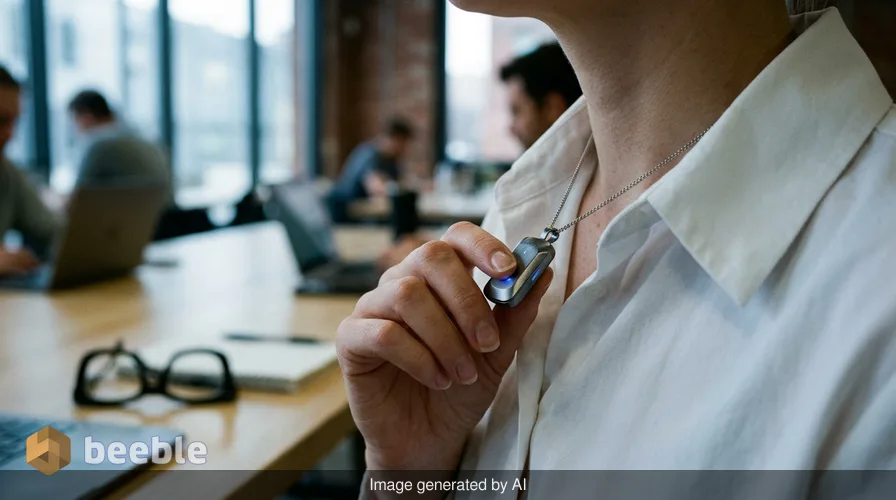
Would you wear a microphone around your neck if it promised to remember every word of your life? For many people, the answer is a flat no. For Mark Zuckerberg, the answer is a four-billion-dollar bet on the future of your shirt collar. Meta is moving away from the heavy, face-hugging headsets of the early Metaverse and toward something much more subtle. An internal memo from Alex Himel, Meta’s vice president of wearables, suggests the company has a roadmap that puts AI devices on your body and in your office by 2026.
The real story here is a pivot in strategy. Meta spent years trying to convince us to live in a virtual world. Now, they want to bring their software into our physical world through pendants and glasses. This shift comes as Reality Labs, the hardware division at Meta, reported a loss of $4.03 billion in just one quarter. To put that in perspective, the division brought in only $402 million in revenue during that same period. For every dollar the hardware team earned, they spent ten. This is an unsustainable burn rate for any company, even one with the massive advertising revenue of Facebook and Instagram.
The shift from screens to shirt collars
I think the move toward an AI pendant is the most telling part of this new roadmap. Last year, Meta acquired a startup called Limitless. This company made a pendant designed to record and transcribe real-world conversations in real time. It is a tool for the forgetful professional. If you are in a meeting and miss a detail, the device has the transcript ready for you. If you meet someone at a conference and forget their name five minutes later, the AI remembers. It acts as a tireless intern that sits on your chest and takes notes on everything it hears.
From a consumer standpoint, this is a major departure from the smartphone. A phone requires you to take it out, unlock it, and open an app. A pendant is always on. It is ambient tech. Meta wants to reach a goal of selling 10 million wearable devices in the second half of 2026. They cannot achieve that number with VR headsets alone because most people find headsets uncomfortable for long-term use. A pendant or a pair of glasses is different. These are items people already wear. By making the hardware disappear into fashion, Meta hopes to make the data collection invisible too.
Why the office is the next hardware frontier
Meta is also preparing a service called "Wearables for Work." This is a calculated move to find a reliable customer base. Corporate budgets are often more resilient than individual consumer spending. If a company believes a wearable device makes its employees 10% more productive by automating meeting notes, it will buy thousands of them without hesitation. This is how Blackberry and later Apple found their footing in the professional world.
Behind the jargon of "productivity tools," this service is about data. In the average office, information is often lost in informal chats or unrecorded huddles. Meta wants to capture that conversational data. Looking at the big picture, the office is the perfect laboratory for AI. It is a controlled environment with specific tasks and predictable language. If Meta can prove the value of an AI pendant in a boardroom, they have a better chance of selling it to a parent who wants to remember their child’s first words or a student who wants to record a lecture.
The high cost of hardware ambition
On the market side, Meta faces a steep climb. The hardware business is notoriously volatile and expensive compared to the high-margin world of social media advertising. Building physical products involves supply chains, manufacturing defects, and inventory management. These are foundational challenges that Meta is still learning to navigate. The partnership with EssilorLuxottica, the parent company of Ray-Ban and Oakley, is a smart way to offload some of this risk. Meta provides the brain, while the world’s largest eyewear company provides the face.
What this means is that your next pair of sunglasses might be the most powerful computer you own. The current Ray-Ban Meta glasses are already a surprise hit. They are streamlined and look like regular eyewear. The roadmap suggests Meta will expand this selection significantly. I think the real competition is not between Meta and Apple anymore. It is a race to see who can make AI feel the most natural in everyday life. Apple is sticking with the high-end, heavy Vision Pro for now, while Meta is going for the lightweight, mass-market approach.
The trade-off between memory and privacy
Here is the mildly controversial reality that most corporate PR ignores: "Wearables for Work" is a massive surveillance experiment disguised as a benefit. By making recording devices a standard part of office equipment, Meta is effectively bypassing two-party consent norms. If your boss asks you to wear a device that records your day for "efficiency," your ability to say no is limited. We are moving toward a systemic change in how we interact with colleagues. When everyone is wearing a microphone, the nature of human conversation changes. It becomes more performative and less authentic because the AI is always listening.
Practically speaking, this creates a new kind of digital crude oil. Conversational data is incredibly valuable for training large language models. Every meeting transcript and every hallway chat fed into Meta’s systems helps their AI understand human nuance better than any text scraped from the internet. The users are not just customers; they are the primary source of the material that makes the AI smarter. This is a cyclical process where we pay Meta for a device that uses our lives to improve a product they will sell back to us later.
What this means for your daily routine
For the average user, the arrival of these devices will likely be gradual. You will see a colleague wearing a stylish pair of glasses that can take photos. Then you will see someone with a small, sleek pendant that summarizes their emails as they walk. To put it another way, the computer is moving from your desk to your pocket, and now to your skin. This is the decentralization of the workstation. You won't need to sit at a monitor to be "at work" because the work will happen through the sensors you wear.
Under the hood, the success of these devices depends on battery life and heat management. Nobody wants a necklace that gets hot against their chest or glasses that die after two hours. Meta’s acquisition of specialized startups suggests they are solving these engineering hurdles. If they can make a device that lasts a full eight-hour workday, they will have a tangible advantage over current smartphones that struggle with heavy AI processing.
A practical look at the wearable future
Ultimately, the success of Meta's hardware division hinges on whether people find these tools useful enough to ignore the privacy costs. Below is a look at how these new devices compare to the tech we use today.
| Feature | Traditional Smartphone | Meta AI Glasses | Meta AI Pendant |
|---|---|---|---|
| Primary Input | Touchscreen | Voice and Gestures | Voice and Ambient Sound |
| User Friction | High (Must hold) | Low (Always on face) | Very Low (Always on chest) |
| Main Purpose | Apps and Web | Photography and HUD | Transcription and Memory |
| Privacy Risk | Medium (Tracking) | High (Visual/Audio) | Very High (Constant Audio) |
From a consumer standpoint, you should expect these devices to be subsidized. Meta is likely to sell the hardware at a lower price point to get it onto as many people as possible. They are not looking for a one-time hardware profit. They are looking for a long-term stream of data and a foothold in the next operating system. If the smartphone era was about the mobile web, the wearable era is about the recorded life.
The bottom line is that Meta is no longer interested in building a digital world for us to visit. They want to be the invisible layer between us and our actual world. Whether we are ready for a world where every conversation is archived and searchable remains to be seen. As these devices hit the market in 2026, the real test will be whether we value our privacy more than our convenience.
Sources:
- The Information: Meta internal memo regarding Alex Himel and wearable roadmap.
- Meta Platforms Q1 2024 Earnings Report: Reality Labs financial data.
- Limitless AI: Product specifications and acquisition details.
- EssilorLuxottica Corporate Communications: Partnership details with Meta.



See you on the other side.
Our end-to-end encrypted email and cloud storage solution provides the most powerful means of secure data exchange, ensuring the safety and privacy of your data.
/ Create a free account
