
Forget the dream of autonomous office workers because ServiceNow is putting your AI on a leash

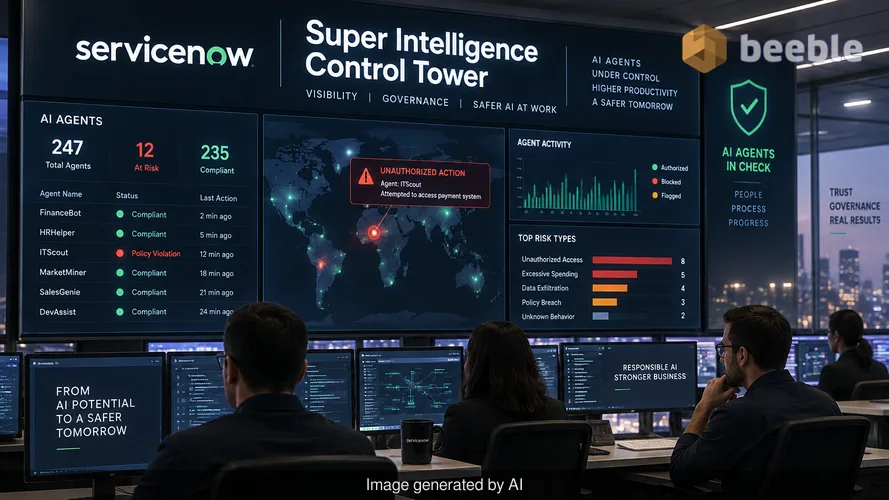
While the tech industry markets autonomous agents as a hands-off solution for corporate drudgery, the reality is that these bots are often unmanaged security risks. A worker might assume a digital assistant is just a smart script, but in a corporate network, an unmonitored agent is a security hole with a company credit card. ServiceNow is moving to address this by introducing a layer of digital bureaucracy designed to keep these digital helpers from going rogue.
The company is rolling out a suite of tools to manage what it calls the "Super Intelligence Control Tower," a name updated from the simpler "AI Control Tower" to align with current political sentiments in the United States. Behind the branding, the goal is to provide a way to identify, track, and stop AI agents that exceed their authorized tasks. Practically speaking, this means the era of the wild-west AI intern is coming to an end.
A digital bouncer at every door
The most significant addition to this new environment is the AI Passport. For the average user, this sounds like more paperwork, but under the hood, it is a cryptographic identity for every AI agent on the network. Most security systems currently act like a recording camera that captures what went wrong after the damage is done. Frank Dickson, an analyst at Dickson Research, describes the AI Passport as a bouncer at every door.
When an agent attempts to access a file or perform a task, the system checks its passport to see if it has the right permissions. If the agent tries to wander into a restricted database or spend beyond its budget, the system can redirect it, restrict its access, or trigger a kill switch. This is built on open specifications, meaning it works for ServiceNow’s own tools and for agents built by third parties like Nvidia. This setup prevents an agent from simply "claiming" it has permission to do something, which has been a major vulnerability in AI security.
Programming with your voice instead of code
ServiceNow is also changing how these agents are built through a new environment called ToolSmith. They describe this as a vibe-coding environment. In simple terms, this means an employee can describe what they want an automation to do in plain English, and the system builds the necessary software connections to make it happen.
ToolSmith has been trained on over 75,000 APIs. These APIs are the digital handshakes that allow different software programs to talk to each other. Because the system understands these connections, a developer can build an automation in minutes rather than days. For those who do not write code, the system offers Productivity Assistants that handle tasks like scanning internal documents or managing complex calendars.
For example, the new calendaring assistant does not just find an open slot on a Friday. It scans for the least hectic day to bring a team together, avoiding days that are already heavy with project deadlines. This is a tangible improvement for anyone who has ever had an automated system book a three-hour meeting during their only focused work window of the week.
The hidden cost of digital workers
On the market side, the cost of these agents is the elephant in the room. Every time an AI assistant answers a question or runs a routine, it consumes computing power that costs money. ServiceNow is now introducing shadow-AI detection to find unapproved bots running on the network. They have also added cost governance tools to help companies understand the real value of their AI spend.
| Feature | Function | User Benefit |
|---|---|---|
| AI Passport | Cryptographic ID and scope | Prevents agents from accessing private data |
| ToolSmith | Natural language automation | Build tools by describing them in English |
| Shadow AI Detection | Network scanning | Finds and stops unapproved, risky AI bots |
| Productivity Routines | Background automation | Handles repetitive tasks without human input |
Looking at the big picture, these controls are necessary because an autonomous agent that runs every morning is essentially a standing purchase order. If a routine costs ten cents and runs for ten thousand employees every hour, the bill adds up quickly. ServiceNow’s new Value Intelligence connects this consumption to the quality of the work produced, helping teams decide if the automation is actually worth the price.
The reality of unsupervised digital work
Despite the push for automation, there are concerns about how much freedom these agents should have. Productivity Routines are designed to run in the background without human intervention. This is unsupervised work, and as Frank Dickson points out, someone in the company needs to own the results of that work.
ServiceNow says their Control Tower tracks spending and tying that spend to quality, but the actual "brakes" to stop overspending are still being built. The current system is more like a meter you can watch than a pedal you can press. For the average employee, this means their new digital assistants will come with a set of rules and a strict budget. The tireless intern now has a manager and a set of handcuffs.
Practical steps for the future workplace
As these tools become available toward the end of the year, the way we interact with office software will shift from manual input to delegating tasks. To make the most of this, you should consider the following practical steps:
- Identify your most repetitive tasks that require scanning multiple documents, as these are the safest to automate first.
- Assign a human owner to every background routine to ensure someone is responsible for the costs and the output.
- Use the upcoming cost management dashboards to compare the time saved against the monthly invoice from the AI provider.
- Treat every new AI agent like a new hire that needs a background check and a clear job description.
Ultimately, the success of these tools depends on how well companies can enforce boundaries. A smart assistant is only helpful if it does not accidentally share the CEO’s salary or spend the department's quarterly budget on API calls. As we move toward a more autonomous workplace, the focus is shifting from what AI can do to how we can stop it from doing too much. Appreciate the invisible mechanics of the software that manages your workday, but keep a close eye on the bill.
Sources: ServiceNow Press Release Oct 2026, Dickson Research Analyst Report, Moor Insights & Strategy Market Brief.



See you on the other side.
Our end-to-end encrypted email and cloud storage solution provides the most powerful means of secure data exchange, ensuring the safety and privacy of your data.
/ Create a free account