


Meta Has Handed Everyone a Game Studio, So Why Does Play Feel Like Data Entry?

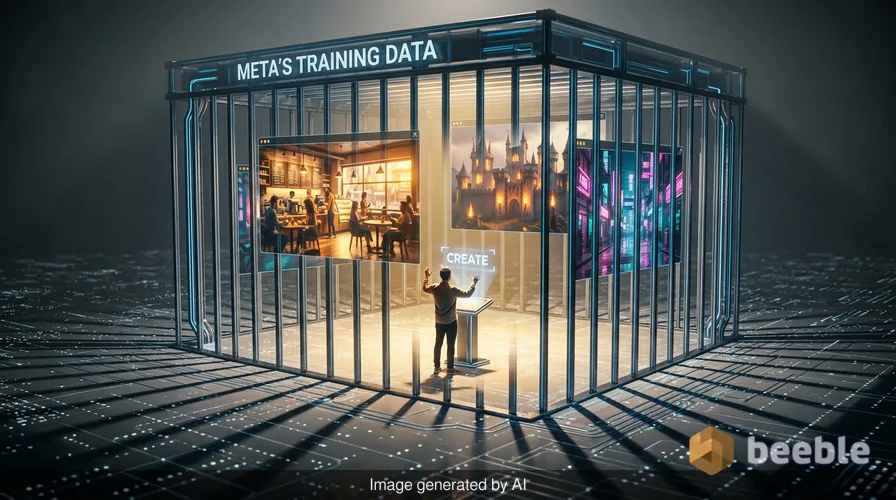
You enter a text box and the digital world bends to your whim. You type a few words about a cozy coffee shop where the baristas are ghosts and the game appears instantly. The art is there, the logic is there, and you feel like a god of your own digital universe. You swipe through an endless stream of these tiny worlds and each one offers a new flavor of interaction. The choices seem infinite because the engine generates whatever you imagine.
Except the engine only understands what Meta allows it to see. The prompts lead to a narrow set of visual styles that the AI was trained on. You play within a feed that rewards the most addictive interactions. You think you are a creator until you realize you are just a data point for a new recommendation algorithm. The system gives you the tools to build anything, provided that anything fits into a 30-second window on a smartphone screen. The freedom is the hook, but the architecture is the cage.
The quiet arrival of the vibe-coded game
On June 29, 2026, Meta launched an app called Pocket. It arrived without a press release or a flashy keynote. Instead, it appeared on the App Store and Google Play as a creative platform for making and sharing gizmos. These gizmos are small, interactive experiences that exist somewhere between a game, a meme, and a toy. You do not need to know how to code C++ or draw 3D models to make one. You only need a prompt.
This launch is the result of Meta’s acquisition of the Gizmo team earlier this year. Gizmo was a startup that understood a fundamental shift in how younger audiences interact with software. They do not want to learn complex tools. They want to manifest an idea through language. The original Gizmo app had 635,000 installs and a 98% positive sentiment rating. People loved it because it felt like magic. Now, Meta owns that magic and is weaving it into a much larger corporate strategy.
Pocket looks almost identical to its predecessor. It features a discovery feed where you can scroll through creations made by other users. If you see something you like, you can play it. If you want to change it, you can use AI to remix it. It is the TikTokification of game development. The barrier to entry has vanished, and in its place is a streamlined conveyor belt of user-generated content.
Why vibes replaced mechanics in the new gaming era
For decades, game design was about mechanics. Developers obsessed over jump heights, hit boxes, and resource management. We called this the game feel. But Pocket belongs to a new category of entertainment that critics call vibe-coded. In a vibe-coded game, the specific rules matter less than the aesthetic and the mood.
When you use Pocket to create a gizmo, you are not thinking about the physics engine. You are thinking about a vibe. You might want a vaporwave racing game or a gothic horror dating sim. The AI handles the heavy lifting of programming the logic. It generates the assets and the sounds. The player becomes a director or a curator rather than a builder. This shift reflects a broader cultural trend where we value the immediate emotional payoff over the mastery of a skill.
This trend is visible across the entire Meta ecosystem. The company has already launched Meta AI for images and an app called Vibes for video. Pocket is the third pillar of this strategy. It completes the trifecta by adding interactivity to the mix. Meta is not just a social media company anymore. It is an automated content factory where the users are the supervisors.
The death of the developer and the rise of the prompt engineer
Behind the scenes, the traditional role of the game developer is under siege. In the AAA industry, thousands of artists and programmers spend years building a single world. In the world of Pocket, that same world is a temporary, disposable experience. You play it for a minute and then you swipe to the next one.
This creates a paradox in our media consumption. We have access to an infinite amount of content, yet the individual pieces of content feel less significant. When anything is possible with a single sentence, the value of the final product drops. We used to admire the craft of a well-designed level. Now, we just judge the quality of the AI generation.
From a creator’s standpoint, this is both a gift and a curse. It allows someone with no technical background to tell a story or share a joke through an interactive medium. It is a form of digital literacy that was previously locked behind years of study. But it also means that the creator has less control. You are at the mercy of the model’s biases and limitations. If the AI cannot generate a specific art style, that style ceases to exist in your world. The creator is no longer an architect. The creator is a passenger.
The content walled garden is growing taller
Zooming out to the industry level, Pocket is a strategic move to keep users inside the Meta ecosystem. Every time you create a gizmo, you are training Meta’s models. You are providing data on what kinds of games people want to play and what prompts lead to the most engagement. This data is more valuable to Meta than the app itself.
Meta has also added AI features to its video-editing app, Edits, and across its social platforms. The goal is a seamless loop of creation and consumption. You make a gizmo in Pocket, you record a clip of it using Edits, and you share it on Instagram. The tools are all interconnected. This is the content walled garden in its most advanced form.
Historically, gaming was a destination. You sat down at a console or a PC to play. Pocket turns gaming into a background activity. It is something you do while waiting for the bus or during a commercial break. It is designed to fill the small gaps in our lives with micro-doses of interactivity. Consequently, the games themselves become fragmented. They are not meant to be remembered. They are meant to be consumed and forgotten.
Reclaiming the human element in a generated world
Through this audience lens, we have to ask what we lose when we automate creativity. There is a specific kind of joy in the clunky, imperfect designs of a human creator. Those flaws often reveal the intent and the personality of the person who made the game. An AI-generated gizmo is polished, but it is often hollow. It lacks the specific, weird choices that a human makes.
Meta’s experiment with Pocket is still in its early stages. The app has not seen a massive marketing push yet, which suggests that the company is still testing the waters. They are watching how we use these tools and how much we are willing to let the algorithm lead the way.
As audiences, we should observe our own habits as we interact with these new platforms. It is easy to get lost in the feed and let the AI do the thinking for us. But the most resonant experiences are still the ones that require effort and intent. Whether you are a player or a creator, there is value in stepping outside the walled garden. We must remember that the most interesting games are often the ones that the algorithm would never think to make.
Sources:
- Appfigures mobile app intelligence data
- Alessandro Paluzzi social media reports
- Meta corporate acquisition history
- Business Insider technology sector reports



See you on the other side.
Our end-to-end encrypted email and cloud storage solution provides the most powerful means of secure data exchange, ensuring the safety and privacy of your data.
/ Create a free account
